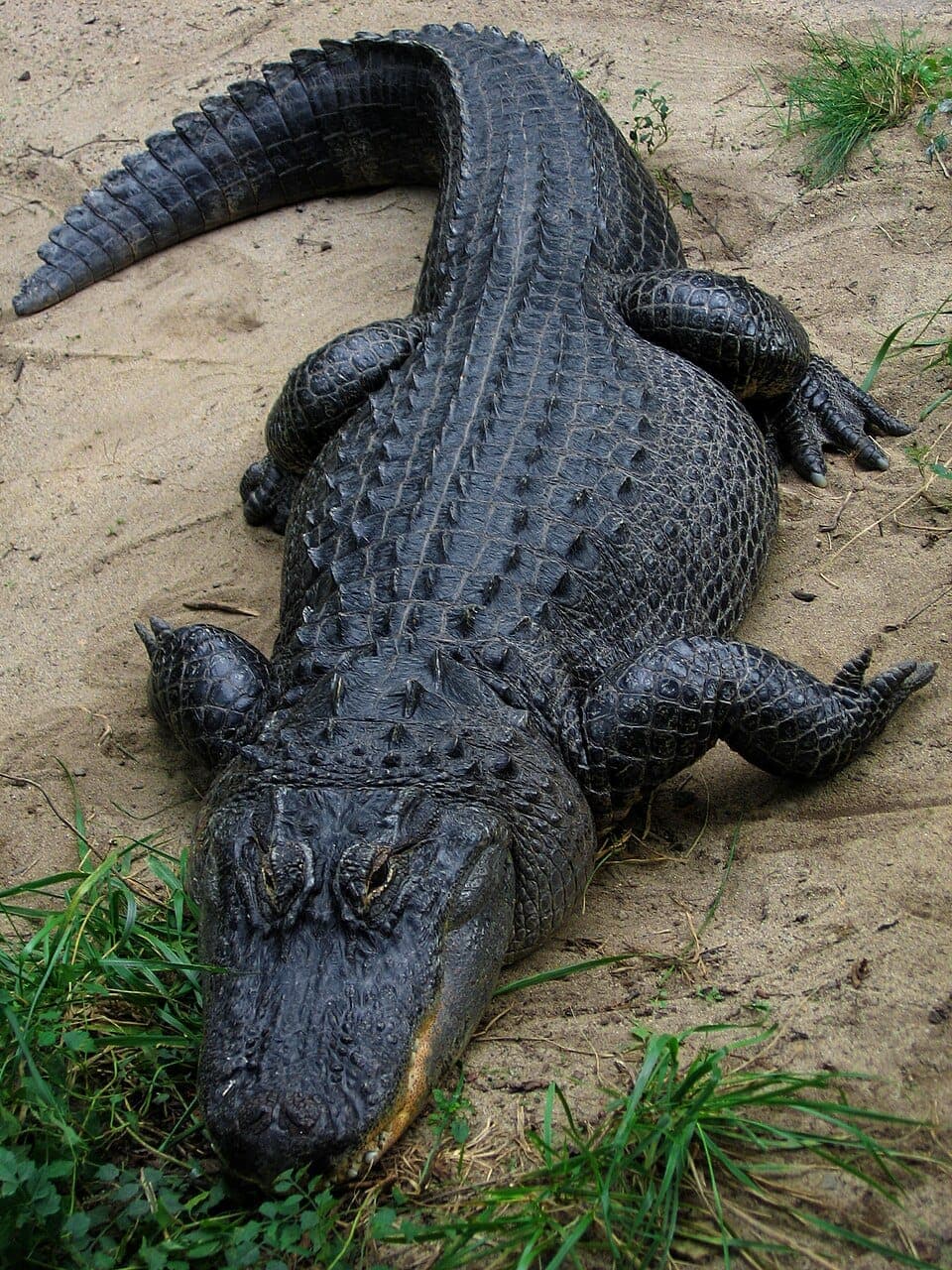
The fastest way to tell an alligator from a crocodile is the snout: an alligator has a wide, rounded, U-shaped snout, while a crocodile has a narrower, pointed, V-shaped one. The second giveaway is the teeth — when a crocodile shuts its mouth, a large tooth on each side of the lower jaw (the fourth tooth) stays visible outside the snout, giving it a permanent toothy grin, whereas an alligator’s wider upper jaw overlaps and hides its lower teeth when the mouth is closed. In the United States the question is usually settled by geography alone: almost every large reptile you see in the water is an American alligator, because the American crocodile lives only at the warm coastal tip of South Florida. Here is how to tell the two apart for certain, and how to stay safe around both.
How to Tell an Alligator From a Crocodile
Alligators and crocodiles are both crocodilians — large, armored, semi-aquatic reptiles with long jaws, short legs, and powerful tails — so from a distance they look much alike. Up close, a few features separate them reliably. Run through snout shape, teeth, color, and especially where you are standing, and you can name the animal with confidence.
Snout shape: U versus V
The snout is the classic field mark. An alligator has a broad, rounded, U-shaped snout, wide and blunt like a shovel — an adaptation for the crushing bite it uses on turtles and hard-shelled prey. A crocodile has a narrower, more tapered, V-shaped snout that comes to more of a point, better suited to seizing fish and quick prey. If the head looks wide and rounded, think alligator; if it looks slim and pointed, think crocodile.
The teeth: hidden versus a toothy grin
Look at the jawline when the mouth is closed. In an alligator the upper jaw is wider than the lower, so it closes over the bottom teeth and hides them — you mostly see a clean upper lip. In a crocodile the upper and lower jaws are about the same width and the teeth interlock, so the big fourth tooth on each side of the lower jaw protrudes up outside the snout, visible even with the mouth shut. That exposed, grinning tooth is one of the most dependable crocodile tells.
Color and skin
Color helps as a secondary clue. Alligators tend to be dark — blackish to dark gray or olive — which, combined with the dark tannin-stained swamp water they favor, makes them look almost black. American crocodiles are usually paler, a grayish olive to tan or light brown. Skin texture differs too: both are armored, but a crocodile often looks more rugged and bumpy. Color varies with age, algae, and water, so use it to support the snout and tooth clues rather than to decide on its own.
Size
Both get big, so size alone will not separate them, but the extremes differ. American alligators commonly reach 10 to 15 feet. The American crocodile is similar in length, while some Old World crocodiles — notably the saltwater crocodile of the Indo-Pacific — are the largest reptiles on Earth and can exceed 17 to 20 feet. In the United States, though, a very large crocodilian is far more likely to simply be a big alligator.
Where they live: range is the biggest clue in the US
In the United States, location answers the question most of the time. The American alligator ranges across the entire Southeast, from the Carolinas through Florida and west to Texas, and thrives in freshwater — rivers, lakes, ponds, marshes, swamps, and golf-course water hazards. The American crocodile is rare in the US and found almost exclusively in the brackish and saltwater coasts of extreme South Florida, around Florida Bay and the Keys. So a crocodilian in a freshwater pond in Louisiana, Georgia, or central Florida is an alligator; only in coastal South Florida do the two overlap at all.
A quick step-by-step
- 1Where are you? Anywhere in the US outside coastal South Florida, in fresh water, it is almost certainly an American alligator.
- 2Look at the snout: wide, rounded, and U-shaped points to alligator; narrow, tapered, and V-shaped points to crocodile.
- 3Check the closed mouth: hidden lower teeth mean alligator; a big lower tooth sticking up outside the snout means crocodile.
- 4Use color as a tiebreaker: very dark, near-black animals are usually alligators; paler gray-green to tan ones are more likely crocodiles.
Try Spotter Free on iOS & Android
Plants, animals, fungi, and rocks — all from a photo. 5 free identifications every day, no credit card required.
Other Crocodilians and Look-Alikes
A few other reptiles get folded into the "alligator or crocodile" question:
- Caimans — small South and Central American relatives of alligators, sometimes kept (and illegally released) as pets. They look like compact alligators with a slightly upturned snout and a bony ridge between the eyes.
- Gharial — an Asian crocodilian with an extremely long, thin, needle-like snout and, in males, a bulbous knob on the tip; unmistakable and not found in the wild in the Americas.
- Large monitor lizards — animals like escaped or introduced monitors are sometimes mistaken for small crocodilians, but they have a long forked tongue, a more lizard-like head, and no armored back plates.
- Hatchlings and juveniles — young alligators are dark with bright yellow crossbands, which can confuse people, but the wide U-shaped snout still gives them away.
Alligators, Crocodiles, and Safety
Both animals are powerful ambush predators and should be treated with respect and distance. The single most important rule is never to feed one: feeding teaches a crocodilian to associate people with food, destroys its natural wariness, and is both dangerous and illegal in places like Florida. Keep well back from the water’s edge — at least 30 to 60 feet — especially at dawn, dusk, and after dark when these animals hunt, and never let pets or small children play or swim near waters known to hold them, since a dog at the shoreline is an easy target. Give nesting females, which guard their nests and young aggressively, an especially wide berth.
If one hisses, opens its mouth, or lunges, it is warning you that you are far too close; move away from the water promptly. On land, a short, brisk retreat in a straight line away from the animal is all that is needed — the myth about running in zigzags is not necessary. Do not attempt to catch, corner, or handle any wild crocodilian.
Frequently Asked Questions
What is the easiest way to tell an alligator from a crocodile?
Look at the snout and the teeth. An alligator has a wide, rounded, U-shaped snout and hides its lower teeth when its mouth is closed; a crocodile has a narrow, pointed, V-shaped snout and shows a large lower tooth sticking up outside the snout even when shut.
Are there crocodiles in the United States?
Yes, but barely. The American crocodile lives in the US only along the brackish and saltwater coasts of extreme South Florida, around Florida Bay and the Keys. Everywhere else in the Southeast — and in all fresh water — the large reptile you are seeing is an American alligator.
Which is more dangerous, an alligator or a crocodile?
As a group, crocodiles are generally considered more aggressive than alligators, and some species — notably the saltwater and Nile crocodiles overseas — are responsible for serious attacks. The American crocodile is relatively shy. Either animal is dangerous when fed, provoked, or approached near a nest, so the safe distance is the same for both.
Can alligators and crocodiles live in the same place?
They do in exactly one place on Earth: South Florida, where the American alligator and American crocodile ranges overlap. It is the only region in the world where you might see both a wild alligator and a wild crocodile, which is part of what makes the Everglades so unusual.
Spotted a big crocodilian basking on a bank and want to settle the debate? Snap a photo from a safe distance and let Spotter help you identify it as a starting point, then confirm it with the snout shape and the tooth test.
Try Spotter Free on iOS & Android
Plants, animals, fungi, and rocks — all from a photo. 5 free identifications every day, no credit card required.