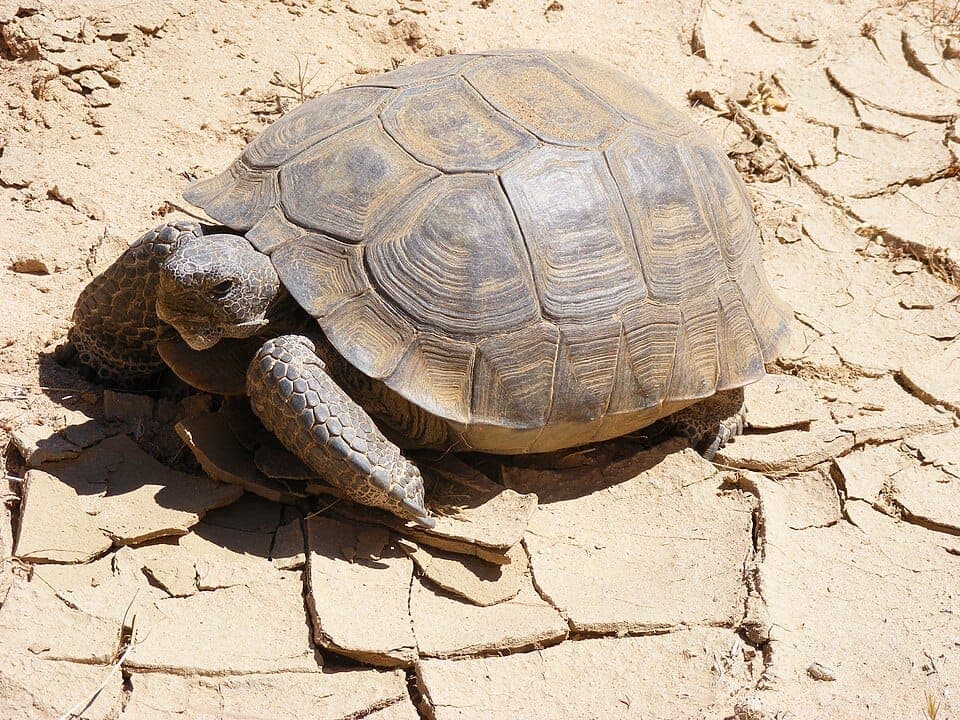
A tortoise is a kind of turtle that lives entirely on land, and you can tell the two apart by habitat, shell shape, and feet. A tortoise has a high, heavy, domed shell and short, stumpy, elephant-like legs with clawed toes for walking on dry ground; a typical water turtle has a flatter, more streamlined shell and webbed feet or flippers for swimming. Put simply: all tortoises are turtles, but not all turtles are tortoises. If the animal is built for land with a tall rounded shell and column-like legs, it is a tortoise; if it is built for water with a low shell and webbed feet, it is one of the many aquatic turtles. Here is how to tell them apart with confidence.
How to Tell a Turtle From a Tortoise
"Turtle" is the umbrella word for all shelled reptiles in the order Testudines — sea turtles, pond turtles, box turtles, and tortoises alike. "Tortoise" is a narrower term for the land-dwelling turtles in the family Testudinidae. So the real question most people are asking is: is this a swimming water turtle or a walking land tortoise? Four features answer it almost every time.
Where it lives
Habitat is the biggest clue. A tortoise lives on dry land — deserts, grasslands, scrub, and dry forest — and only wades into shallow water to drink or soak; it cannot swim and will drown in deep water. Aquatic turtles live in and around ponds, lakes, rivers, marshes, and the sea, basking on logs and rocks and sliding into the water at the first sign of danger. If you find the animal in or beside the water, it is almost certainly a turtle, not a tortoise.
Shell shape
Look at the profile of the shell. A tortoise has a tall, rounded, dome-shaped shell — heavy and thick, built as armored protection against land predators. Most aquatic turtles have a flatter, lower, more streamlined shell that cuts through water with less drag; sea turtles are the most extreme, with light, teardrop shells. A high dome points to tortoise; a low, flat shell points to a swimming turtle.
Feet and legs
The feet are a dead giveaway. A tortoise has short, sturdy, cylindrical hind legs often described as "elephantine," with stubby toes and blunt claws made for walking and digging burrows — the front legs are flattened and scaly for the same work. Water turtles instead have webbed feet with longer claws, and sea turtles have evolved their limbs into flippers. Elephant-like stumps mean tortoise; webbing or flippers mean a water turtle.
Diet and size
Most tortoises are herbivores, grazing on grasses, weeds, leaves, flowers, and fruit, and many are long-lived and slow-growing — some species live well over a hundred years and the largest can top 500 pounds. Aquatic turtles tend to be omnivores, eating insects, worms, fish, snails, and aquatic plants, and most are smaller and shorter-lived than the giant tortoises. These are supporting clues rather than field marks, but they fit the pattern: a big, slow land grazer is likely a tortoise.
Quick checks
- 1Habitat: on dry land away from water means tortoise; in or beside a pond, river, or the sea means an aquatic turtle.
- 2Shell: a tall, heavy dome means tortoise; a low, flat, streamlined shell means a swimming turtle.
- 3Feet: short, stumpy, elephant-like legs with blunt claws means tortoise; webbed feet or flippers means a water turtle.
- 4Behavior: slowly grazing on plants means tortoise; basking on a log and diving into water means an aquatic turtle.
Try Spotter Free on iOS & Android
Plants, animals, fungi, and rocks — all from a photo. 5 free identifications every day, no credit card required.
Quick Comparison
- Tortoise — a land-living turtle with a high domed shell, stumpy elephant-like legs, and blunt claws; a slow herbivore of deserts, grasslands, and scrub that cannot swim.
- Aquatic turtle — a water-living turtle with a flatter, streamlined shell and webbed feet or flippers; an omnivore of ponds, rivers, and seas that swims well and basks to warm up.
- Both — are reptiles with a bony shell, lay eggs on land, breathe air, and belong to the same order, Testudines.
Turtle, Tortoise, or Terrapin?
A third word, "terrapin," adds to the confusion. A terrapin is simply a small, hard-shelled turtle that lives in or near water, often in brackish or coastal marshes — the diamondback terrapin of the eastern United States is the classic example. It is still a turtle; the name just points to a semi-aquatic lifestyle between the fully aquatic sea turtles and the fully terrestrial tortoises. In short:
- Turtle — the umbrella term for every shelled reptile, and in everyday use often the water-dwelling ones.
- Tortoise — a turtle that lives on land with a domed shell and stumpy legs.
- Terrapin — a small turtle of brackish or fresh water near the coast.
Common North American Examples
- Gopher tortoise and desert tortoise — true tortoises of the Southeast and the arid Southwest, with domed shells and burrowing habits.
- Eastern box turtle — a land turtle with a domed shell, but a true turtle (not a tortoise); it has a hinged shell it can close completely, which tortoises cannot do.
- Painted turtles and sliders — classic pond turtles with low shells and webbed feet, usually seen basking on logs.
- Snapping turtles — large aquatic turtles of ponds and rivers with long tails and small shells.
- Sea turtles — ocean turtles with flipper limbs and light, streamlined shells.
Frequently Asked Questions
Is a tortoise a turtle?
Yes. A tortoise is a specific kind of turtle — one of the land-dwelling species in the family Testudinidae. All tortoises are turtles, but not all turtles are tortoises, because the word turtle also covers the aquatic species.
Can a tortoise swim?
No. Tortoises are built for land and cannot swim; they can drown in deep water. They may wade into shallow water to drink or soak, but their heavy domed shells and stumpy, unwebbed legs are not made for swimming the way an aquatic turtle’s streamlined shell and webbed feet are.
Is a box turtle a tortoise?
No. A box turtle lives on land and has a domed shell, so it is easy to mistake for a tortoise, but it is a true turtle. The clearest difference is the hinged lower shell a box turtle can close up like a box; tortoises cannot seal their shells, and box turtles also spend more time near damp woodland and water.
What is the quickest way to tell them apart?
Look at the feet and where you found it. Short, stumpy, elephant-like legs on dry land mean a tortoise; webbed feet or flippers in or near water mean an aquatic turtle. The shell helps too — a tall dome for a tortoise, a low flat shell for a swimmer.
Found a shelled reptile and not sure whether it is a tortoise, a pond turtle, or a box turtle? Snap a photo and let Spotter help you identify it as a starting point, then confirm it with the feet, the shell shape, and where you found it.
Try Spotter Free on iOS & Android
Plants, animals, fungi, and rocks — all from a photo. 5 free identifications every day, no credit card required.