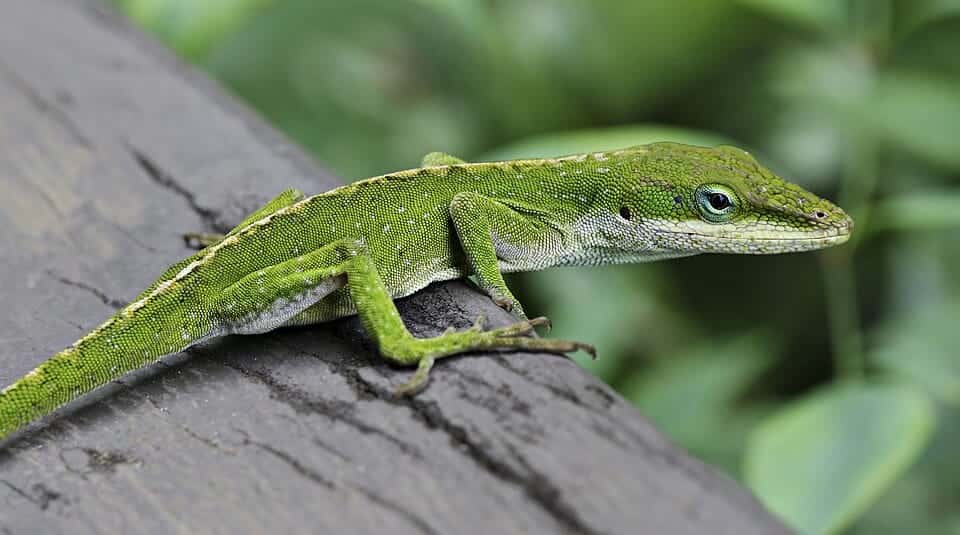
The quickest way to tell a green anole from a brown anole is color plus chin: a green anole is bright green (though it can turn brown) with a clean white chin and throat, while a brown anole is always some shade of brown or gray — never green — usually with light markings or a pale stripe down its back. The catch that fools everyone is that green anoles can turn brown, so color alone is not enough. A green anole in its brown phase keeps its white chin, its longer pointed snout, and its habit of climbing high; a brown anole stays low to the ground and shows ridged, patterned backs and a reddish-orange throat fan. Here is how to tell these two little lizards apart for certain.
How to Tell a Green Anole From a Brown Anole
Green anoles (Anolis carolinensis) are the native “American chameleons” of the southeastern United States, while brown anoles (Anolis sagrei) are an introduced species from Cuba and the Bahamas that has exploded across Florida and the Gulf Coast. They are closely related, similar in size (about 5 to 8 inches including the tail), and often share the same yards — but a handful of features separate them reliably.
Color and color change
A green anole can be brilliant leaf-green, brown, or anywhere in between, because it changes color with temperature, mood, and stress — the trait that earned it the “chameleon” nickname. A brown anole cannot turn green; it ranges from pale tan to dark chocolate brown to gray, so any true green instantly rules out a brown anole. The trap is the reverse: a green anole in its brown phase looks superficially like a brown anole, so you have to check the other marks before you call it.
Chin, throat, and dewlap
The chin is the most reliable tell. A green anole has a clean, unmarked white or pale chin and throat whatever color its body happens to be, while a brown anole’s underside is typically dull and mottled. The males’ dewlap — the extendable throat fan they flash to display — differs too: the green anole’s dewlap is pink to rose-red, while the brown anole’s is a more vivid orange-red to yellow-orange, often with a pale or yellow border. A displaying male’s throat fan is a quick giveaway once you learn the colors.
Back pattern
Look at the pattern down the back. Green anoles are smooth and nearly uniform in color, without bold markings. Brown anoles almost always show patterning — a light tan or yellowish stripe down the spine in females and juveniles, or a series of pale diamonds, triangles, or scalloped lines along the back — and males often carry a low toothed ridge, or crest, along the spine and tail. Crisp geometric back markings point to a brown anole.
Snout, size, and build
Green anoles tend to have a longer, more tapered, pointed snout, giving the head a sleeker look, while brown anoles have a somewhat shorter, blockier muzzle. The two are close in size, but brown anoles often look a touch stockier. Neither trait alone is conclusive, but combined with chin color and perch height they help confirm an animal caught in its ambiguous brown phase.
Perch height and behavior
Behavior is one of the best field clues. Brown anoles are ground-huggers: they perch low on fences, walls, sidewalks, mulch, and the base of trees, rarely climbing more than a few feet up. Green anoles prefer to be higher, in shrubs, vines, and the tree canopy, and tend to retreat upward when disturbed. Where brown anoles have invaded, they have actually pushed green anoles higher into the vegetation, so a lizard basking on the ground is usually brown, and one up in the leaves is more often green.
Quick side-by-side
- Color: a green anole can be green or brown; a brown anole is never green.
- Chin: a green anole has a clean white chin in any color phase; a brown anole’s underside is mottled.
- Dewlap: the green anole’s throat fan is pink-red; the brown anole’s is orange-red with a pale edge.
- Back: a green anole is plain; a brown anole has stripes, diamonds, or a spiny crest.
- Perch: a green anole climbs high; a brown anole stays low to the ground.
Try Spotter free on iPhone or Android
Plants, animals, fungi and rocks from one photo. 5 free identifications every day, no card required.


Other Lizards People Confuse With Anoles
Anoles are not the only small lizards in southern yards. A few others get mixed in:
- Five-lined skink — shiny and smooth with bold light stripes and (in juveniles) a brilliant blue tail; skinks have a glossy, almost wet-looking body quite unlike an anole’s matte skin.
- Eastern fence lizard — rough, spiny, gray-brown scales rather than an anole’s smooth skin, and it never turns green; it clings to tree trunks and fences.
- House geckos (Mediterranean, common) — mostly nocturnal, with large lidless eyes, translucent pinkish-tan skin, and sticky toe pads; usually seen on walls near porch lights at night, when anoles are asleep.
- Juvenile anoles — tiny versions of the adults; check chin color and back pattern just as you would on a full-grown lizard.
Why It Matters
Telling these two apart is more than a curiosity. The brown anole is one of the most successful reptile invaders in North America, and its spread has reshaped where native green anoles live and even how they are evolving — green anoles in brown-anole territory are developing larger, stickier toe pads for life higher in the trees. Tracking which anole is where helps document that ongoing change, and casual observations add up: a clear photo logged with Spotter records which species you saw and where, turning a backyard sighting into useful range data.
Frequently Asked Questions
Can a green anole turn brown?
Yes. Green anoles change color with temperature, mood, light, and stress, shifting between bright green and dark brown. A brown green anole still has its white chin and climbs high, which separates it from a true brown anole.
Can a brown anole turn green?
No. Brown anoles cannot turn green — they range only through browns, tans, and grays. Any anole showing true green is a green anole, no matter how dull that green may be.
Are brown anoles pushing out green anoles?
Largely by displacement, not direct attack. Brown anoles dominate the ground and lower perches and compete for the same food, pushing green anoles higher into shrubs and trees. In some areas green anoles have become scarce at ground level, but the two often still coexist by using different heights.
Which anole is native to the United States?
The green anole is the only anole native to the United States, found across the Southeast. The brown anole was introduced from Cuba and the Bahamas and has spread through Florida and the Gulf states since the 20th century.
Try Spotter free on iPhone or Android
Plants, animals, fungi and rocks from one photo. 5 free identifications every day, no card required.