
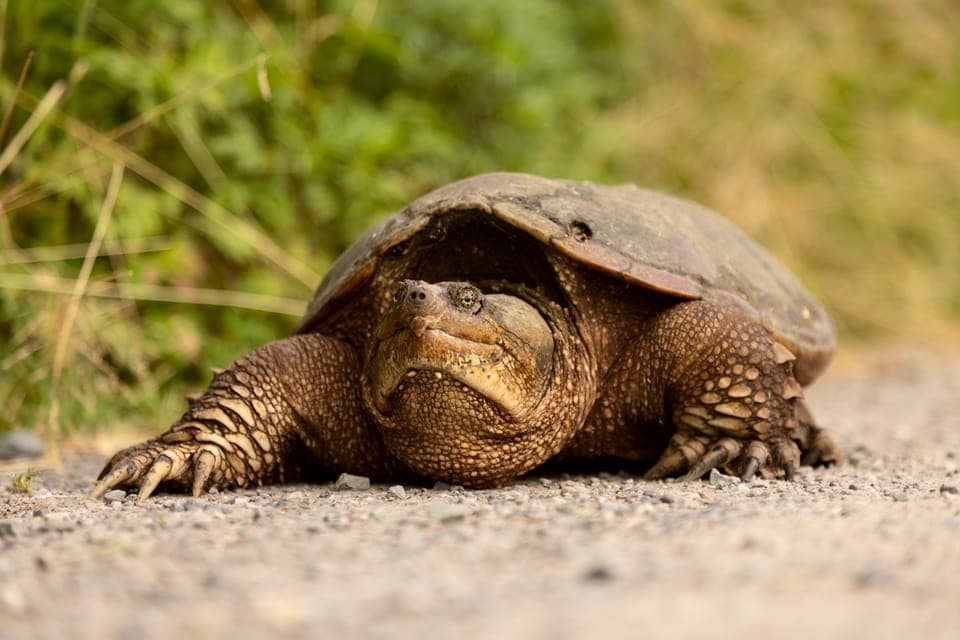
You are almost certainly looking at a snapping turtle if you see a large, dark, rough-shelled turtle with an oversized head, a long thick tail edged with saw-tooth points, and a surprisingly small belly plate that leaves its legs and tail exposed. Snapping turtles are the big, prehistoric-looking freshwater turtles that never bask on logs the way painted turtles and sliders do — you usually find them plodding across a road, sitting on the bottom of a pond, or lumbering onto land to lay eggs in early summer. Here is how to identify a snapping turtle for certain, how to tell a common snapper from the rarer alligator snapper, and how to stay safe around one.
How to Identify a Snapping Turtle
Snapping turtles are built differently from the tidy, dome-shelled turtles most people picture. Check the shell, the head and neck, the tail, and the belly plate together, and a snapper is unmistakable — no other North American freshwater turtle combines these features.
Size and shell (carapace)
A common snapping turtle is big: adults typically have a shell 8 to 14 inches long and weigh 10 to 35 pounds, far heavier than the palm-sized painted turtles they share ponds with. The upper shell, or carapace, is broad, usually dark brown to olive or nearly black, and often coated in mud or algae. It tends to look rough or ridged, especially in younger animals with three low keels running down the back, and the rear edge of the shell is noticeably saw-toothed rather than smooth.
The oversized head, hooked beak, and long neck
The head is the standout feature. It is large and blocky relative to the body, tipped with a strong, hooked upper beak, and set on a thick, muscular neck that is far longer than it looks — a snapper can whip its head back nearly to its hind legs, which is exactly why you never pick one up by the sides of the shell. The eyes sit high and forward on the head, and the skin of the neck and legs is often covered in small, warty bumps (tubercles).
The long, saw-toothed tail
A snapping turtle’s tail is long, thick, and muscular — often nearly as long as the shell — with a raised, jagged crest of triangular scales running along the top like the ridged back of a tiny dinosaur. Most other pond turtles have a short, stubby tail, so a long, saw-crested tail is one of the fastest confirmations you are looking at a snapper.
The small belly plate (plastron)
Flip the picture over — figuratively; never flip a live snapper — and the bottom shell, or plastron, is strikingly small and cross- or plus-shaped, leaving much of the legs, neck, and tail exposed. This reduced plastron is why a snapping turtle cannot pull fully into its shell for protection the way a box turtle can, and it is a big reason the animal defends itself by biting instead.
Habitat and behavior
Snapping turtles live in almost any permanent fresh water — ponds, lakes, marshes, and slow rivers — usually with a soft, muddy bottom and plenty of vegetation. They spend most of their time underwater, walking along the bottom rather than swimming in open water, and they famously do not bask out in the open. The main time people see them on land is late spring and early summer, when females travel, sometimes surprising distances, to dig nests in sandy or loose soil.
Try Spotter Free on iOS & Android
Plants, animals, fungi, and rocks — all from a photo. 5 free identifications every day, no credit card required.
Common Snapper vs. Alligator Snapper
Two kinds of snapping turtle live in the United States, and they are easy to tell apart once you know the range and the shell:
- Range — the common snapping turtle lives across almost the entire eastern and central U.S. and into Canada, so it is the one nearly everyone encounters. The alligator snapping turtle is limited to the Deep South and the lower Mississippi River drainage, roughly from Texas and Florida up into southern Illinois.
- Shell — a common snapper’s shell is comparatively smooth-backed with low keels, while an alligator snapper’s carapace has three dramatic rows of tall, jagged, pyramid-like ridges that make it look genuinely prehistoric.
- Size — common snappers top out around 35 pounds; alligator snappers are the largest freshwater turtles in North America, with big males reaching well over 100 pounds.
- Head and lure — the alligator snapper has an enormous head with a sharply hooked beak and a small, pink, worm-like lure on its tongue that it wiggles to draw in fish; the common snapper has no such lure.
If you are anywhere outside the Deep South, a snapping turtle you meet is a common snapping turtle. An alligator snapper is a rarer, protected animal in much of its range and should simply be left alone.
Are Snapping Turtles Dangerous? Safety First
Snapping turtles have a fierce reputation, but the picture is more nuanced. In the water they are shy and will almost always swim or walk away from a person rather than confront one — bites in the water are very rare. On land is a different story: unable to retreat into that small plastron and slow to flee, a cornered snapper defends itself by lunging and snapping with a fast, powerful bite that can cause serious injury. The rule is simple: do not handle, tease, or crowd one. Never pick a snapper up by the tail, which can injure its spine, and keep your hands and your pets’ noses well clear of the head and that long, fast neck. If you are bitten and the skin is broken, treat it like any deep bite wound and seek medical care.
Frequently Asked Questions
Will a snapping turtle bite me while I’m swimming?
Almost never. In open water snapping turtles are wary and avoid people, and they reserve their defensive biting for when they are cornered on land. Give any turtle its space and there is little to worry about in the water.
Is it a snapping turtle or just a big pond turtle?
Look at the tail and the belly. Basking turtles like painted turtles and sliders have short tails, smooth domed shells, and large belly plates, and they sun themselves on logs. A long, saw-crested tail, an oversized head, a rough shell, and a small cross-shaped plastron mean a snapping turtle.
Should I move a snapping turtle out of my yard or pond?
Usually not. A snapper passing through is almost always just traveling to nest or find new water and will move on within a day or two. It is a native animal that helps keep a pond healthy, so the best course is to leave it alone and give it room rather than relocating it.
How do I safely help one cross a road?
Only if you can do it safely for both of you, and always move it in the direction it was already headed. Because of that long neck, never lift a snapper by hand or by the tail; instead, guide it from behind onto a car mat or piece of plywood and drag it across, or slide a shovel under it from the rear. When in doubt, just stop traffic and let it walk.
Found a big, rough-shelled turtle and not sure whether it’s a snapper, a slider, or something else? Snap a photo from a safe distance and let Spotter help you identify it.
Try Spotter Free on iOS & Android
Plants, animals, fungi, and rocks — all from a photo. 5 free identifications every day, no credit card required.