
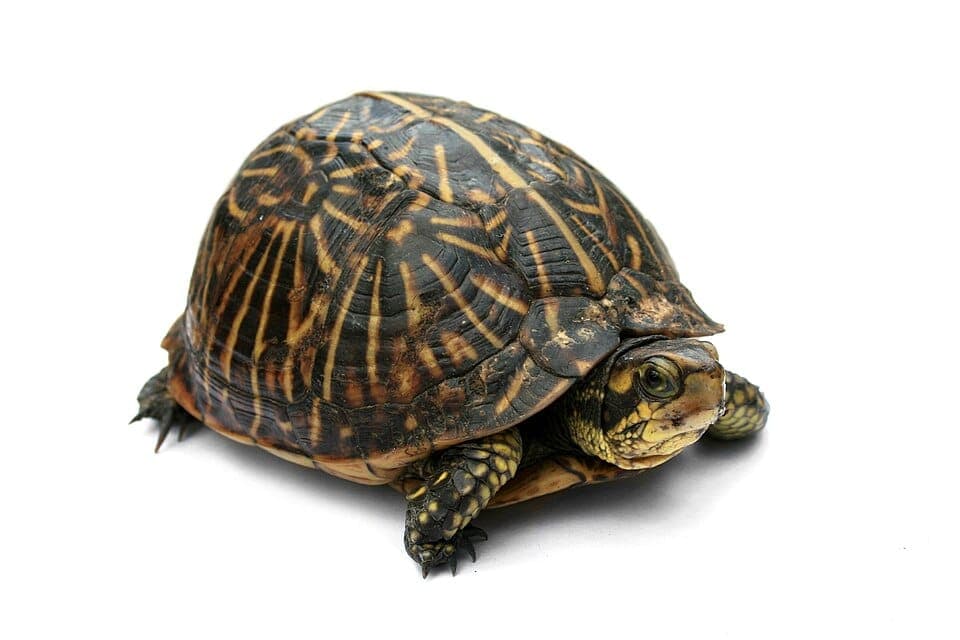
You are almost certainly looking at a box turtle if you find a small, high-domed land turtle whose bottom shell is hinged so it can close up into a tight box — pulling its head, legs, and tail completely inside and clamping shut like a drawbridge. Box turtles are terrestrial turtles, usually 4.5 to 6 inches long, with a tall, rounded upper shell marked in yellow-to-orange blotches or lines on a dark brown or black background, and unlike pond turtles they spend their lives on land in woods and meadows rather than in the water. That domed, hinged, closeable shell is the single feature that separates a box turtle from the aquatic sliders and painted turtles people confuse them with. Here is how to identify a box turtle, tell the eastern species from the ornate, and figure out whether yours is male or female.
How to Identify a Box Turtle
Box turtles are land turtles built for defense rather than swimming, and a few features identify them at a glance. Check the shape of the shell, the hinge on the underside, the color and markings, and where you found the animal, and a box turtle is hard to mistake for anything else.
The high, domed shell
A box turtle’s upper shell (carapace) is tall and steeply rounded, like a helmet or a loaf of bread, not the low, flattened dome of a pond turtle built for slipping through water. Adults are usually 4.5 to 6 inches long. The high dome is a clue in itself: aquatic turtles like sliders and painted turtles are streamlined and low, while a turtle shaped like a little rounded box is almost always a box turtle.
The hinged plastron — the "box"
The defining feature is underneath. A box turtle’s lower shell (plastron) has a flexible hinge across the middle, so the animal can pull in its head, legs, and tail and then fold the front and back of the plastron up tight against the carapace, sealing itself completely inside — the "box" that gives the turtle its name. No aquatic turtle can do this; sliders and snappers have a rigid plastron and cannot close up. If a frightened turtle clamps fully shut with no gaps, it is a box turtle.
Color and markings
Box turtles are colorful. The domed shell is dark brown to black, overlaid with a highly variable pattern of bright yellow, orange, or olive blotches, lines, or radiating streaks — no two are quite alike. The skin of the head, neck, and legs is usually brown or black flecked with yellow, orange, or red. That bold yellow-and-orange patterning on a high black dome is very different from the smoother green, olive, and red markings of sliders and painted turtles.
Head, feet, and size
A box turtle has a short, hooked upper beak, and its feet are built for walking on land — sturdy, with stubby toes and only slight webbing, unlike the broad webbed feet of water turtles. Males often have striking red eyes, while females’ eyes are usually yellowish-brown. Most box turtles you meet are 4.5 to 6 inches long and feel surprisingly heavy and solid for their size.
Habitat and behavior
This is a land animal. Box turtles live in moist woodlands, meadows, field edges, and gardens, where they plod slowly through leaf litter eating berries, mushrooms, worms, slugs, and insects. They soak in shallow puddles but do not swim in ponds the way sliders do, and they famously stay within a small home range their whole lives. A turtle walking through the woods far from water, rather than basking on a log, is very likely a box turtle.
Try Spotter Free on iOS & Android
Plants, animals, fungi, and rocks — all from a photo. 5 free identifications every day, no credit card required.
Eastern Box Turtle vs. Ornate and Other Box Turtles
Several kinds of box turtle live in North America, and range and pattern usually tell them apart:
- Eastern box turtle — the most widespread, across the eastern U.S.; a high domed shell with bright, irregular yellow-orange blotches and streaks on dark brown, and often red eyes in males.
- Ornate (western) box turtle — a prairie and grassland species of the central U.S.; a flatter-topped shell with a striking pattern of yellow lines radiating outward on each scute, like the spokes of a wheel, on a darker background.
- Three-toed box turtle — south-central U.S.; usually more olive or tan with a plainer shell and, as the name says, three toes on each hind foot instead of four.
- Gulf Coast and Florida box turtles — southeastern subspecies; larger with flared rear shells (Gulf Coast) or narrow, bright yellow radiating lines (Florida).
- Pond turtles (sliders, painted turtles, cooters) — the main confusion outside box turtles: low streamlined shells, webbed feet, and no working hinge, always found in or right beside water.
If the turtle has a high dome, a hinged plastron it can close, and turns up on land, it is a box turtle; the pattern and the part of the country then point to the species.
Should You Move or Keep a Box Turtle? Why It Matters
Box turtles look tough, but their populations are in serious, long-term decline, and how people treat individual turtles is a big part of why. Each turtle lives its entire life — often 50 years or more — inside a home range of just a few acres, navigating by landmarks it has learned. A box turtle moved even a mile away will often wander for the rest of its life trying to get home, crossing roads and missing food, and rarely survives. The rules that follow are simple: never take a wild box turtle home as a pet, and never "rescue" a healthy one to a new area. If you find one crossing a road, move it only to the side it was already heading, set it down off the shoulder, and let it go. Snapping a photo to identify it is a perfect way to enjoy the animal without disturbing its life.
Frequently Asked Questions
Is my box turtle male or female?
Look at the eyes, tail, and underside. Males usually have red or orange eyes, a longer and thicker tail, and a slightly concave (dished-in) plastron; females typically have yellowish-brown eyes, a shorter tail, and a flat plastron. Use several features together — no single trait is reliable on its own.
How long do box turtles live?
A very long time. Wild box turtles commonly live 40 to 50 years, and some individuals have reached 80 to 100. That extreme longevity, paired with low reproduction, is exactly why losing even a few adults hurts a local population so much.
What do box turtles eat?
They are omnivores. Box turtles eat berries, fallen fruit, mushrooms, flowers, and greens along with earthworms, slugs, snails, insects, and carrion; young turtles tend to eat more animal prey, while adults eat more plants.
Is it a box turtle or a tortoise?
They are different. Tortoises (like the gopher tortoise) are larger, have thick elephant-like hind legs, and cannot close their shell, while a box turtle is smaller, has a hinged plastron it can seal shut, and has less club-like feet. Both live on land, which is where the confusion comes from.
Found a domed turtle plodding across the yard and not sure which kind it is? Snap a photo and let Spotter help you identify it — from a respectful distance.
Try Spotter Free on iOS & Android
Plants, animals, fungi, and rocks — all from a photo. 5 free identifications every day, no credit card required.