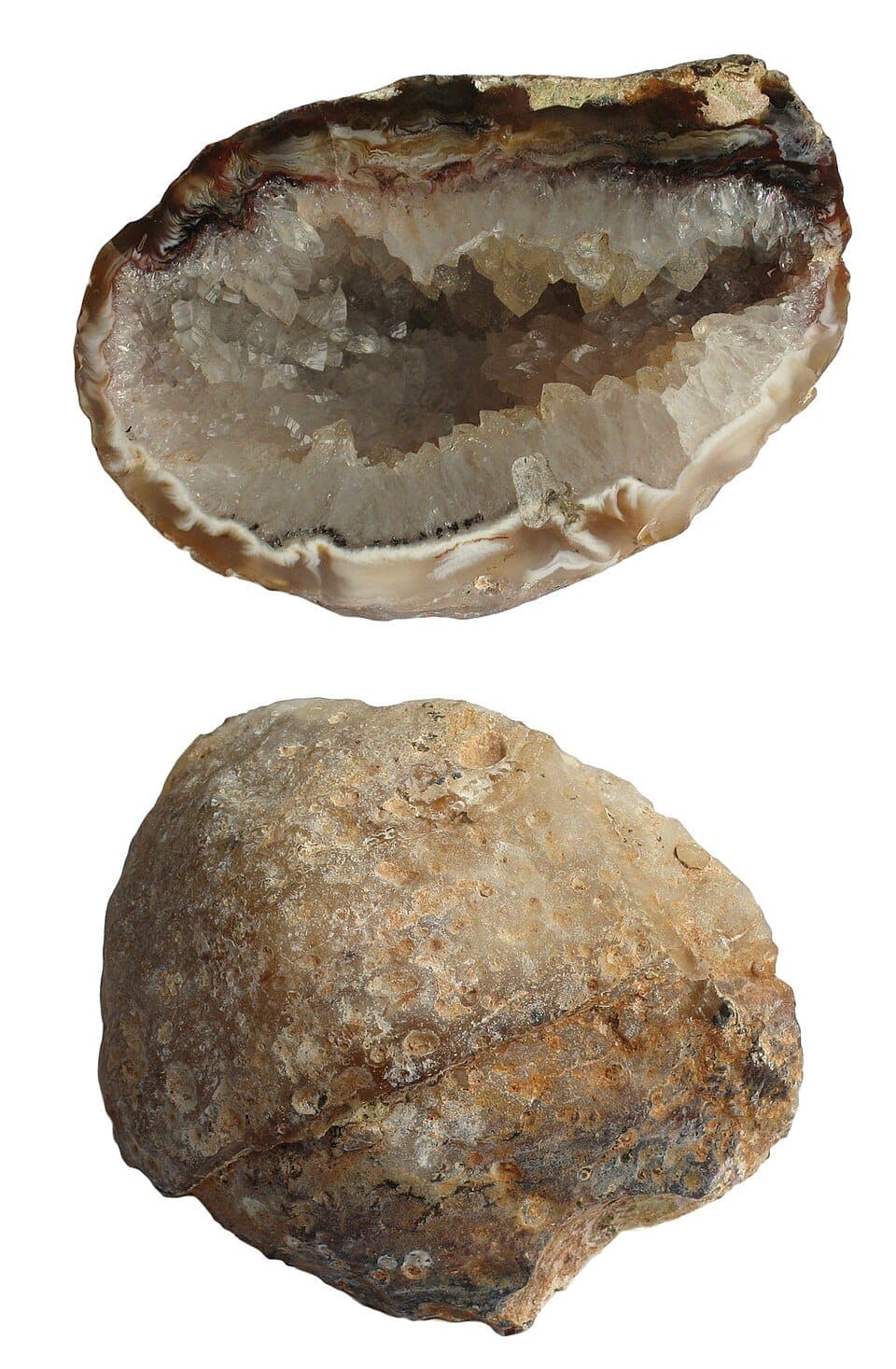
A geode is a rounded, hollow rock lined on the inside with crystals — and from the outside it usually looks like a lumpy, bumpy ball that feels surprisingly light for its size. The quickest field test is exactly that: if a fist-sized, roughly spherical rock feels lighter than a solid stone of the same size and has a knobby, cauliflower-like surface, there is a good chance it is a geode with a hollow, crystal-lined center. Here is how to recognize one before you ever crack it open, and how to tell a true geode from an ordinary rock or a solid nodule.
How to Identify a Geode
Because a geode’s treasure is hidden inside, identification is mostly about reading the outside clues — shape, weight, surface, and where you found it. No single clue is proof on its own, so look for several together.
Shape and surface texture
Geodes are roughly spherical or egg-shaped, but almost never perfectly round or smooth. The exterior is typically bumpy, warty, or cauliflower-like — a texture geologists call botryoidal — with a dull grayish, tan, or brown rind. If a rock is jagged, flat, or angular, it is probably not a geode; if it is rounded and knobby like a lumpy potato, it is worth a closer look.
Weight — the hollow test
Heft it in your hand and compare it to a solid rock of the same size. A true geode is partly hollow, so it feels noticeably lighter than a solid stone of equal size. Give it a gentle shake near your ear, too: sometimes you can hear loose crystals rattling, or water sloshing inside a rare water-filled "enhydro" geode. A rock that feels dense and heavy for its size is more likely a solid nodule than a geode.
The outer rind versus the surrounding rock
A geode’s shell is usually made of chalcedony or quartz, which is harder and more weather-resistant than the host rock around it. That is why geodes tend to weather out as rounded balls while the softer rock erodes away, and why the rind often looks and feels different — harder, denser, a different color — than the surrounding matrix. Running the rock against a harder surface, the quartz rind resists scratching.
Where geodes are found
Geodes form in both volcanic rock (gas bubbles in basalt) and sedimentary rock (cavities in limestone and dolomite), so they turn up in dry creek beds, deserts, road cuts, and eroding hillsides. Classic U.S. hunting grounds include the Keokuk area where Iowa, Illinois, and Missouri meet, plus parts of Kentucky, Indiana, and the desert Southwest; Brazil and Mexico produce the big amethyst geodes you see in shops. Knowing your local geology — limestone or old volcanic terrain — helps you know where to look.
To check a suspect rock in the field, work through these steps in order:
- 1Pick it up and compare its weight to a solid rock of the same size — lighter than expected suggests a hollow interior.
- 2Look at the shape: favor rounded, bumpy, cauliflower-like balls over jagged or flat pieces.
- 3Hold it near your ear and shake gently, listening for a rattle of loose crystals or a slosh of water.
- 4Examine the surface for a hard, quartz-like rind that differs in color and texture from the surrounding rock.
- 5Check any natural crack or worn "window" for a glint of crystals inside before deciding whether to open it.
Try Spotter Free on iOS & Android
Plants, animals, fungi, and rocks — all from a photo. 5 free identifications every day, no credit card required.
Geode Look-Alikes and What’s Inside
Plenty of rounded rocks masquerade as geodes. The main difference is almost always whether the inside is hollow:
- Nodules and thundereggs — rounded like geodes but solid all the way through; they feel heavy and may hold a pretty agate center, but there is no open crystal cavity.
- Concretions — hard, rounded masses that are solid throughout, often with a smoother surface than a true geode.
- Ordinary river cobbles — rounded by water but dense, heavy, and lacking a quartz rind or hollow core.
- Vugs — crystal-lined pockets found inside a larger rock rather than in a free-standing ball; the same crystals, different container.
- Inside a genuine geode you might find clear or milky quartz, purple amethyst, banded agate, white or amber calcite, or blue-gray chalcedony, depending on the minerals present.
Should You Break It Open?
You do not have to open a geode to identify or enjoy it, but if you want to see the crystals, there are safer and cleaner ways than a hammer swing. Many rockhounds cut geodes with a rock saw for a smooth, polished face, or use a soil-pipe cutter that scores and snaps the rock along an even line. If you do crack one with a hammer, wrap it in a sock or cloth to contain flying shards and always wear eye protection — quartz splinters are sharp. A slow, careful open preserves the delicate crystals inside far better than brute force.
Frequently Asked Questions
How can you tell if a rock is a geode without breaking it?
Combine four clues: it feels lighter than a solid rock of the same size, it is rounded and bumpy rather than jagged, it sometimes rattles when shaken, and it has a hard quartz-like rind that differs from the surrounding stone. Several of those together point to a geode.
What is inside a geode?
A hollow cavity lined with crystals. The most common are quartz and its purple variety amethyst, along with banded agate and calcite. The colors and crystal shapes depend on which minerals crystallized inside as the geode formed.
Where can I find geodes?
Look in dry creek beds, deserts, limestone outcrops, and volcanic regions. In the U.S., the Keokuk area (where Iowa, Illinois, and Missouri meet) and parts of Kentucky and Indiana are famous. Always check local rules and get permission before collecting.
What is the difference between a geode and a nodule?
A geode is hollow, with a crystal-lined cavity inside; a nodule, such as a thunderegg, is solid all the way through. Weight is the giveaway — geodes feel light for their size, while nodules feel dense and heavy.
Found a mysterious round rock and want to know if it is a geode — or what the crystals inside might be? Snap a photo and let Spotter help you identify the rock, mineral, or crystal you have picked up.
Try Spotter Free on iOS & Android
Plants, animals, fungi, and rocks — all from a photo. 5 free identifications every day, no credit card required.