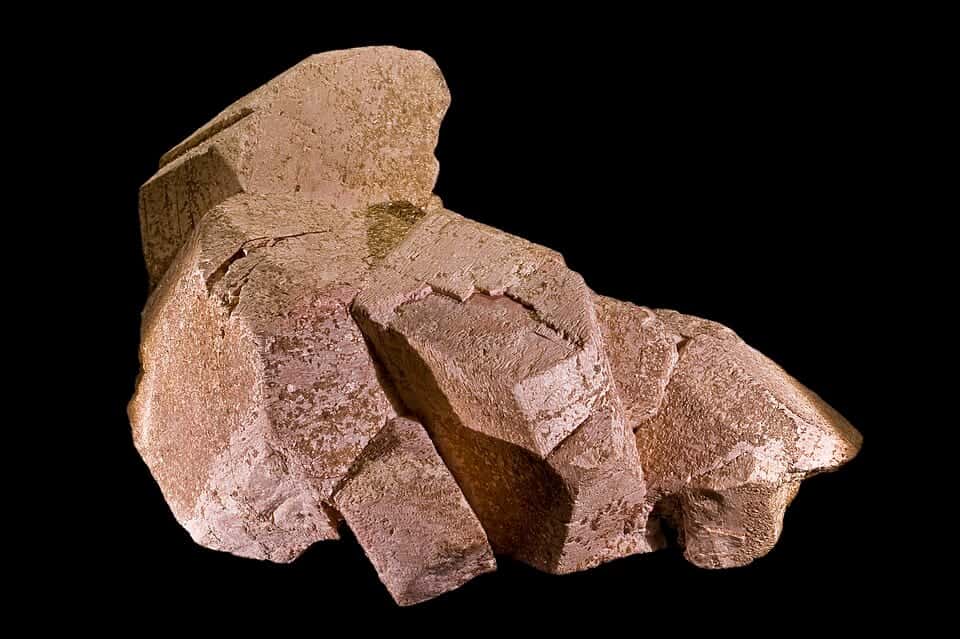
Feldspar is the most common mineral group in the Earth’s crust, and you identify a piece by three things together: it breaks along flat faces that meet at close to a right angle, it sits at 6 to 6.5 on the Mohs hardness scale so it scratches glass but quartz scratches it, and it is usually an opaque pink, white, cream, or gray with a pearly to porcelain luster. Those flat cleavage surfaces are the key, because they are what separate feldspar from quartz, the mineral it is confused with most. Quartz has no cleavage and breaks in curved, glassy scoops, while feldspar splits into blocky, stair-step faces. Most of the time you meet feldspar locked inside another rock, especially granite, where it makes up the pink and white blocks between the glassy quartz and the dark flakes of mica. If your crystal is hard, blocky, flat-faced, and chalky rather than glassy, feldspar is the leading answer.
How to Identify Feldspar
Work through four features you can judge by eye: the cleavage, the hardness, the luster, and the color. Together they separate feldspar from quartz and calcite, the two minerals it most often gets mixed up with. Feldspar rarely arrives alone. Over the past 45 days, Spotter’s rock identifications were dominated by the quartz family: a milky quartz specimen came back five times, and a granite-type rock the app labeled “quartz with mica and feldspar” came back four more, with the app keying on a milky-white, rough crystalline texture and a glassy luster in places. That pairing is the whole reason this guide exists: feldspar and quartz grow side by side in granite, sit close in hardness, and are both pale, so the one test that splits them, cleavage, does most of the work.
Flat cleavage faces near 90 degrees
This is the single most useful field mark. Feldspar has perfect cleavage in two directions, and according to geology.com those two cleavage planes usually intersect at or close to a 90 degree angle. In practice that means a broken feldspar crystal shows flat, reflective faces that step against each other at roughly right angles, like the corner of a box. Tilt the piece in good light and whole facets flash at once as they catch the light. Quartz does the opposite: it has no cleavage at all and breaks with a curved, shell-shaped conchoidal fracture, so its broken surfaces are glassy scoops with no flat planes. Flat faces at right angles point to feldspar; curved, glassy breaks point to quartz.
Hardness of 6 to 6.5
All feldspars sit at about 6 to 6.5 on the Mohs hardness scale, which puts them just above glass (around 5.5) and just below quartz (a 7). You can use that narrow gap as a test. Feldspar scratches a glass bottle or plate, so a mineral that leaves no mark on glass is too soft to be feldspar. But quartz will scratch feldspar, while feldspar cannot scratch quartz back. If you have two pale crystals and one scratches the other, the one that gets scratched is the feldspar. The Mohs hardness scale lists orthoclase feldspar as the 6 and quartz as the 7, one step apart.
A pearly luster, not glassy
Feldspar cleavage faces have a pearly to porcelain or slightly frosted luster, a soft sheen rather than the wet, glassy shine of quartz. The difference is easiest to see on a fresh break. Quartz looks like broken glass, bright and vitreous, while feldspar looks more like glazed ceramic. Some feldspars also show a floating glow or a flash of color, the effect behind gem varieties like moonstone and labradorite. Ordinary quartz never does this.
Color: pink, white, cream, or gray
Feldspar is almost always opaque and pale. Potassium feldspar, the minerals orthoclase and microcline, is commonly pink, salmon, cream, or white, and it is the source of the familiar pink in pink granite. Plagioclase feldspar, the sodium-to-calcium series, is usually white to light gray. Clear, colorless, see-through material is more likely quartz, which often grows water-clear or smoky. A chalky, solidly opaque pink or white block with flat faces is a strong feldspar signal, and pink in a coarse rock is almost always potassium feldspar, which is one reason pink stones get read as granite.
Striations separate the two feldspars
Once you know a crystal is feldspar, one mark tells you which kind. Plagioclase feldspar often shows striations, a set of fine, dead-straight parallel grooves on a cleavage face, caused by repeated twinning during growth. Orthoclase and the other potassium feldspars do not show them. Catch a flat face in raking light and look for those hairline parallel lines: present means plagioclase, absent, especially with a pink color, points to potassium feldspar. Quartz never shows striations of this kind on a broken surface, so their presence also confirms you are not holding quartz.
Where you find it
Because feldspar makes up more than half the crust, it turns up almost everywhere, but you usually meet it as crystals inside a coarse rock rather than as a loose mineral. Granite is the classic host: the pink or white blocky grains packed between glassy quartz and dark mica are feldspar. In the glaciated Midwest and Great Lakes, Ice Age glaciers carried granite and gneiss south from the Canadian Shield and dropped them as rounded cobbles, so a pink-and-white speckled stone on a Wisconsin beach or in a gravel driveway is very often feldspar-rich granite. For the rock that showcases it best, see how to identify granite.
Feldspar vs. Quartz vs. Calcite
Feldspar, quartz, and calcite are three of the most common pale minerals, and they get confused constantly because all three can be white or clear. The fastest way to sort them is cleavage plus a hardness test plus, for calcite, a drop of vinegar. The table lays out the marks you can judge without lab gear. For more on the first two, see how to identify quartz and quartz vs. calcite.
| Mineral | Hardness (Mohs) | Cleavage | Typical color | Quick tell |
|---|---|---|---|---|
| Potassium feldspar | 6 to 6.5 | Two directions near 90° | Pink, salmon, cream, white | Blocky flat faces, often pink, no striations |
| Plagioclase feldspar | 6 to 6.5 | Two directions near 90° | White to gray | Flat faces with fine parallel striations |
| Quartz | 7 | None (conchoidal fracture) | Clear, milky, smoky, rose | Glassy curved breaks, scratches feldspar |
| Calcite | 3 | Three directions (rhombs) | White, clear, honey | Soft, fizzes in vinegar, breaks into rhombs |
Hardness alone separates calcite from the other two, because calcite is soft enough to scratch with a steel nail and it fizzes in weak acid, while feldspar and quartz do neither. Between feldspar and quartz, cleavage is the decider: feldspar’s flat, right-angle faces versus quartz’s curved, glassy fracture. Geology.com notes that feldspar’s two cleavage directions meeting near 90 degrees are its defining structural feature.
Frequently Asked Questions
How can I tell feldspar from quartz?
Look at how it breaks. Feldspar has cleavage, so it splits into flat, reflective faces that meet at close to a right angle, like the corner of a box. Quartz has no cleavage and breaks in curved, glassy, shell-shaped scoops. Hardness backs this up: quartz (Mohs 7) will scratch feldspar (6 to 6.5), but feldspar cannot scratch quartz. Flat faces and a pearly luster mean feldspar; curved breaks and a glassy shine mean quartz.
Why is granite pink?
The pink comes from potassium feldspar, usually the mineral microcline or orthoclase. The feldspar grains themselves are tinted pink to salmon, most often by microscopic traces of iron, and because feldspar makes up a large share of granite, those pink grains color the whole rock. Granite with little potassium feldspar looks gray or white instead. The blocky pink crystals you see in a polished pink granite countertop are feldspar.
Is feldspar valuable?
Common feldspar is not a valuable gemstone, though it is mined in huge quantities for industrial use in glass and ceramics. A few feldspar varieties are cut as gems, including moonstone, labradorite, sunstone, and the green microcline called amazonite, and those can carry real value when the color or shimmer is strong. An ordinary pink or white feldspar crystal from a granite cobble is a great find for learning, but not a payday.
What is the difference between orthoclase and plagioclase?
Both are feldspar, but they differ in chemistry and in one visible clue. Orthoclase is a potassium feldspar, commonly pink or cream, and its cleavage faces are plain. Plagioclase is the sodium-to-calcium series, usually white to gray, and it often shows fine parallel striations on a cleavage face from repeated twinning. If a pale feldspar shows dead-straight hairline grooves, it is plagioclase; if it is pink and smooth-faced, it is more likely orthoclase.
Found a blocky pink or white crystal and not sure if it is feldspar or quartz? Check how it breaks: flat faces at right angles and a pearly sheen mean feldspar, while curved glassy scoops mean quartz. For the wider family of stones feldspar travels with, see our guide to common rocks and minerals, or start on the rock identifier page. Spotter can give you a first read from a photo.
Try Spotter free on iPhone or Android
Plants, animals, fungi and rocks from one photo. 5 free identifications every day, no card required.