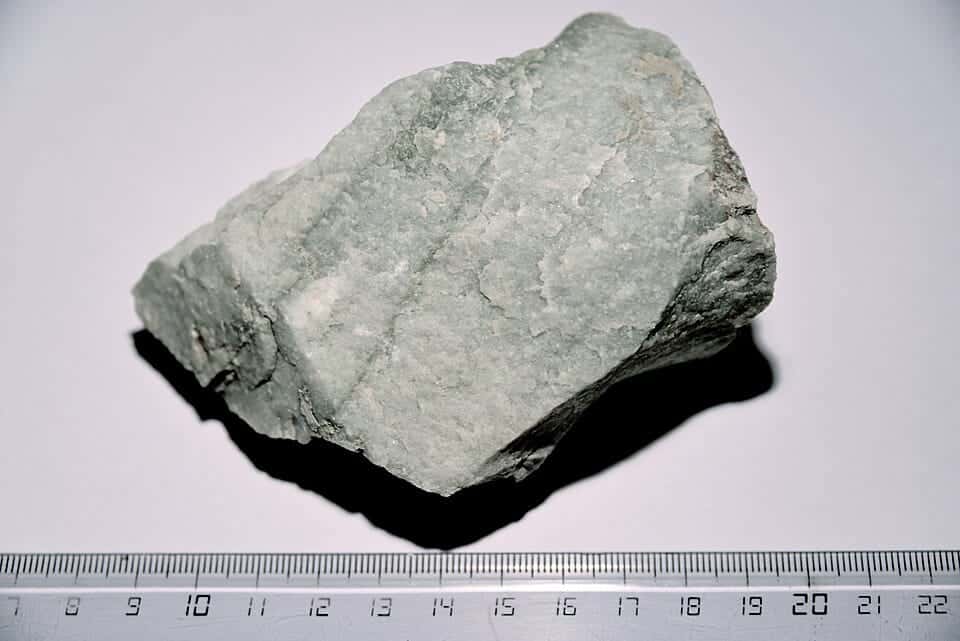
Quartzite is a hard metamorphic rock made almost entirely of quartz, and you identify it by three things together: it scratches glass easily because it sits at 7 on the Mohs hardness scale, it does not fizz when you drop vinegar on it, and when it breaks the fracture runs straight through the sand grains instead of crumbling around them. That last test is the one that separates quartzite from the sandstone it started as. Quartzite forms when a quartz-rich sandstone is squeezed and heated until the grains and their silica cement fuse into one interlocking mass, which is why a fresh break looks sugary and glassy rather than grainy and loose. It is usually white or gray, though iron can tint it pink, red, or purple. The rocks it gets confused with are vein quartz, plain sandstone, marble, and pale granite, and a hardness test plus a drop of acid sorts out all four.
How to Identify Quartzite
Quartzite is a stone Spotter sees regularly. Over the past 45 days its rock identifications included quartzite three times, with the app keying on a crystalline white-and-tan surface, a granular sugary texture, and sharp angular edges; on one piece it flagged a reddish-brown iron-stained band and called out a “granular texture typical of metamorphic sandstone.” That is a fair picture of the whole challenge: quartzite looks enough like sandstone, quartz, and even marble that people photograph it unsure which one they are holding. Work through five features and the answer usually falls out.
Hardness of 7: it scratches glass
Quartzite is made of quartz, so it inherits quartz’s hardness of 7 on the Mohs scale. In practice that means a clean edge of quartzite will scratch a glass bottle or plate, and a steel knife will not scratch the quartzite back. This single test rules out the soft look-alikes at once: marble and limestone are calcite at about 3 on the scale, soft enough for a nail to mark, and they cannot touch glass. The Mohs hardness scale puts quartz at 7 and calcite at 3, so the gap is wide and easy to feel. If your pale rock scratches glass, you are holding something quartz-rich, which narrows it to quartzite, sandstone, vein quartz, or chert.
A sugary, interlocking texture
Look at a fresh broken surface in good light. Quartzite has a granular, sugary look, like a block of compressed sugar or coarse frosted glass, because it is built from sand grains that have recrystallized and fused together. The grains interlock so tightly that there are no gaps, which is why quartzite feels dense and solid and does not shed sand when you rub it. Geology.com notes that quartzite is “composed almost entirely of quartz,” with some deposits running over 98 percent silica, so the whole rock is essentially one mineral welded into a mass.
It breaks through the grains, not around them
This is the test that separates quartzite from sandstone, and it is the most reliable one you have. In sandstone, the sand grains are glued together by a weaker cement, so the rock breaks around the grains: the surface crumbles, individual grains pop loose, and you can often rub sand off with a thumb. In quartzite the grains and cement have fused, so a break cuts straight across the grains and leaves a smooth, hard surface. Geology.com states that quartzite “breaks through the quartz grains rather than breaking along the boundaries between them,” and that through-grain fracture is the defining difference from sandstone. If grains rub loose, it is sandstone; if the break is clean and glassy, it is quartzite.
No fizz with acid
A drop of white vinegar or dilute acid tells quartzite apart from marble, the polished stone it most resembles. Marble is metamorphosed limestone, made of calcite, so it fizzes and bubbles when weak acid touches it. Quartzite is pure silica and does nothing at all. Pair the acid test with hardness and the two are never confused: marble is soft and fizzes, quartzite is hard and inert. For the soft, acid-sensitive rock on the other side of that pair, see how to identify limestone, marble’s sedimentary parent.
Color: white, gray, pink, or red
Pure quartzite is white to light gray. Iron oxide is the usual colorant, staining it pink, rose, red, or even purple, while other impurities can turn it yellow, orange, or green. Color alone proves nothing, because quartz, marble, and granite all span similar ranges, but a uniform, slightly translucent pink or gray stone with a sugary texture and a glassy break is a strong quartzite signal. Watch for a glittery sparkle on some pieces: thin flakes of mica caught in the rock catch the light, an effect geologists call aventurescence.
Where you find it
Quartzite is tough and resists erosion, so it tends to stand up as ridges and bluffs long after softer rock around it has worn away. Wisconsin has a textbook example: the Baraboo Range in the south-central part of the state, where the bluffs of Devil’s Lake State Park are carved from quartzite that the Wisconsin DNR dates to 1.6 billion years old, “one of the most ancient rock outcrops in North America.” The DNR describes how the rock “first formed sandstone and then, under great heat and pressure, became quartzite,” which is the whole story of the stone in one sentence. The Baraboo quartzite is famously pink to purple. Across the glaciated Midwest you also meet quartzite as hard, rounded cobbles dropped by Ice Age glaciers, mixed in with granite and gneiss on beaches and in gravel.
Quartzite vs. Sandstone vs. Quartz vs. Marble
These four pale, common rocks cause most quartzite mix-ups. Two quick tests, a scratch on glass and a drop of vinegar, split them cleanly, and the way each one breaks confirms the call. The table lays out the marks you can judge without lab gear. For the mineral quartzite is built from, see how to identify quartz; for the speckled rock it is sometimes mistaken for, see how to identify granite.
| Rock | Hardness (Mohs) | Fizz in acid? | How it breaks | Quick tell |
|---|---|---|---|---|
| Quartzite | 7 | No | Through the grains, clean and glassy | Sugary texture, scratches glass, no loose sand |
| Sandstone | Grains are 7, rock is weaker | No, unless calcite cement | Around the grains, crumbly | Rub it and sand grains come loose |
| Vein quartz | 7 | No | Curved, glassy conchoidal scoops | One glassy mass, no grain texture |
| Marble | 3 | Yes, fizzes | Sugary but soft, scratched by a nail | Soft, fizzes in vinegar |
Quartzite and vein quartz are both pure silica and both scratch glass, so hardness will not separate them; use texture instead. Quartzite is granular and sugary, built from fused sand grains, while a lump of vein quartz is a single glassy mass that breaks in smooth, curved scoops with no grain structure at all. Marble is the easy one: it is soft and it fizzes. Sandstone and quartzite can grade into each other, and geologists admit the line is sometimes impossible to draw, so if grains barely cling and the rock feels a little soft, you are near the sandstone end of that range.
Frequently Asked Questions
How can I tell quartzite from sandstone?
Try to rub sand off the surface and look at how it breaks. Sandstone is held together by weaker cement, so grains rub loose under your thumb and a break crumbles around the grains. Quartzite has fully fused grains, so nothing rubs off and a break runs straight through the grains, leaving a smooth, glassy surface. Quartzite also scratches glass cleanly, while weakly cemented sandstone tends to crumble instead. The two grade into each other, so a rock that is mostly solid but sheds a few grains sits somewhere in the transition.
Is quartzite the same as quartz?
No. Quartz is a single mineral, silicon dioxide, that grows as glassy crystals or solid vein masses. Quartzite is a rock made of countless quartz sand grains fused together by heat and pressure. They share the same chemistry and the same hardness of 7, so both scratch glass, but quartzite has a visible granular, sugary texture while a piece of quartz is one uniform glassy mass that breaks in curved scoops.
Is quartzite valuable?
Common quartzite is not a precious stone, but it has real commercial value as a durable building and countertop material, prized because it is harder and more scratch-resistant than marble. As a rock to find and learn from, a clean pink or gray quartzite cobble is a satisfying identification rather than a payday. Watch for one marketing twist: some stone sold as “quartzite” countertop is actually softer marble or engineered quartz, which the acid-and-hardness tests above will expose.
How do you tell quartzite from marble?
Hardness and acid. Quartzite is hard at Mohs 7 and scratches glass; marble is soft at Mohs 3, so a steel knife or even a nail will scratch it. Marble is calcite, so a drop of vinegar makes it fizz, while quartzite does nothing. Both can look sugary and pale, but no amount of polishing changes those two tests, which is also how buyers check that a “quartzite” countertop is the real, tougher stone.
Holding a hard, pale, sugary-looking rock and not sure if it is quartzite, quartz, or sandstone? Try to scratch glass with it, drop on a little vinegar, and see whether grains rub loose: quartzite scratches glass, stays silent in acid, and sheds no sand. For the wider family of stones it travels with, see our guide to common rocks and minerals, or start on the rock identifier page, where Spotter can give you a first read from a photo.
Try Spotter free on iPhone or Android
Plants, animals, fungi and rocks from one photo. 5 free identifications every day, no card required.