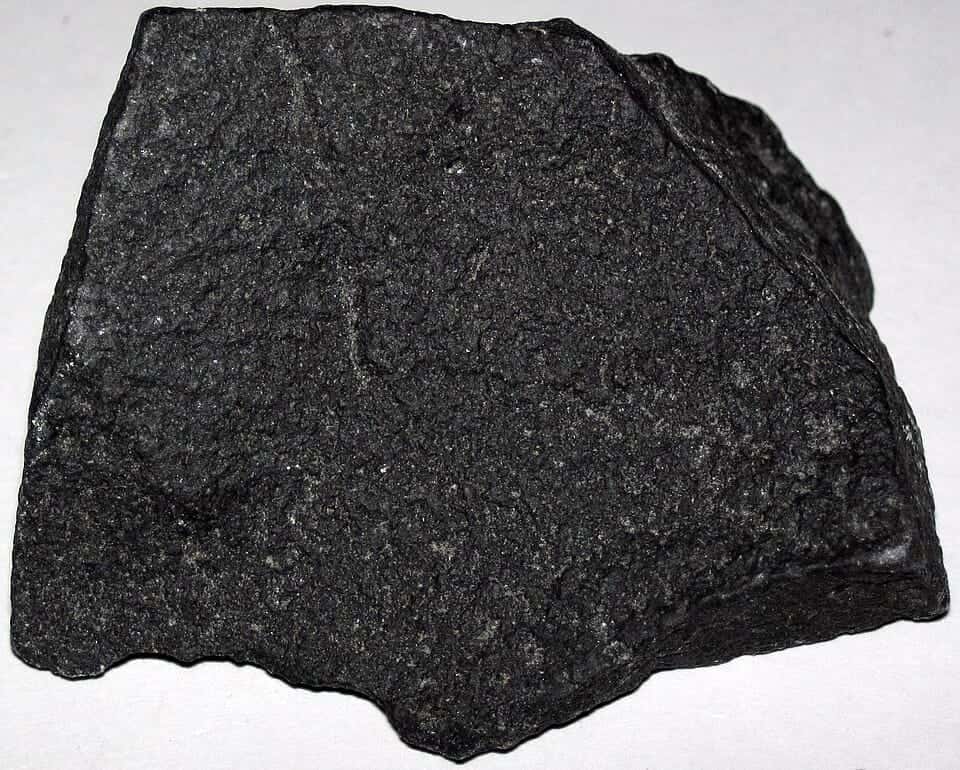
Basalt is a dark, fine-grained volcanic rock, and the fastest way to identify it is to check three things at once: it reads nearly black to dark gray, its grains are too small to see so the surface looks smooth and dull rather than sparkly, and it feels heavy and dense for its size. Basalt is low in silica and rich in iron and magnesium, which is what makes it so dark, and it is the most common volcanic rock on Earth, forming most of the ocean floor and vast lava-flow plateaus on land. If a dark, heavy rock shows no visible crystals, often carries small round gas holes, and weathers to a rusty brown, basalt is the leading answer.
Basalt forms when runny, iron-rich lava erupts and cools quickly at the surface, freezing its crystals before they grow large enough to see. Around Lake Superior, more than 200 stacked basalt lava flows poured out about 1.1 billion years ago as North America began to rift apart, and those flows are now exposed along the north and south shores, including far northern Wisconsin. Ice Age glaciers then scattered their dark cobbles across the Upper Midwest, so heavy black stones turn up in gravel, fields, and along shorelines far from any volcano. The comparison table below lines basalt up against the four rocks it is most often mistaken for, drawn from published geology references, so you can separate them by eye.
How to Identify Basalt
Work through the color, the grain, the weight, any gas holes, and where you found it. Together these marks separate basalt from the other dark rocks it gets confused with, and from the glassy and coarse-grained igneous rocks that share its chemistry.
Dark color that weathers to rust-brown
Fresh basalt is dark gray to black because it is a mafic rock, meaning it is rich in iron and magnesium and low in silica (roughly 45 to 52 percent). Those iron-bearing minerals oxidize over time, so a weathered surface often turns a rusty brown, tan, or reddish color while a fresh break stays dark. A uniformly dark, almost black rock with little or no pale material points toward basalt rather than a pale, speckled rock. If your stone is mostly white, pink, or salt-and-pepper, it is more likely granite or another felsic rock.
Fine grain with no visible crystals
Basalt is aphanitic, which means its crystals are too small to pick out with the naked eye, even up close. The result is a smooth, even, matte surface with no sparkle and no separate grains catching the light. This is the key difference from the coarse igneous rocks it matches in chemistry: in granite and diorite you can clearly see individual crystals of quartz, feldspar, and dark minerals, because those rocks cooled slowly underground. Basalt cooled fast at the surface, so if the rock is dark and grainless with no visible crystals, basalt is far more likely than gabbro or diorite.
Heavy and dense for its size
Those iron- and magnesium-rich minerals make basalt noticeably denser than pale rocks. A fist-sized piece of basalt feels heavier in the hand than the same size chunk of granite or limestone. Heft alone will not clinch an identification, but a dark, fine-grained rock that feels surprisingly heavy fits basalt well, and the weight helps rule out lightweight look-alikes such as weathered scoria or lightweight volcanic pumice.
Gas holes: vesicular and amygdaloidal basalt
Lava traps gas as it cools, and the bubbles freeze in place as small round or oval holes called vesicles. Basalt studded with these cavities is called vesicular basalt, and the holes range from pinhead size to larger than a marble. When later groundwater fills those old bubbles with secondary minerals such as quartz, calcite, or green zeolites, the rock is called amygdaloidal basalt, and the filled almond-shaped spots stand out against the dark background. Small round holes or filled spots in a dark, fine-grained rock are a strong sign you are holding basalt.
Where you found it
Basalt forms from surface lava flows, so it turns up in old volcanic terrain, along road cuts through lava beds, and as hard, rounded cobbles in rivers and on beaches. Famous flows build recognizable shapes: thick sheets sometimes cool into tall five- and six-sided columns, the columnar basalt seen at places like Devils Postpile in California and Giant’s Causeway in Ireland. Across the Upper Midwest, glaciers carried basalt far from its source, so in Wisconsin, Minnesota, and Michigan the dark, heavy stones you find in gravel and on Lake Superior beaches are usually these glacial travelers from the ancient rift flows.
Basalt vs. Gabbro, Obsidian, Andesite, and Diorite
Basalt is confused most with gabbro (its coarse-grained twin), glassy obsidian, lighter-gray andesite, and speckled diorite. The split comes down to grain size and color, both of which you can judge by eye. This table lines up the field marks that set them apart.
| Rock | Grain size | Color and composition | How it forms | Quick tell |
|---|---|---|---|---|
| Basalt | Fine, no visible crystals | Dark gray to black, mafic (plagioclase and pyroxene) | Extrusive: fast-cooled lava flows, ocean floor | Dark, dull, heavy, often gas holes; weathers rust-brown |
| Gabbro | Coarse, visible crystals | Dark, nearly black, same mafic chemistry as basalt | Intrusive: magma cooled slowly underground | Like basalt but with crystals you can actually see |
| Obsidian | Glassy, no grains at all | Black and glossy, sometimes brown or green | Extrusive: lava cooled too fast to crystallize | Wet, glassy shine; breaks in smooth curved scoops; edge glows |
| Andesite | Fine, sometimes scattered larger crystals | Medium to light gray (intermediate silica) | Extrusive: stratovolcano lava | Lighter gray than basalt, often with visible pale specks |
| Diorite | Coarse, salt-and-pepper | Gray, black-and-white speckled (intermediate) | Intrusive: cooled slowly underground | Clear black and white crystals, no dark matte body |
The cleanest split is grain size versus cooling history. Basalt and gabbro share nearly identical chemistry, but according to geology.com, the difference is simply that basalt is fine-grained while gabbro is coarse-grained, because basalt cooled fast at the surface and gabbro cooled slowly at depth. Obsidian cooled so fast it never formed crystals at all, which gives it a glassy shine basalt never has. For more on telling the glossy black rock apart, see how to identify obsidian.
Basalt and Lake Superior Agates
If you rockhound the Great Lakes, basalt is worth knowing because it is the parent rock of the famous Lake Superior agate. As the rift’s basalt lava flows solidified, trapped water vapor and carbon dioxide left millions of gas pockets, and the Minnesota DNR explains that later groundwater carrying iron, silica, and other dissolved minerals passed through those vesicles and slowly deposited the banded chalcedony we call agate. In other words, the same gas holes that mark vesicular basalt are where agates grow. Glaciers broke many of these agate-bearing flows apart and spread the stones across the region, which is why you can hunt Lake Superior agates hundreds of miles from the lake. See how to identify agate for the banded look to watch for, and our guide to common rocks and minerals for the wider set of stones glaciers left behind.
Frequently Asked Questions
Is basalt the same as lava rock?
Mostly, yes. Basalt is the most common rock that forms from cooled lava, so a lot of what people call lava rock is basalt. The term lava rock is loose, though, and can also cover lighter, bubbly volcanic rocks like scoria and pumice. True basalt is dark, dense, and fine-grained, while scoria is lighter and full of holes and pumice is so frothy it can float.
How do I tell basalt from obsidian?
Look at the surface and the shine. Basalt is dull, opaque, and grainy, often with small gas holes. Obsidian is natural volcanic glass with a bright, wet-looking shine, it breaks in smooth curved scoops with sharp edges, and a thin edge held to the light often glows faintly. If a dark rock looks like a chunk of thick bottle glass, it is obsidian, not basalt.
Why is my basalt full of small holes?
Those holes are vesicles, frozen gas bubbles. As the lava rose and cooled, dissolved gases came out of solution and formed bubbles that were trapped when the rock hardened. Basalt full of them is called vesicular basalt. If the holes have since been filled with lighter secondary minerals, the rock is called amygdaloidal basalt, and those filled pockets are where agates and zeolites form.
Is basalt magnetic?
Often weakly, yes. Basalt commonly contains small amounts of magnetite and other iron-oxide minerals, so a strong magnet may tug gently on a piece or a compass needle may twitch near a large outcrop. The pull is usually subtle, not the firm grab you get from a magnetite-rich rock or a piece of iron, so weak magnetism supports a basalt identification but does not prove it on its own.
Try Spotter free on iPhone or Android
Plants, animals, fungi and rocks from one photo. 5 free identifications every day, no card required.