
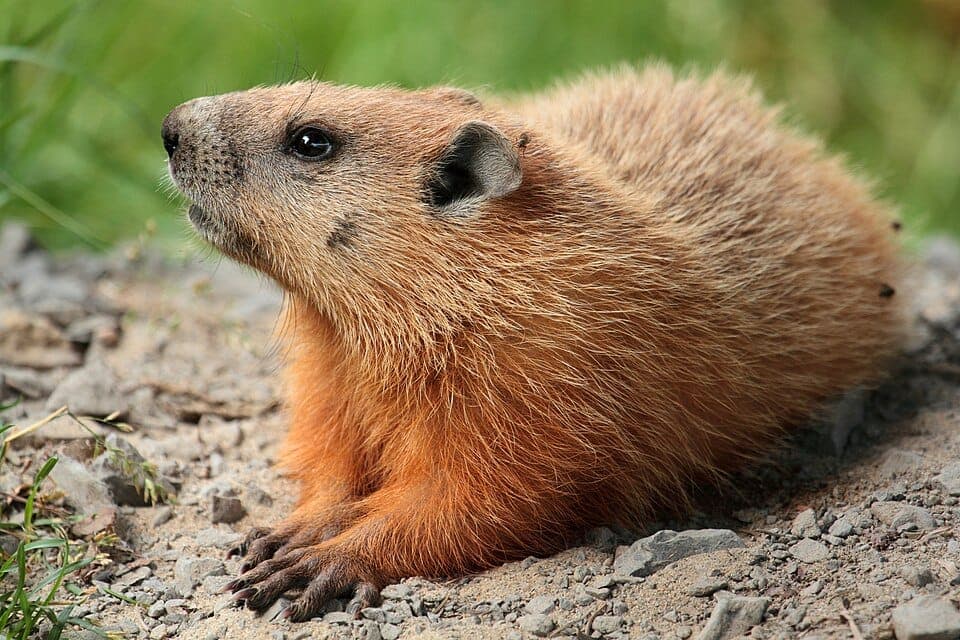
If you have spotted a chunky, brown, ground-dwelling animal about the size of a large house cat — sitting up on its haunches near a hole or waddling across a field — you are almost certainly looking at a groundhog, also called a woodchuck. Groundhogs are the largest members of the squirrel family, with a stocky body, grizzled brown fur, short powerful legs, and a short, bushy, dark tail, and they live in extensive burrows dug in fields, yards, and along fence lines. The two animals people confuse them with most — muskrats and beavers — live in and around water and have very different tails, so once you check the tail, the size, and where the animal is, a groundhog is easy to name. Here is how.
How to Identify a Groundhog (Woodchuck)
Groundhog and woodchuck are two names for the same animal, Marmota monax, a stout burrowing rodent found across much of the eastern and central United States and southern Canada. Focus on the body, the tail, the teeth, and above all the burrow.
Size and body shape
A groundhog is about 16 to 27 inches long including the tail and weighs 5 to 13 pounds, growing noticeably heavier and rounder in late summer and fall as it fattens up for hibernation. The body is low-slung, heavy, and hunched, with short legs, so the overall impression is of an oversized, ground-bound squirrel.
Fur, face, and feet
The coat is a grizzled grayish-brown, often frosted-looking where the guard hairs are pale-tipped. The face is blunt and rounded with small rounded ears, dark eyes, and a short muzzle. On the front feet are large curved claws built for digging, and behind the lips are the white-to-yellowish ever-growing incisors typical of a rodent.
The short, bushy tail
The tail is short — about 4 to 7 inches — furry, dark brown, and usually held low. That furred tail is the single fastest way to separate a groundhog from a muskrat or beaver, both of which have hairless tails built for swimming.
The burrow — the surest sign
You will often find the burrow before you see the animal. A groundhog’s main entrance is a hole about 10 to 12 inches wide with a large fan of freshly excavated dirt beside it, plus one or more hidden secondary "spy holes" dug from below that have no mound. Burrows sit in dry ground — in fields and lawns and tucked under sheds, decks, woodpiles, and rock walls — never at the edge of the water like a muskrat’s.
Behavior and season
Groundhogs are active by day, feeding on grasses, clover, dandelions, and garden vegetables, and they sit bolt upright to scan for danger. Alarmed, they give a sharp whistle — the reason for the nickname "whistle-pig" — and bolt for the burrow. They are true hibernators, largely out of sight from roughly October into February, so you see them most in spring and again in late summer as they bulk up. They are generally solitary.
Try Spotter Free on iOS & Android
Plants, animals, fungi, and rocks — all from a photo. 5 free identifications every day, no credit card required.
Groundhog vs. Muskrat vs. Beaver
All three are brown rodents, but two of them are semi-aquatic, and the tail settles it almost instantly:
- Muskrat — much smaller (about 2 to 4 pounds and roughly 20 inches), lives in and along water, with a long, thin, nearly hairless tail flattened side-to-side; it builds cattail lodges and bank burrows right at the waterline.
- Beaver — far larger (35 to 70 pounds), with an unmistakable broad, flat, hairless paddle tail, and it needs water to live; look for gnawed, pencil-pointed stumps and dams.
- Habitat is the giveaway — muskrat and beaver swim as a way of life, while a groundhog can swim but is a land animal of dry burrows and fields with a short furry tail.
- Marmot and prairie dog — western relatives; yellow-bellied marmots live on rocky mountain slopes, and prairie dogs are smaller, tan, and live in big open colonies.
- Nutria — an invasive wetland rodent that looks muskrat-like but larger, with a round, rat-like tail and orange front teeth; found across the southern states.
Are Groundhogs a Problem? Living With Them
Groundhogs are mostly a garden and structural nuisance rather than a danger. They eat vegetables and ornamentals, and their extensive burrows can undermine sheds, patios, and foundations or create holes that livestock step in. They are not aggressive and rarely bite unless cornered or handled, but like any wild mammal they can carry rabies on rare occasions, so never handle one. The gentlest deterrents are removing brush and cover, protecting beds with fencing buried several inches deep, and — where removal is truly needed — letting a local extension office or licensed wildlife professional advise what is legal in your area. On the plus side, abandoned groundhog burrows shelter foxes, rabbits, and other wildlife, and their digging turns and aerates the soil.
Frequently Asked Questions
Is a groundhog the same as a woodchuck?
Yes. Groundhog, woodchuck, and whistle-pig are all common names for the same animal, Marmota monax. The name has nothing to do with wood — "woodchuck" comes from an Algonquian word that early settlers reshaped into English.
What is the difference between a groundhog and a muskrat?
Location and tail. A groundhog is a land animal with a short, furry tail that digs dry burrows in fields and yards. A muskrat is smaller, lives in water, and has a long, thin, nearly hairless tail. If the animal is in or right beside a pond, it is not a groundhog.
Do groundhogs really hibernate?
Yes — they are true hibernators. From about October to February their body temperature and heart rate drop dramatically, which is why you rarely see one in winter, and why Groundhog Day in early February marks roughly when they begin to emerge.
How do I know if a groundhog is living in my yard?
Look for a burrow entrance 10 to 12 inches wide with a large mound of fresh dirt beside it, often near a shed, deck, or wall, along with chewed garden plants and a well-worn path. On warm days you may catch the animal sunning near the hole.
Not sure whether the burrowing animal in your yard is a groundhog, a muskrat, or something else? Snap a photo of the animal or its burrow and let Spotter help you identify it.
Try Spotter Free on iOS & Android
Plants, animals, fungi, and rocks — all from a photo. 5 free identifications every day, no credit card required.