Spotted wintergreen (Chimaphila maculata) is a small evergreen plant of dry eastern woodlands, and the fastest way to identify it is the single bright white stripe running down the midrib of each dark, leathery, toothed leaf. Because those leaves stay green through the cold months, it is one of the few plants you can still pick out on a bare December forest floor, when the leaf litter is brown and almost nothing else is green. The name causes some confusion: it is not the source of the wintergreen smell in gum and candy, and it goes by several names, including striped wintergreen, striped prince’s pine, and spotted pipsissewa. Once you learn the one-stripe pattern, it is hard to mistake for anything else. Here is how to recognize it and tell it from the woodland plants it gets confused with.
This is a plant Spotter sees in late fall. Over the past 45 days its plant identifications included spotted wintergreen twice, both in November, and the features the app keyed on were “dark green lance-shaped leaves,” a “distinctive white stripe along the center vein,” “low-growing evergreen foliage,” and plants “growing among moss and leaf litter.” That is the entire search image in four marks: a low, dark, striped evergreen leaf sitting close to the ground in a shady wood. Work through the features below and the identification usually falls out.
How to Identify Spotted Wintergreen
Spotted wintergreen is a low, slightly woody perennial whose flowering stems reach only about four to eight inches tall, according to the Lady Bird Johnson Wildflower Center at the University of Texas at Austin. Everything distinctive about it is in the leaves, so start there.
The white stripe down the midrib
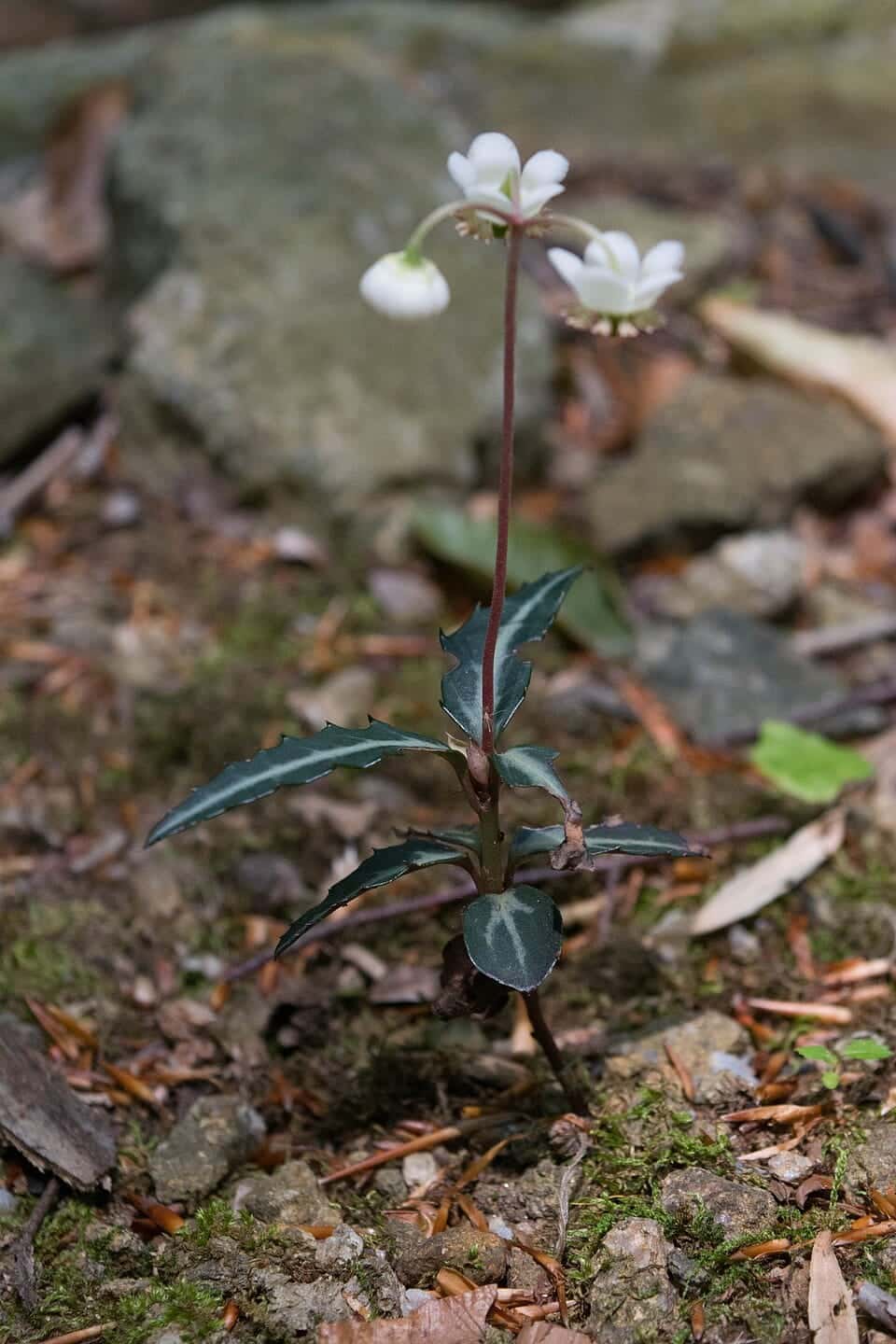
This is the field mark that names the plant. Each leaf is dark green to bluish-green with a crisp band of white running along the central vein, so it looks as though someone painted a pale stripe down the middle of every leaf. Faint white can bleed a short way along the side veins as well, but the bold line down the center is what catches your eye. NC State Extension describes the foliage as “dark bluish-green” and “mottled with white along the leaf veins,” which is exactly what you see on a healthy patch. If the whole leaf is a solid, even green with no pale center, you are not looking at spotted wintergreen.
Dark, leathery, toothed leaves
The leaves are firm and leathery, roughly one to two and a half inches long, and shaped like a lance, widest below the middle and tapering to a point. The margins carry small, sharp, widely spaced teeth. They are arranged in loose whorls, meaning two to four leaves spread out from about the same point on the short stem rather than running up it one at a time. The upper surface is glossy and dark; the underside is a paler green. Because the leaves are evergreen, you find them in full color in the middle of winter, which is when they stand out most against dead leaves and snow.
Low stems, often in a small colony
Spotted wintergreen spreads by slender underground stems, so it usually grows as a scattered patch of several plants rather than one isolated sprout. Each aboveground shoot is short and unbranched, with its whorls of striped leaves near the top. Seeing a loose colony of identical low, striped-leaved shoots across a patch of shaded ground is itself a good clue, since the look-alikes below tend to grow in different ways.
Nodding summer flowers and upright winter capsules
From June through August the plant sends up a thin stalk topped with one to five nodding, waxy, fragrant flowers that are white to pale pink, each with five petals. After bloom the flower stalk straightens and the developing seed capsules point stiffly upward, turning brown and woody. Those small dry capsules often persist on the stalk into fall and winter, so a low rosette of white-striped evergreen leaves topped by a few upright brown capsules is a reliable cold-season signature.
Where it grows
Look in dry, shaded woods with acidic, sandy soil, especially under oaks and pines. The Wildflower Center gives its native range as running from southern Ontario to southern New Hampshire, south to Georgia, and west to Alabama, Tennessee, northeastern Illinois, and Michigan, with a second population reaching down into Mexico. It is a plant of undisturbed woodland floors, not lawns or roadsides, so habitat alone narrows the field.
Spotted Wintergreen vs. Its Look-Alikes
A few other low, evergreen woodland plants get confused with spotted wintergreen, and the amount and pattern of white on the leaf separates them cleanly. The table lays out the marks you can judge by eye, without digging anything up.
| Plant | Leaf shape and arrangement | White markings | Quick tell |
|---|---|---|---|
| Spotted wintergreen (Chimaphila maculata) | Lance-shaped, toothed, in loose whorls on a short upright stem | One bold white stripe down the midrib | A single stripe on a dark, toothed leaf |
| Pipsissewa (Chimaphila umbellata) | Broadest near the tip, toothed, whorled | None, solid glossy green | Same plant shape but no stripe at all |
| Downy rattlesnake plantain (Goodyera pubescens) | Oval, smooth-edged, in a flat ground rosette | A whole network of fine white veins | A web of white across the leaf, not one line |
| Eastern teaberry (Gaultheria procumbens) | Oval, glossy, alternating along a creeping stem | None | No stripe, a red berry, wintergreen scent when crushed |
The cleanest cut is between spotted wintergreen and its closest relative, pipsissewa. The two share the same low, whorled growth and toothed leaves, but pipsissewa’s leaves are solid dark green with no pale center, and they are broadest nearer the tip rather than below the middle. The Wildflower Center notes that pipsissewa “has shiny, dark green leaves that lack the mottling,” so the white stripe is the deciding mark. Downy rattlesnake plantain, a small orchid, also sits low with evergreen leaves, but its white forms a dense net of veins across an oval leaf in a flat ground rosette, not a single stripe on a toothed, pointed leaf. For other green plants you can still name in winter, see juniper vs. eastern red cedar.
A note on picking it
Spotted wintergreen is slow to establish and depends on partnerships with soil fungi, which is why it rarely survives being dug up or transplanted. It is also genuinely uncommon toward the edges of its range. In Canada it is officially listed as Threatened, a status the Committee on the Status of Endangered Wildlife in Canada assigned in 2017, noting the plant is restricted to a handful of sandy sites in southern Ontario, and it is protected or tracked as rare in several northern US states as well. The responsible move is simple: photograph it where it grows and leave the plant and its roots undisturbed.
Frequently Asked Questions
Is spotted wintergreen the same as the wintergreen flavor in gum and candy?
No. The familiar wintergreen aroma comes from eastern teaberry (Gaultheria procumbens), a different low woodland plant with glossy oval leaves and a red berry. Spotted wintergreen is named only for keeping its leaves green through winter; crushing its leaves does not produce that scent.
What is the difference between spotted wintergreen and striped wintergreen?
There is none. They are two common names for the same species, Chimaphila maculata. The names spotted wintergreen, striped wintergreen, striped prince’s pine, and spotted pipsissewa all point to the same white-striped evergreen plant.
How do I tell it from rattlesnake plantain?
Look closely at the white. Spotted wintergreen shows one bold stripe down the center of a toothed, lance-shaped leaf carried on a short upright stem. Downy rattlesnake plantain is an orchid that grows as a flat rosette of oval, smooth-edged leaves laced all over with a network of fine white veins. One stripe versus a whole web is the quickest way to separate them.
Is spotted wintergreen rare?
It can be locally frequent in the right dry oak and pine woods, but it is slow to spread and is listed as Threatened in Canada and as rare or protected in parts of the northern United States. Because it relies on soil fungi and does not transplant, the best practice is to enjoy and photograph it in place rather than move it.
Try Spotter free on iPhone or Android
Plants, animals, fungi and rocks from one photo. 5 free identifications every day, no card required.