
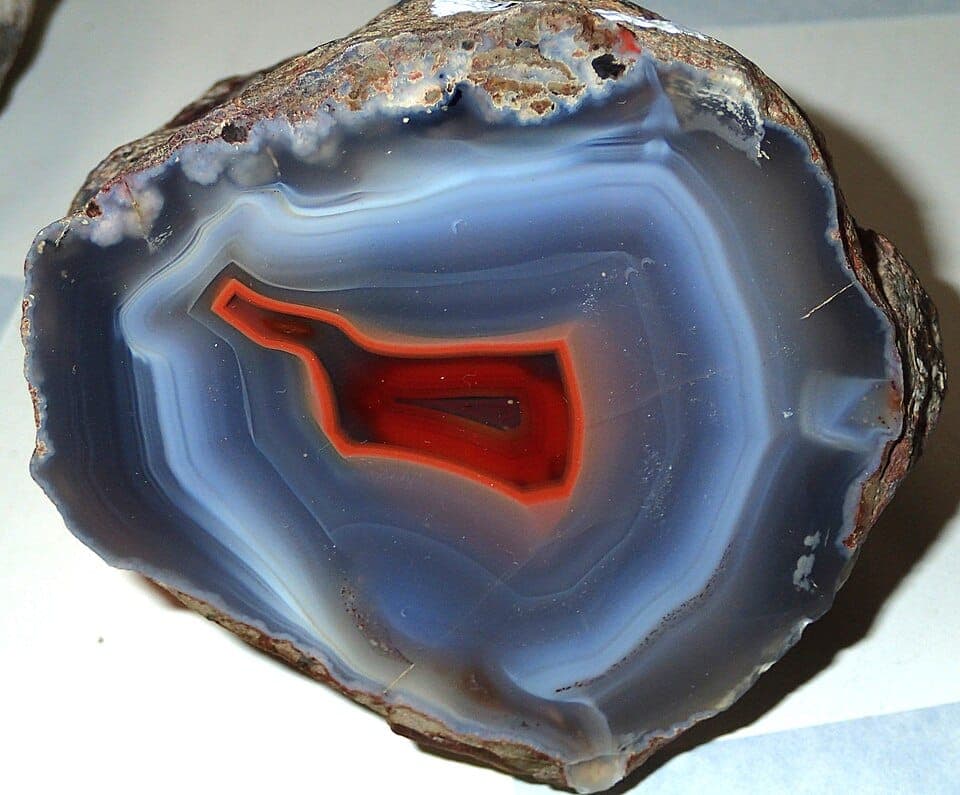
The surest way to identify an agate is to hold it up to a light: a true agate is a banded form of chalcedony that is at least partly translucent, so a thin edge glows and light passes a short way into the stone, and its surface often shows curved, concentric bands of color like tree rings or a fingerprint. It is hard — 6.5 to 7 on the Mohs scale, enough to scratch glass — with a smooth, waxy shine and sharp, curved (conchoidal) fractures rather than flat cleavage faces. Those four traits together — translucence, banding, hardness, and a waxy conchoidal break — separate agate from the ordinary rocks it hides among on a gravel bar or beach. Here is how to test a suspect stone.
How to Identify an Agate
Agate forms when silica-rich water seeps into cavities in volcanic rock (and some sedimentary rock) and hardens layer by layer into microcrystalline quartz. That glassy, layered origin gives agate a set of clues you can check by eye and by hand, no lab required.
Translucence: hold it to the light
This is the single best field test. Wet the stone or shine a phone flashlight against a thin edge in a dark room. A real agate lets light pass a little way in and glows amber, gray, or honey-colored at the edges, even if the center looks solid. A plain rock stays stubbornly dark and opaque. Partial translucence is the trait that trips up most impostors.
Banding and pattern
The name-defining feature is banding: curved concentric rings, angular "fortification" lines that echo the shape of the cavity, or flat "waterline" layers stacked like sediment. Colors range from white, gray, and blue to red, orange, and brown, often several in one stone. Not every agate is obviously banded — some is cloudy or mossy chalcedony — but when you see fine curved bands, agate is the leading answer.
Hardness: it scratches glass
Agate is hard, 6.5 to 7 on the Mohs scale. A piece will scratch a glass bottle or a steel knife blade, and a knife will not scratch the agate back. If your pocketknife bites into the stone and leaves a groove, it is something softer — calcite, limestone, or a plain pebble — not agate.
Luster, texture, and fracture
Agate has a waxy or greasy luster and a smooth feel. A weathered nodule often wears a pitted, frosted rind, while a broken or tumbled piece is glassy. Where it has chipped, look for conchoidal fracture — smooth, curved, shell-like breaks with very sharp edges, just like broken glass — rather than the flat, stair-step cleavage planes of many crystals.
Shape: nodules and pebbles
Agate frequently occurs as rounded nodules that weather out of volcanic rock, sometimes with a bumpy, grape-like (botryoidal) rind. In rivers and on beaches these tumble into smooth, egg-shaped pebbles that catch the light differently from the dull stones around them.
Try Spotter Free on iOS & Android
Plants, animals, fungi, and rocks — all from a photo. 5 free identifications every day, no credit card required.
Agate vs. Rocks It Is Confused With
Plenty of stones get pocketed as agates that are not. Here is how to tell them apart:
- Jasper — also chalcedony and just as hard, but opaque and solid- or mottled-colored, with no translucence and rarely true bands; jasper and agate sometimes occur together in a single stone.
- Chert and flint — hard and conchoidal like agate but dull, opaque, and unbanded, usually gray, brown, or black.
- Quartz (clear or milky) — the same hardness, but glassy-clear or evenly milky and crystalline, without agate’s fine curved banding.
- Calcite — can look banded and translucent, but it is much softer (Mohs 3), scratches easily with a knife, and fizzes in vinegar; agate does neither.
- Glass and slag — smooth and translucent but often perfectly clear or full of bubbles, with too-even color; beach glass has frosted, rounded edges from tumbling.
- Plain quartzite or granite pebbles — hard but grainy and fully opaque, showing separate mineral grains instead of agate’s smooth, waxy surface.
Where to Look — and a Word on Testing Safely
Agates turn up on gravel bars, riverbeds, lakeshores, ocean beaches, and old volcanic ground; the Lake Superior agate is a famous example. Hunt after rain or right at the waterline, when stones are wet and their translucence shows. If you break rocks to test them, wear eye protection, because their sharp conchoidal shards fly. Finally, check the rules before you collect: many parks, preserves, and private lands prohibit removing rocks, so know where collecting is allowed.
Frequently Asked Questions
How can you tell a real agate from a plain rock?
Wet the stone or hold a thin edge up to a bright light. A real agate is at least partly translucent and usually shows curved bands, and it is hard enough to scratch glass. A plain rock stays opaque, is softer, or looks grainy.
Is agate the same as quartz?
Agate is a variety of quartz — specifically banded chalcedony, which is quartz built from crystals too small to see. So agate is quartz, but not all quartz is agate; the difference is that fine, banded, microcrystalline structure.
Does agate glow under UV light?
Some agates fluoresce a faint green under ultraviolet light because of trace minerals, but many do not, so UV is not a reliable test. Translucence, banding, and hardness are far more dependable.
Why is my agate not banded?
Not every agate shows obvious bands. Solid or cloudy chalcedony, moss agate, and heavily weathered stones can look bandless; in those cases translucence, waxy luster, and hardness carry the identification.
Not sure whether that glassy, banded pebble is an agate or just a pretty rock? Wet the stone, snap a clear, well-lit photo, and let Spotter help you identify it.
Try Spotter Free on iOS & Android
Plants, animals, fungi, and rocks — all from a photo. 5 free identifications every day, no credit card required.