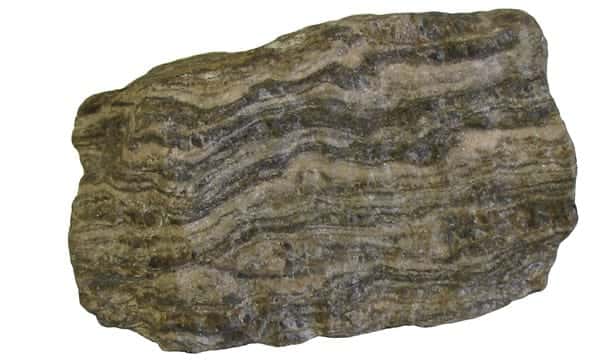
Gneiss is a coarse-grained metamorphic rock, and the fastest way to identify it is the banding: alternating light and dark stripes that run through the stone like the grain in a plank of wood. The light bands are quartz and feldspar, the dark bands are mica and hornblende, and the grains are big enough to see without a lens. Gneiss (pronounced "nice") forms deep in the crust under intense heat and pressure, which lines its minerals up into those parallel bands. It is hard enough to scratch glass, does not fizz with vinegar, and does not split cleanly into sheets the way its close cousin schist does. If your rock is coarse, hard, and striped with pale and dark layers, gneiss is the leading answer.
How to Identify Gneiss
Work through four things in order: the banding, the grain size, the hardness, and what the rock will not do, meaning fizz or flake. Together they separate gneiss from the granite and schist it is most often confused with. Spotter users have identified gneiss three times recently, with the app averaging 87 percent confidence, and the features it reported each time line up with the field marks below: a distinct layered or banded texture, coarse-grained mineral crystals, light-colored veins of quartz or feldspar, and darker streaks of mica or hornblende.
Banding: the one feature that matters most
This is the defining trait. Gneiss shows gneissic banding, roughly parallel stripes that alternate between pale felsic layers (quartz and feldspar) and darker mafic layers (biotite mica, hornblende, sometimes pyroxene). The bands are usually thicker and more irregular than the fine layering in other metamorphic rocks, and they often bend or fold where the rock was squeezed. One common variety, augen gneiss, carries lens-shaped or eye-shaped feldspar crystals (augen is German for eyes) wrapped by the darker bands. If you can see clear light-and-dark striping in a coarse rock, you are most of the way to an identification.
Coarse, interlocking grains
Gneiss is coarse-grained: individual crystals of quartz, feldspar, and mica are large enough to pick out by eye. The grains interlock rather than sit as loose cemented particles, so the rock feels solid, with no gritty surface and no grains that rub off on your hand. That coarse crystal texture tells you the rock recrystallized at high temperature, which rules out fine sedimentary rocks like shale or siltstone.
Hardness and the acid test
Because gneiss is built largely from quartz and feldspar, it is hard, about 6 to 7 on the Mohs scale, and a sharp corner will scratch glass. A steel knife will not scratch the quartz-rich bands. Gneiss carries no carbonate, so a drop of vinegar does nothing: no fizz, no bubbles. A pale banded rock that fizzes is more likely marble or limestone, which you can check against how to identify limestone.
Where gneiss comes from
Gneiss forms by regional metamorphism, the slow reworking of rock under mountain-building pressures at roughly 600 to 900 degrees Celsius and depths of many kilometers. The U.S. Geological Survey describes this foliation as the parallel alignment of mineral grains that pressure squeezes into a striped appearance. Geologists split gneiss by parent rock: orthogneiss started as an igneous rock such as granite, while paragneiss started as a sedimentary rock such as shale or sandstone. Either way, the heat and pressure sorted the minerals into the light and dark bands you see. You can compare that layered origin with the random, unsorted crystals of its igneous look-alike in how to identify granite.
Gneiss vs. Granite, Schist, and Migmatite
Four coarse, crystal-rich rocks get mixed up with one another. These field marks tell them apart:
| Rock | Texture | Banding | Splits into sheets? | Origin |
|---|---|---|---|---|
| Gneiss | Coarse interlocking crystals | Strong light-and-dark bands | No, breaks across the bands | High-grade metamorphic |
| Granite | Coarse, evenly speckled crystals | None, minerals scattered at random | No | Igneous (cooled magma) |
| Schist | Medium grain, visible shiny mica flakes | Weak, but strongly layered | Yes, splits along mica planes | Medium-grade metamorphic |
| Migmatite | Coarse, with swirled light veins | Bands folded and contorted | No | Gneiss pushed to partial melting |
The split test is the quickest way to separate gneiss from schist. Schist is loaded with aligned platy mica, so it flakes and splits along those planes and glitters in the light. Gneiss has less mica and more quartz and feldspar, so it holds together and breaks across its bands instead of peeling into sheets. Granite shares gneiss’s minerals but never bands them: its crystals are scattered at random like confetti.
Why Gneiss Is Worth Knowing
Gneiss is one of the most abundant rocks in the deep continental crust, and it records some of the oldest history on the planet. The Acasta Gneiss along the Acasta River in Canada’s Northwest Territories is over four billion years old, which, according to Natural Resources Canada, makes it the oldest known rock on Earth. Closer to home, gneiss turns up as glacial cobbles on beaches and in gravel across the northern states, carried south from the Canadian Shield by Ice Age glaciers, and it is quarried as a tough building and countertop stone, often sold under the loose trade name "granite." For the broader set of rocks it travels with, see our guide to common rocks and minerals, or start on the rock identifier page.
Frequently Asked Questions
What is the difference between gneiss and granite?
Granite is an igneous rock whose quartz, feldspar, and mica crystals are scattered at random, with no layering. Gneiss is a metamorphic rock made of those same minerals, but heat and pressure have sorted them into alternating light and dark bands. Banding means gneiss; a random speckle means granite.
Is gneiss the same as schist?
No. Both are foliated metamorphic rocks, but schist is rich in aligned mica and splits easily into thin, shiny sheets, while gneiss has coarser light-and-dark banding, less mica, and breaks across the bands instead of flaking apart. Gneiss also forms at higher temperatures and pressures than schist.
How do you pronounce gneiss?
It is pronounced "nice," with a silent g. The name comes from an old German mining term, and it has nothing to do with the English word nice.
Does gneiss react with vinegar?
No. Gneiss is made of silicate minerals, not carbonate, so vinegar or dilute acid produces no fizz. A pale banded rock that does bubble with acid is more likely marble, which is recrystallized limestone.
Found a striped, coarse-grained cobble and not sure whether it is gneiss, granite, or schist? Look for the bands, test whether it splits into sheets, and try a corner against glass. Spotter can give you a first read from a photo, and these three tests confirm it.
Try Spotter free on iPhone or Android
Plants, animals, fungi and rocks from one photo. 5 free identifications every day, no card required.