
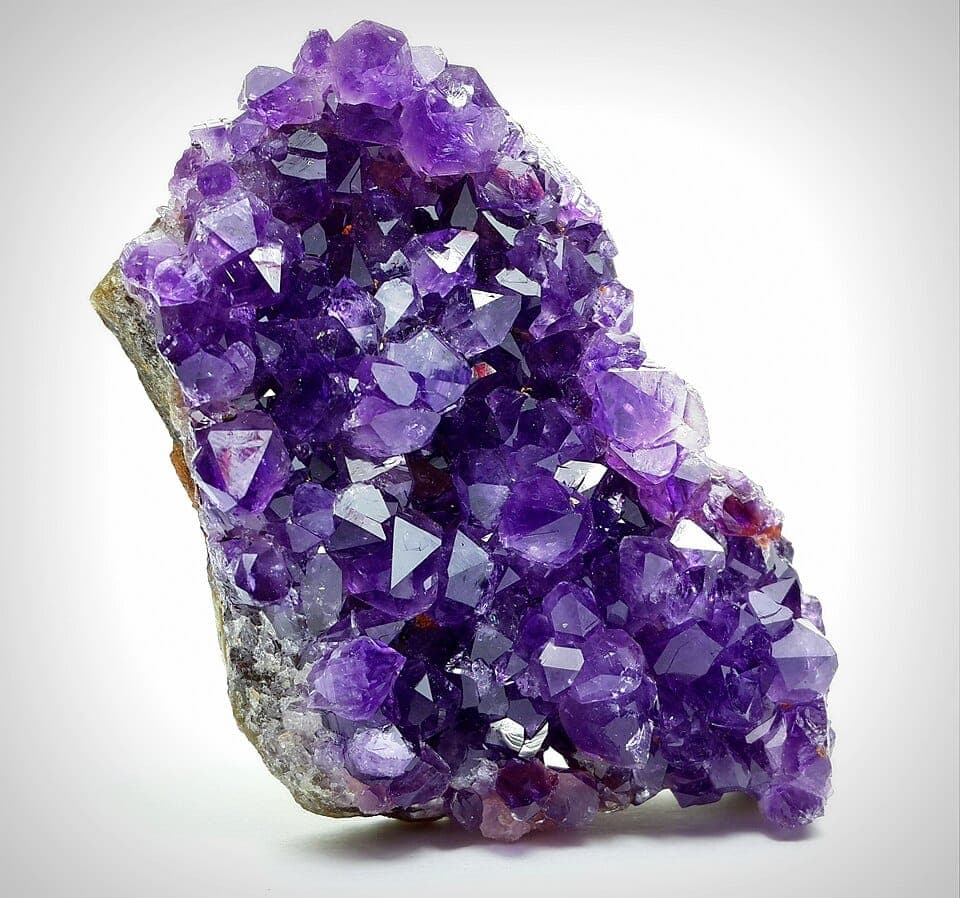
Amethyst is the purple variety of quartz — a hard, glassy, violet-to-deep-purple crystal that is one of the most recognizable and most imitated stones in the rock world. If you are holding a transparent purple crystal that feels cool to the touch, scratches glass without being scratched itself, and shows subtle color zoning rather than a flat, uniform dye job, you are very likely looking at real amethyst. The hard part is rarely recognizing amethyst’s color — it is telling genuine amethyst from dyed glass, purple-coated quartz, and other purple minerals sold as the real thing. Here is how to identify amethyst with simple at-home tests, and how to catch the common fakes.
How to Identify Amethyst
Because amethyst is simply colored quartz, it carries all of quartz’s physical properties: it is hard, it has no cleavage, it breaks in curved fractures, and it grows six-sided crystals. Identification means combining those quartz traits with amethyst’s particular color behavior. No single feature is proof on its own, but the combination below is hard to fake.
Color and color zoning
Amethyst ranges from pale lilac to rich reddish-purple, and the single most useful tell is that the color is usually uneven. Natural amethyst tends to concentrate its color in zones, bands, or the tips of the crystals, often in angular or chevron-like patterns, so one crystal may shade from near-colorless at the base to deep violet at the point. Genuine stones also show a subtle shift in tone as you turn them to the light. Flat, perfectly even color — especially a bright, neon purple with no variation — is a warning sign of dye or glass.
Crystal shape
When amethyst grows good crystals, they are six-sided (hexagonal) prisms ending in a six-sided pyramid point, the classic quartz shape. In geodes and clusters, you see forests of these points crowded together and aimed inward, or a sparkling druzy carpet of tiny points. The faces are glassy and often slightly irregular or striated, not machine-smooth. A "crystal" with rounded, molded edges and no true faces is more likely glass or resin.
Hardness — it scratches glass
Quartz, including amethyst, sits at 7 on the Mohs hardness scale, which is harder than ordinary glass (about 5.5) and far harder than a steel knife blade. That means real amethyst will scratch a glass bottle, and a knife will not scratch the amethyst. This single test rules out most fakes: if your purple stone is scratched easily by a knife, or will not mark glass, it is softer than amethyst and is probably glass, plastic, or a softer purple mineral.
Clarity, inclusions, and feel
Natural amethyst usually carries small imperfections — faint veils, tiny internal fractures, color wisps, or mineral inclusions — because it grew in the earth over a long time. Those flaws are evidence of authenticity, not defects. Glass imitations, by contrast, often look flawless or contain round trapped air bubbles and faint swirl lines from being poured molten. Quartz also feels cool and stays cool in your hand for a moment, while glass warms up faster, and quartz breaks in curved, shell-like (conchoidal) fractures rather than clean flat planes.
Try Spotter Free on iOS & Android
Plants, animals, fungi, and rocks — all from a photo. 5 free identifications every day, no credit card required.
Simple Tests, in Order
Think you have amethyst? Run down this list — most people can decide after the first three checks:
- 1Study the color. Uneven purple, zoning, or color concentrated at the crystal tips points to natural amethyst; dead-flat, uniform, neon color is suspicious.
- 2Look for bubbles. With a hand lens, hunt for round, trapped air bubbles. Bubbles mean glass — real quartz never contains them.
- 3Scratch test. Real amethyst (hardness 7) scratches a glass bottle and resists a steel knife. If a knife marks the stone, it is too soft to be amethyst.
- 4Temperature check. Natural amethyst feels cool and stays cool against your skin for a few seconds; glass warms quickly to the touch.
- 5Hand-lens the insides. Natural veils, fractures, and angular color banding support amethyst; swirl lines and bubbles support glass.
Amethyst vs. Common Fakes and Look-Alikes
A few materials fool buyers most often:
- Dyed or molded glass — the most common fake. It often shows swirl lines and round air bubbles, warms quickly in the hand, has suspiciously even color, and is softer, so it will not scratch glass and may be marked by a knife.
- Purple fluorite — a genuine mineral but much softer (Mohs 4), so a steel knife scratches it easily. Fluorite grows cubes and octahedrons with flat cleavage faces, while amethyst grows six-sided prisms and has no cleavage.
- Dyed quartz or agate — pale natural quartz is sometimes dyed a deep purple. Watch for color pooling in cracks, an unnaturally saturated and even tone, and a lack of the gradual zoning real amethyst shows.
- Synthetic (lab-grown) amethyst — chemically real quartz, so it passes the hardness and temperature tests, but it is not natural. It often looks too flawless with perfectly even color; telling it apart reliably usually takes a gemologist.
Is Amethyst Valuable — and How Do You Care for It?
Amethyst is abundant, so most pieces are inexpensive, and big decorative geodes are priced for their size and looks rather than rarity. Value climbs with a deep, saturated, evenly rich purple, good clarity, and a skillful cut, which is why fine faceted amethyst costs far more than a cloudy cluster. For care, keep deeply colored amethyst out of long, direct sunlight, because prolonged sun and heat can fade its purple over time. The stone is durable at hardness 7 but can still chip on a hard knock, so store it away from harder gems. Clean it with mild soap and water, and never put a mineral in your mouth to test it — the old tongue-test habit is never worth the risk.
Frequently Asked Questions
What is the easiest way to tell if amethyst is real?
Combine three quick checks: real amethyst scratches a glass bottle without being scratched by a knife, contains no round air bubbles, and shows uneven, natural purple color that zones toward the crystal tips. A stone that fails any of those is probably glass or dyed.
Does real amethyst have air bubbles?
No. Round trapped bubbles are a sure sign of glass. Natural amethyst can contain veils, fractures, and mineral inclusions, but never the spherical bubbles left behind when molten glass cools.
Why is my amethyst fading?
Amethyst gets its color from traces of iron combined with natural irradiation, and that color is light-sensitive. Long exposure to direct sunlight or heat can gradually fade a deep purple to pale lavender, so keep prized pieces out of sunny windows.
Is amethyst just purple quartz?
Yes. Amethyst is the same mineral as clear quartz and yellow citrine, differing only in color, which comes from iron impurities and natural radiation in the earth. That is why it shares quartz’s hardness, crystal shape, and curved fracture.
Not sure whether the glassy purple crystal in your hand is amethyst, fluorite, or dyed glass? Snap a photo and let Spotter help you identify the rock or mineral as a starting point, then confirm it with a quick scratch and bubble check.
Try Spotter Free on iOS & Android
Plants, animals, fungi, and rocks — all from a photo. 5 free identifications every day, no credit card required.