
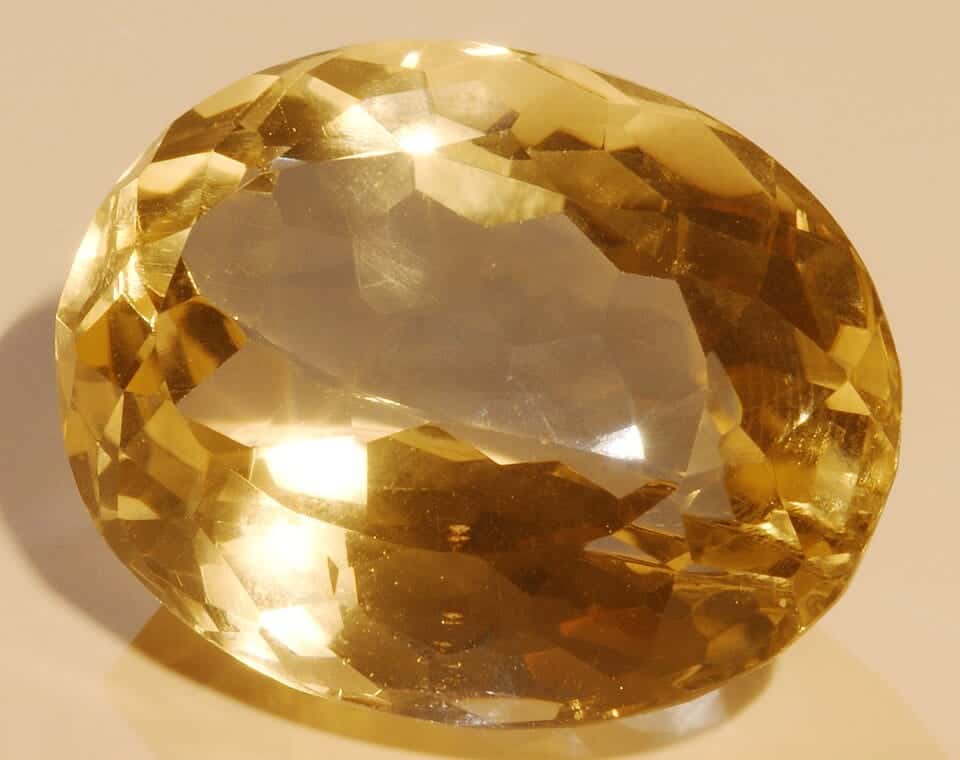
Citrine is the golden-to-amber variety of quartz — a transparent yellow crystal prized for its warm color and, unfortunately, one of the most faked stones on the market. If you are holding a quartz crystal with an even, slightly smoky honey-yellow color that is roughly the same from base to tip, scratches glass, and shows no internal bubbles, you are probably looking at real citrine; if it has a stark white base with abruptly burnt-orange tips, you are almost certainly holding heat-treated amethyst sold under citrine’s name. Natural citrine is genuinely rare, so most “citrine” in shops is heated amethyst — not fake exactly, but not what it claims to be. Here is how to identify citrine, run a few simple at-home checks, and catch the common imposters.
How to Identify Citrine
Because citrine is just iron-bearing quartz that took on (or was heated into) a yellow color, it carries all of quartz’s physical properties — it is hard, has no cleavage, breaks in curved fractures, and grows six-sided crystals. Identifying citrine means pairing those quartz traits with the right color behavior. No single clue is proof, but the combination below is hard to fake.
Color and color zoning
Real natural citrine ranges from pale, smoky champagne-yellow to a soft golden or honey-brown, and the color is usually subtle and fairly even throughout the stone, sometimes with a faint smoky cast. It rarely reaches the vivid, saturated orange most people picture. The single most useful tell is how the color is distributed: natural citrine grades gently or sits evenly across the crystal, while heat-treated amethyst shows a near-colorless or white base that jumps abruptly to intense orange at the tips. If the stone looks like a candy-orange point sitting on a white stub, it was baked, not grown that way.
Crystal shape and clarity
When citrine grows good crystals, they are six-sided (hexagonal) prisms capped by a six-sided pyramid point — the classic quartz habit — with glassy, slightly striated faces. Natural stones usually contain a few internal veils, fractures, or mineral inclusions; a flawless, water-clear “citrine” the size of your fist with perfectly even neon color is a warning sign for glass. Look closely, ideally with a loupe: tiny round bubbles trapped inside mean you are looking at molded glass, because quartz never contains gas bubbles.
Hardness and the quartz tests
Citrine sits at 7 on the Mohs hardness scale, hard enough to scratch glass and resist a steel knife. Drag an inconspicuous edge of the stone across a piece of window glass: real citrine leaves a scratch and comes away unmarked, while glass fakes scratch each other about equally and plastic resin leaves no scratch at all. Citrine also lacks cleavage, so broken surfaces show smooth, curved, shell-like (conchoidal) fractures rather than flat planes. And like all quartz, it feels cool to the touch and warms slowly — glass warms faster in the hand.
Where real citrine comes from
Natural citrine is genuinely scarce. Most of it comes from a handful of deposits in Brazil, Madagascar, and parts of Africa and Russia, and even there it is far less common than amethyst or clear quartz. That rarity is exactly why so much “citrine” on the market is heat-treated amethyst: sellers discovered long ago that baking cheap amethyst turns it yellow-orange. Knowing this flips the usual question around — with citrine, the realistic goal is not spotting outright fakes so much as telling natural citrine from heated amethyst, both of which are real quartz.
Quick checks
- Color: natural citrine is a soft, fairly even smoky-yellow to honey-gold, not a vivid candy orange.
- Color transition: a white or clear base with abruptly burnt-orange tips means heat-treated amethyst, not natural citrine.
- Bubbles: look with a loupe — trapped round bubbles mean molded glass, never quartz.
- Hardness: a 7-hardness stone scratches glass and is not scratched by a steel blade.
- Fracture and feel: curved, glassy fractures and a cool touch point to real quartz; flat cleavage planes or a quick-warming feel suggest a fake.
Try Spotter free on iPhone or Android
Plants, animals, fungi and rocks from one photo. 5 free identifications every day, no card required.


Real Citrine vs. Heat-Treated Amethyst and Fakes
Several different things get sold as citrine. Here is how to tell them apart:
- Natural citrine — real quartz colored by traces of iron over geologic time; soft, even smoky-yellow to golden color with subtle zoning, genuinely uncommon and usually priced accordingly.
- Heat-treated amethyst — also real quartz, but amethyst baked in a kiln until the iron turns yellow-orange; betrayed by a white or clear base, sharply concentrated orange tips, and an overly bright, uniform orange body. Not a scam when sold honestly, but it is not natural citrine.
- Dyed or coated quartz — clear or milky quartz with a surface dye or coating; the color pools in cracks and rubs off at edges, and the hue often looks flat and painted-on.
- Glass — molded yellow glass with no true crystal faces, rounded edges, trapped bubbles, and a warmer feel; it scratches about as easily as it scratches back.
- Other yellow stones — topaz, yellow sapphire, and even some calcite get confused with citrine; hardness, crystal shape, and cleavage separate them from quartz.
Why Getting It Right Matters
Citrine is one of the most popular stones in jewelry and crystal shops, and the line between “natural citrine” and “heated amethyst” drives a real difference in price and, for collectors, in authenticity. You will not hurt yourself with a mislabeled stone — this is about not overpaying and knowing what you actually own. If you are buying citrine specifically because it is natural, ask directly whether it was heat-treated, and look for the even, smoky-gold color rather than the bright orange that screams kiln. Photographing a crystal next to a known quartz point, or snapping it with Spotter, can help you narrow down what you are holding before you pay a premium.
Frequently Asked Questions
Is most citrine actually heated amethyst?
Yes. Natural citrine is rare, so the large majority of bright-orange “citrine” sold today is amethyst that has been heat-treated to turn yellow-orange. It is still genuine quartz, but it is not natural citrine, and the giveaway is the white base with sharply orange tips.
What color is real citrine?
Natural citrine is usually a pale to medium smoky-yellow, champagne, or honey-gold, often with a slightly smoky tint and fairly even color throughout. The intense, saturated orange most people associate with citrine almost always comes from heat treatment.
How can I test citrine at home?
Check hardness (it should scratch glass and resist a steel blade), look for trapped bubbles with a loupe (bubbles mean glass), and examine the color transition (an abrupt white-to-orange jump means heated amethyst). None of these harm the stone when done carefully on an inconspicuous spot.
Is citrine the same as smoky quartz or topaz?
Citrine, smoky quartz, and amethyst are all color varieties of the same mineral — quartz — differing only in trace elements and natural irradiation. Topaz is a completely different mineral that is harder (8 on the Mohs scale) and has cleavage, which quartz lacks.
Try Spotter free on iPhone or Android
Plants, animals, fungi and rocks from one photo. 5 free identifications every day, no card required.