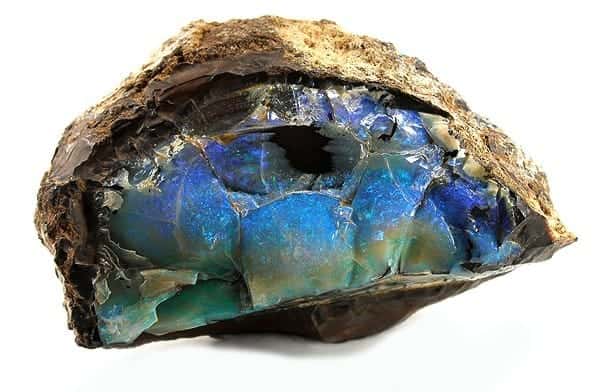
To identify an opal, look for a translucent-to-milky stone that flashes bursts of rainbow color — fire that seems to float inside the stone and shift as you tilt it. That shifting internal rainbow, called play-of-color, is the single defining feature of precious opal and the thing no ordinary rock or simple glass bead can fake convincingly. A real opal also feels smooth and slightly waxy, is fairly soft (it scratches more easily than quartz), and is surprisingly light in the hand. If your stone shows dancing patches of color that change with the angle of light, you are very likely holding an opal. Here is how to confirm it and sort a solid natural opal from the doublets, triplets, lab-grown stones, and glass imitations that fill the market.
How to Identify Opal
Opal is hardened silica gel — microscopic spheres of silica packed with water, which is why it can hold up to twenty percent water and behaves unlike any crystal. It forms no crystal faces and has no cleavage; instead it fills cracks and cavities in rock. Identification comes down to the play-of-color, the body color and type, the surface and luster, the hardness, and whether the stone is solid or layered.
Play-of-color (the key test)
Play-of-color is the flashing, shifting rainbow that appears to come from inside the stone — patches of red, green, blue, orange, and violet that move and change as you rotate the opal or move the light. It is caused by light diffracting through the orderly grid of silica spheres, and it is completely different from the surface sheen of an ordinary polished rock. Precious opal shows play-of-color; common opal (called "potch") does not and is simply a milky or colored stone. Real play-of-color flashes in distinct patches that break up and reappear as you tilt the stone; a static, painted-on, or perfectly repeating pattern is a warning sign of an imitation.
Body color and opal type
The background color behind the flashes is the body color, and it defines the opal’s type. White opal has a pale, milky body; black opal has a dark gray-to-black body that makes its colors glow and is the most prized; crystal opal is transparent to translucent with play-of-color floating in clear stone; fire opal is translucent orange to red and may or may not flash; boulder opal is natural opal still attached to its host ironstone, showing a dark rocky backing. Knowing the type helps you judge whether a dark backing is natural (boulder opal) or glued on (a doublet).
Surface, luster, and feel
Polished opal has a smooth, glassy-to-waxy luster and a soft, almost soapy feel, with no visible crystal faces or grainy texture. Rough opal often has a slightly greasy or resinous sheen. Because opal is amorphous, you will never see the flat, mirror-like facets of quartz or the sugary grain of many rocks. Run a fingertip across the surface: smooth and waxy is consistent with opal, while a gritty or painted-feeling surface is not.
Hardness and weight
Opal is soft for a gemstone — only 5.5 to 6.5 on the Mohs scale — so a steel knife or a harder stone can scratch it, and quartz (hardness 7) will scratch opal while opal will not scratch quartz. That softness is also why opal is prone to chips and fine surface cracks. Opal is light, too, with a low specific gravity; a genuine opal feels lighter in the hand than a same-sized piece of glass or agate. Be gentle with any scratch test, try it only on an inconspicuous spot, and skip it entirely on a finished stone, since opal damages easily.
Solid, doublet, or triplet
Much of the "opal" sold cheaply is not a solid stone but a doublet or triplet — a thin slice of real opal glued to a dark backing (doublet), sometimes with a clear quartz or glass cap on top (triplet). Look at the stone from the side: a solid opal shows the same material all the way through, while a doublet or triplet shows a sharp, perfectly straight line where the layers are glued, often above a flat black backing. The join is the giveaway. Doublets and triplets are not fakes exactly — they contain real opal — but they are worth far less than a solid stone and should be sold as what they are.
Quick checks
- Play-of-color: distinct patches of rainbow that shift and break up as you tilt the stone.
- Body color: note whether the background is white, black, clear, or orange — it sets the type.
- Luster: smooth and waxy, with no crystal faces or sugary grain.
- Hardness: soft at 5.5–6.5, so quartz will scratch it and it chips easily.
- Layers: check the side for a glued seam that would mark a doublet or triplet.
Try Spotter free on iPhone or Android
Plants, animals, fungi and rocks from one photo. 5 free identifications every day, no card required.


Real Opal vs. Fakes and Imitations
Several materials are sold as opal or used to imitate it. Here is how to tell them apart:
- Synthetic (lab-grown) opal — real silica opal made in a lab; it shows play-of-color, but often in an unnaturally regular, repeating pattern, sometimes with a tell-tale "chicken-wire" or columnar look under magnification and perfectly even color across the stone.
- Opalite and "sea opal" — milky man-made glass with a bluish glow; it shows a single flat color shift, not true patchy play-of-color, and is harder and heavier than real opal.
- Resin and plastic imitations — very light and warm to the touch, soft enough to scratch with a pin, and often showing trapped bubbles or a painted-looking color layer.
- Foil-backed glass — a glass cabochon with iridescent foil glued behind it; the "fire" sits in one flat plane behind the glass rather than floating in three dimensions.
- Doublets and triplets — genuine opal slices on a dark backing; real opal, but thin and layered, spotted by the straight glue line on the side.
Why Opal Identification Matters
Opal is Australia’s national gemstone and the traditional October birthstone, and a genuine solid black or crystal opal with strong play-of-color can be valuable — which is exactly why imitations and layered stones are so common. Knowing what you have protects you at gem shows, estate sales, and online listings, and it tells you how to care for the stone: because opal is soft and holds water, it can craze or crack if it dries out or is exposed to heat, ultrasonic cleaners, or harsh chemicals, so store it away from extreme dryness and clean it gently with a soft, damp cloth. For anything you suspect is a fine opal, a qualified gemologist or jeweler can confirm the type and whether it is solid, synthetic, or a doublet before money changes hands. Spotter can help you recognize an opal from a photo and point you toward the right next step.
Frequently Asked Questions
How can I tell real opal from fake?
Look for genuine play-of-color — irregular patches of rainbow that shift and disappear as you move the stone — together with a soft, waxy feel and light weight. Perfectly even, repeating color, a flat black backing with a glued seam, visible bubbles, or a stone that feels hard and heavy all point to a synthetic, doublet, or glass imitation.
What is the difference between a solid opal and a doublet?
A solid opal is one piece of natural opal all the way through, so it can be viewed from any angle. A doublet is a thin slice of opal glued onto a dark backing to make the color pop, and a triplet adds a clear protective cap on top. Viewed from the side, doublets and triplets show a straight glue line that a solid stone never has.
Is opalite real opal?
No. Opalite is man-made glass or resin with a milky, bluish glow. It can be pretty, but it shows a single, even color shift rather than the patchy, shifting play-of-color of real opal, and it is harder and heavier than genuine opal.
Why does my opal flash different colors?
The flashes come from play-of-color: opal is built from a microscopic grid of silica spheres, and light bends as it passes through that grid, splitting into colors much as a prism does. The size of the spheres controls which colors you see, while the angle of the light and your viewpoint control when each flash appears.
Try Spotter free on iPhone or Android
Plants, animals, fungi and rocks from one photo. 5 free identifications every day, no card required.