
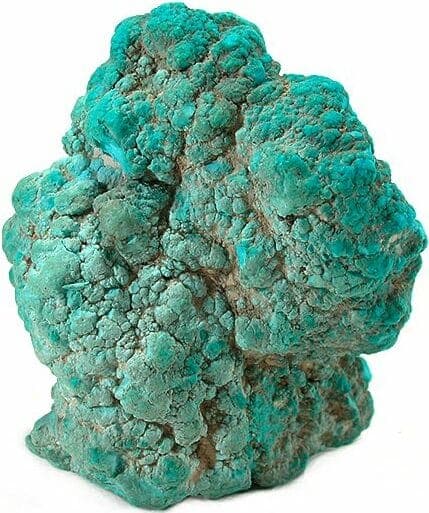
Turquoise is the opaque, sky-blue to blue-green mineral that has been prized for jewelry for thousands of years — and because genuine, untreated turquoise is scarce and valuable, most of the "turquoise" sold today is actually dyed howlite, resin-bound stone dust, or plain plastic. The fastest way to identify real turquoise is to weigh several clues together: a cool, stone-like feel with real heft, a natural web of brown-to-black matrix that looks irregular rather than printed on, a color that varies subtly across the piece, and a hardness that resists a fingernail but is still soft enough to be scratched by a steel blade. No single test is perfect, so the trick is stacking a few of them. Here is how to identify turquoise with simple at-home checks, and how to catch the fakes that fool most buyers.
How to Identify Turquoise
Real turquoise is a hydrated phosphate of copper and aluminum that forms in dry, copper-rich regions. Its best-known traits — that particular robin’s-egg blue, the dark veining, and a waxy-to-dull luster — are exactly the traits imitations try hardest to copy, so learn what the genuine stone looks and feels like first, then use the fakes checklist below to rule out the copies.
Color
Turquoise ranges from a pure, intense sky blue through teal to yellowish and olive green. The blue comes from copper and the greener tones from iron, so color alone tells you little about whether a stone is real — both are natural. What matters is how the color sits in the stone: genuine turquoise usually shows gentle variation, slightly uneven tone, and soft mottling, while the most suspicious pieces are a flat, saturated, perfectly uniform blue with no variation at all. A color that looks almost too vivid and even, like a painted bead, is a warning sign rather than a selling point.
The matrix (the spiderweb veining)
The dark network of lines running through many turquoise stones is called the matrix — remnants of the host rock the turquoise grew in. In natural stones this veining is irregular, varies in width, wanders unpredictably, and often sits slightly below the polished surface. Fakes tend to get this wrong in telltale ways: dyed howlite shows gray-brown veins that are often too bold, too evenly spaced, or dyed a matching color, and printed or resin imitations can show matrix that looks painted on top of the surface or repeats in a pattern. Not all real turquoise has matrix — clean, matrix-free stone exists and is highly valued — but when matrix is present, its natural randomness is one of the better authenticity clues.
Feel, weight, and temperature
Pick the piece up. Real turquoise is a dense mineral that feels cool to the touch and stays cool for a moment against your skin or lip, and it has a solid, stony heft for its size. Plastic and resin imitations feel noticeably warmer, lighter, and sometimes slightly greasy, and they warm up almost instantly in your hand. This simple heft-and-temperature check will not separate turquoise from other stones, but it quickly flags the cheapest plastic fakes.
Luster and surface
Polished turquoise has a soft, waxy to subdued glassy luster rather than the bright mirror shine of glass or the slick gloss of plastic. Under a loupe, natural turquoise often shows tiny pits, a faintly granular texture, and small natural flaws. Molded imitations may reveal mold seams, rounded air bubbles trapped under the surface, or a suspiciously flawless finish — none of which belong on a natural stone.
Hardness
Turquoise sits at about 5 to 6 on the Mohs hardness scale — hard enough that a fingernail (2.5) or a copper coin (3.5) will not mark it, but soft enough that a steel knife blade (around 5.5) can leave a faint scratch. That middle hardness is useful: dyed howlite and magnesite are softer (about 3.5) and scratch far too easily, while glass and many other blue minerals are harder and resist a blade entirely. Because any scratch test damages the stone, only ever try it on an inconspicuous back edge, and never on finished jewelry you care about.
Try Spotter Free on iOS & Android
Plants, animals, fungi, and rocks — all from a photo. 5 free identifications every day, no credit card required.
Real Turquoise vs. the Common Fakes
Most "turquoise" on the market is some form of imitation or heavy treatment. These are the ones you will run into most often:
- Dyed howlite or magnesite — the single most common fake. Both are naturally white, porous stones with gray veining that take blue dye beautifully, producing convincing beads. Tells: the dye often pools darker in cracks, the stone is noticeably soft (scratches with a steel pin), and a cotton swab dipped in acetone or nail-polish remover may pick up blue color.
- Reconstituted or "block" turquoise — real turquoise ground to powder, dyed, and bound with resin into a solid block that is then cut. It contains genuine turquoise but behaves like plastic: unnaturally uniform color, no real matrix, and a warmer, lighter feel.
- Stabilized turquoise — genuine but soft, low-grade turquoise impregnated with clear resin to harden it and deepen the color. This is still real turquoise and is extremely common and accepted in jewelry; it simply is not "natural" untreated stone, which matters for value.
- Plastic, resin, or glass imitations — fully synthetic. Look for air bubbles, mold seams, a warm light feel, and a glassy shine that is either too bright (glass) or too plasticky.
- Other natural blue-green stones sold as turquoise — chrysocolla, variscite, larimar, and dyed chalcedony can all be mistaken for it. These are real minerals in their own right but are not turquoise and differ in hardness and pattern.
A Safe Step-by-Step Check
Work from least to most invasive, stopping as soon as something gives the stone away:
- 1Heft and temperature: hold it. Light and warm points to plastic; cool and dense is consistent with stone.
- 2Look closely, ideally with a loupe: judge the color variation and whether any matrix looks natural and random or bold, even, and printed.
- 3Check for bubbles and seams, which betray molded resin or glass.
- 4Acetone swab on a hidden spot: if blue transfers to the cotton, the stone is dyed (very likely dyed howlite).
- 5Only if you own the piece and accept the risk, test hardness on a hidden back edge — a stone that scratches with a pin is too soft to be turquoise, while one a steel blade cannot mark at all may be glass or another mineral.
Avoid the "hot needle" test you will see online, which involves touching heated metal to the stone to smell for melting plastic. It permanently scars genuine stone and dye alike and tells you little that the gentler checks above do not.
Treated, Stabilized, and Natural: What the Terms Mean
Because most mined turquoise is too soft or chalky to cut as-is, the market is full of treated material, and the labels matter. "Natural" turquoise is untreated and the most valuable. "Stabilized" turquoise is real stone hardened with resin — the most common jewelry grade and perfectly legitimate as long as it is disclosed. "Reconstituted" or "block" turquoise is powdered stone reassembled with binder, and "imitation" means it contains no turquoise at all. None of these is necessarily a scam; the problem is only when a treated or imitation stone is sold as rare natural turquoise at a natural-turquoise price.
Frequently Asked Questions
Does real turquoise scratch glass?
No, not reliably. Turquoise is about 5 to 6 on the Mohs scale and glass is around 5.5, so genuine turquoise will not cleanly scratch glass the way harder stones like quartz or amethyst do. A stone that easily gouges glass is more likely a harder imitation than turquoise.
How can I tell turquoise from dyed howlite?
Howlite is much softer and scratches easily, its dye often pools darker inside cracks, and a cotton swab with acetone may lift blue color off the surface. Natural turquoise resists a fingernail, holds its color under acetone, and shows more subtle, varied coloring.
Is stabilized turquoise real turquoise?
Yes. Stabilized turquoise is genuine turquoise that has been impregnated with clear resin to harden it and bring out the color. It is real stone and completely standard in jewelry — it is simply not untreated "natural" turquoise, which is rarer and more valuable.
Why is real turquoise so expensive?
High-grade natural turquoise is scarce, many historic mines are exhausted, and only a small fraction of mined material is hard and colorful enough to cut without treatment. That rarity, combined with strong demand for Southwestern and Native American jewelry, keeps prices for fine natural stone high.
Not sure whether the blue stone in your hand is turquoise, dyed howlite, or something else entirely? Snap a photo and let Spotter help you identify the rock or mineral as a starting point, then confirm it with the feel, the matrix, and a careful look for dye.
Try Spotter Free on iOS & Android
Plants, animals, fungi, and rocks — all from a photo. 5 free identifications every day, no credit card required.