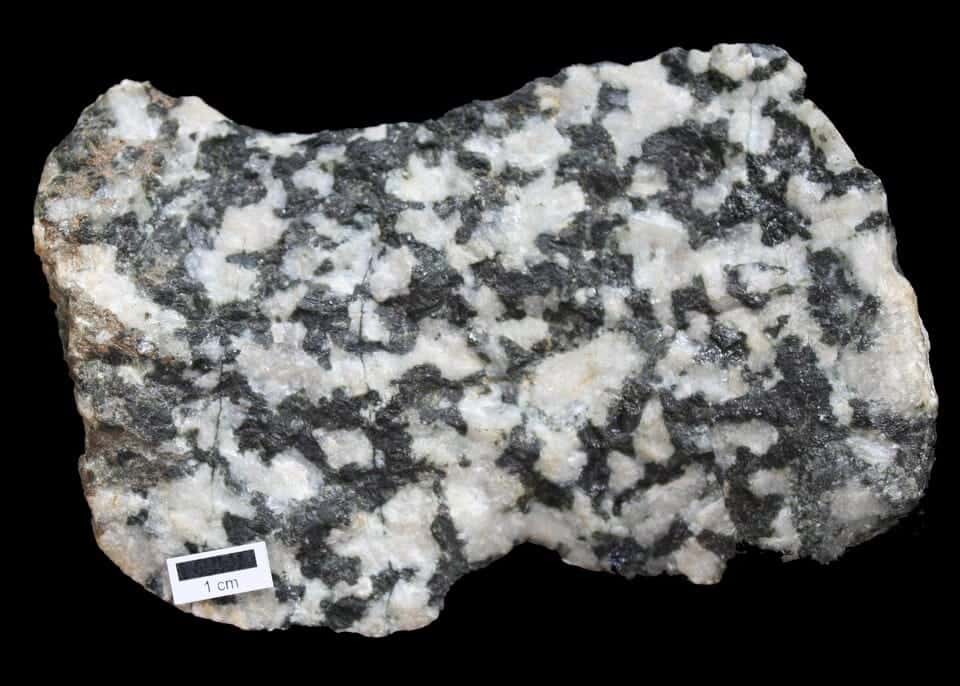
Diorite is a coarse-grained igneous rock with a speckled black-and-white, salt-and-pepper look, and you identify it by three things together: crystals large enough to see without a lens, a roughly even mix of white and dark grains, and almost no glassy quartz or pink feldspar. The white grains are sodium-rich plagioclase feldspar, and the black grains are mostly hornblende and biotite. That balanced black-and-white speckle is what sets diorite apart from granite, which is lighter overall and often pink, and from gabbro, which is darker and dominated by black minerals. If your rock is hard, coarse, and reads as about half white and half black with no quartz sparkle, diorite is the leading answer.
How to Identify Diorite
Work through four features: the grain size, the color balance, the quartz, and the feldspar color. Together they separate diorite from the two igneous rocks it is most often mistaken for, granite and gabbro. In October, Spotter identified a water-rounded diorite cobble from a reader photo at 80 percent confidence, and the features the app keyed on were a speckled black-and-white, coarse-grained crystalline texture and a dull gray-green overall tone. That is the classic diorite signature: a stone that looks like coarse salt and pepper, worn smooth by water or ice.
Coarse grain with crystals you can see
Diorite is an intrusive, or plutonic, rock, meaning it crystallized slowly from magma trapped deep underground. The U.S. Geological Survey explains that this slow cooling gives mineral grains time to grow large, producing a coarse-grained texture. In diorite the crystals are easily visible to the naked eye, often a few millimeters across, and packed together with no gaps. If instead the rock is so fine-grained that you see no individual crystals at all, you are probably looking at andesite, the fast-cooled volcanic rock that shares diorite’s composition but forms at the surface.
A balanced black-and-white color
Diorite has an intermediate color index, which is the geologist’s way of saying the light and dark minerals are present in roughly equal amounts. The pale plagioclase and the black hornblende and biotite give the stone its signature salt-and-pepper speckle, with neither color clearly winning. This is the single most useful field mark. Granite reads much lighter overall because pale quartz and feldspar dominate, while gabbro reads much darker because black minerals take over. A rock that looks genuinely half-and-half, like static on an old television, points straight at diorite.
Little or no quartz
Quartz makes up less than about 5 percent of diorite, so you will not see the glassy, gray, translucent grains that stand out in granite. Granite typically carries 20 percent or more quartz, and those grains catch the light with a wet, glassy sheen even on a dull-looking rock. Hunt across the surface for that sparkle. If clear or smoky glassy grains are a major part of the rock, lean toward granite or granodiorite; if the rock is all opaque white and black with no glassy quartz at all, diorite fits better.
White-to-gray feldspar, not pink
The feldspar in diorite is sodium-rich plagioclase, which is white to light gray, sometimes with a faint greenish cast. Diorite holds essentially none of the potassium feldspar that colors many granites pink, salmon, or red. Pink in the rock is a strong vote for granite, not diorite. Look at the pale grains in good light: chalky white to gray supports diorite, while blocky pink or peach crystals push the answer toward granite. You can see that pink-feldspar case in how to identify granite.
Where you found it
Diorite forms in large underground bodies beneath volcanic mountain belts, and it turns up in road cuts and bedrock across those regions. In the glaciated Midwest and Great Lakes, you are far more likely to meet diorite as a rounded cobble than as bedrock, because Ice Age glaciers carried igneous stones south from the Canadian Shield and dropped them in gravel, fields, and along lake and river shores. That is exactly how the Spotter cobble above arrived: tumbled smooth by water and ice, far from where it first crystallized. For the broader family of igneous and metamorphic stones these erratics travel with, compare the banded look of how to identify gneiss.
Diorite vs. Granite vs. Gabbro
Diorite sits between granite and gabbro on the igneous scale, so it shares the same coarse, crystalline, unlayered look and gets confused with both. They differ mainly in overall color, how much quartz they carry, and the color of their feldspar. The table sorts them by marks you can judge by eye.
| Rock | Overall color | Quartz | Feldspar color | Quick tell |
|---|---|---|---|---|
| Diorite | Even black-and-white | Little to none (under ~5%) | White to gray, never pink | Balanced salt-and-pepper, no glassy quartz |
| Granite | Light: white, gray, or pink | Plenty (~20%+), glassy and gray | Often pink or salmon | Pale overall, sparkling quartz, frequently pink |
| Gabbro | Dark, mostly black | Little to none | Gray, greenish, calcium-rich | Dark and heavy, little white showing |
The boundary between diorite and gabbro comes down to the feldspar chemistry: diorite’s plagioclase is sodium-rich, while gabbro’s is calcium-rich, and gabbro carries enough dark minerals to look nearly black. By eye, the simplest version is that diorite is about half white and gabbro is mostly dark. On the other side, geology.com notes that diorite usually contains little if any quartz, which is what divides it from the quartz-rich granite family. Rocks that fall in between, such as granodiorite and tonalite, carry intermediate amounts of quartz and shade from one name to the next.
Frequently Asked Questions
Is diorite the same as granite?
No. The stone trade often sells diorite and gabbro as "black granite" for countertops, but geologically they are different rocks. True granite is a light-colored, quartz-rich rock, usually with pink or white feldspar, while diorite has little quartz, no pink feldspar, and a balanced black-and-white color. The commercial label is about appearance and durability, not geology.
What is the difference between diorite and andesite?
They have the same composition but cooled at different speeds. Diorite crystallized slowly deep underground, so its crystals are coarse and easy to see. Andesite is the volcanic version of the same magma, erupted and cooled quickly at the surface, so it is fine-grained with few or no crystals visible to the eye. Coarse and speckled points to diorite; smooth and gray-green with no visible grains points to andesite.
How can I tell diorite from gabbro?
Judge the color balance first. Diorite looks about half white and half black, while gabbro is distinctly dark, mostly black with only a little pale material. The underlying reason is the feldspar: diorite’s plagioclase is sodium-rich and paler, gabbro’s is calcium-rich, and gabbro also carries more dark pyroxene. If the rock reads as genuinely balanced salt-and-pepper, it is diorite; if it reads as dark with flecks of gray, it is gabbro.
Is diorite a hard rock?
Yes. Diorite is a tough, dense rock, which is why it has been used for durable building stone, paving, and polished countertops, and why ancient sculptors in Mesopotamia and Egypt prized it for statues that have survived thousands of years. Its hardness and lack of layering mean it resists both weathering and splitting, so cobbles of it round off smoothly rather than flaking apart.
Found a speckled black-and-white cobble and not sure whether it is diorite or granite? Look for the quartz sparkle and any pink in the feldspar: diorite has neither. For the wider family of stones it travels with, see our guide to common rocks and minerals, or start on the rock identifier page. Spotter can give you a first read from a photo.
Try Spotter free on iPhone or Android
Plants, animals, fungi and rocks from one photo. 5 free identifications every day, no card required.