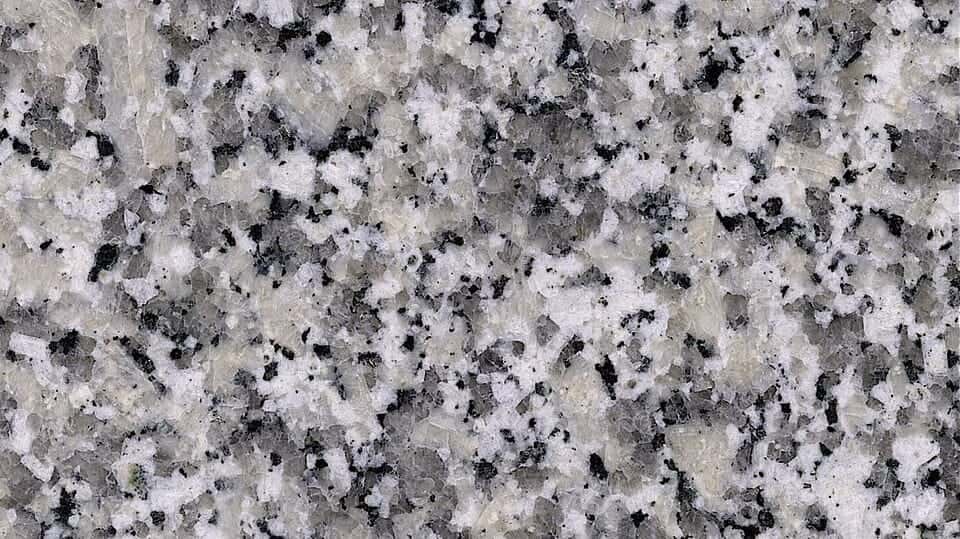
To identify granite, look for a hard, coarse-grained rock speckled with large, interlocking crystals you can see with the naked eye — usually a salt-and-pepper mix of glassy gray quartz, blocky white-to-pink feldspar, and flecks of dark, shiny mica. Granite is a light-colored igneous rock with no layering, no banding, and no fossils; the crystals are roughly equal in size and packed tightly together with no gaps. If your rock is speckled with visible, randomly arranged crystals, feels very hard, and scratches glass, it is almost certainly granite or a close granite relative. Here is how to confirm it and tell it from the rocks it is most often confused with.
How to Identify Granite
Granite forms deep underground when a body of molten rock cools slowly over thousands of years, giving its crystals time to grow large enough to see — a texture geologists call phaneritic. That slow-grown, visibly crystalline, speckled look is the heart of granite identification. Work through the grain, the minerals, the color, and the hardness, and granite separates cleanly from most other rocks.
Grain and texture
The first thing to check is grain size. Granite is coarse-grained: the individual mineral crystals are large enough to see and name without a lens, typically a few millimeters to a centimeter across, and they interlock tightly like a three-dimensional jigsaw with no cement or gaps between them. There is no layering, no banding, no stripes, and no visible fossils or rounded sand grains — just a jumble of randomly oriented crystals. If you need a magnifier to see any grains at all, or if the rock is smooth and glassy with no visible crystals, it is not granite.
The three key minerals
Granite is defined by its mineral mix, and you can usually spot all three. Quartz shows up as glassy, translucent, gray-to-clear grains with no flat faces, often looking slightly greasy. Feldspar is the most abundant mineral and appears as blocky, opaque crystals — milky white, cream, or salmon pink — with flat, reflective faces that catch the light when you tilt the rock. Mica forms small, dark or silvery flakes that glint and can be peeled off with a fingernail. Darker needle-like amphibole crystals are often mixed in too. Quartz plus feldspar plus mica, all visible and interlocked, is the granite signature.
Color
Granite is a light- to medium-toned rock overall, even though it is peppered with dark specks. The background is dominated by pale feldspar and quartz, so most granite reads as white, pale gray, pink, or salmon with scattered black and gray flecks — the classic salt-and-pepper countertop look. The exact color depends on the feldspar: pink or red feldspar gives pink granite, while white or gray feldspar gives gray granite. A rock that is uniformly dark, almost black, with little pale material is probably a related but different igneous rock such as gabbro or basalt, not true granite.
Hardness and heft
Granite is hard — about 6 to 7 on the Mohs scale, thanks to all that quartz and feldspar. A steel knife blade or nail will not scratch it, and a sharp corner of the rock will scratch glass. It is also dense and solid, and it does not fizz in vinegar or weak acid (that fizz is the test for limestone and marble, which granite is sometimes confused with). If your rock is soft enough to scratch with a knife, crumbles easily, or fizzes in acid, it is not granite. Keep any acid testing to household vinegar on a small, hidden spot, and keep it off your skin and eyes.
Granite vs. Other Rocks It Is Confused With
A handful of rocks look granite-like at a glance. Here is how to tell them apart:
- Marble — smooth and sugary rather than speckled with separate crystals, usually white, gray, or veined; much softer (a knife scratches it) and it fizzes in acid, while granite does neither.
- Gabbro and basalt — also igneous but mafic, meaning dark and iron-rich; gabbro is coarse and nearly black with little pale feldspar, and basalt is fine-grained with no visible crystals at all.
- Gneiss — a metamorphic rock made of the same minerals as granite but with them stretched into obvious light-and-dark bands or stripes; granite crystals are randomly scattered, never banded.
- Quartzite — hard like granite but made almost entirely of fused quartz, with a uniform, sugary, glassy texture rather than a mix of distinct mineral colors.
- Diorite — a close relative with the same coarse texture but more evenly black-and-white, with less quartz and no pink; the line between a light diorite and a dark granite is genuinely fuzzy.
- Sandstone and concrete — made of rounded, cemented grains rather than interlocking crystals; sandstone is softer and often layered, and concrete contains obvious gravel chunks set in a gray paste.
Why Granite Identification Matters
Granite is one of the most common and useful rocks on Earth — it makes up much of the continental crust, forms the cores of mountain ranges like the Sierra Nevada, and is quarried everywhere for countertops, curbstones, monuments, and building facades. Learning to recognize it is a foundation of rock identification, because granite is the reference point so many other rocks are compared against. For rockhounds it also signals what else might be nearby: granite country often hosts quartz veins, feldspar and mica crystals, and sometimes gemstones like garnet, tourmaline, and beryl in associated pegmatites. Collecting loose rocks on public land is usually fine, but always check local rules and never hammer on private property, protected sites, or road cuts without permission.
Frequently Asked Questions
Is granite igneous, sedimentary, or metamorphic?
Granite is an intrusive igneous rock — it crystallized from molten magma that cooled slowly deep underground. That slow cooling is what allowed its crystals to grow large enough to see, unlike fast-cooling volcanic rocks such as basalt.
How can I tell granite from quartz?
Quartz is a single mineral — glassy, translucent, and uniform — while granite is a rock made of several minerals, including quartz, feldspar, and mica mixed together. If you see different-colored crystals interlocked in one piece, it is granite; if the whole piece is one clear-to-milky glassy material, it is quartz.
Does real granite scratch glass?
Yes. Granite quartz and feldspar put it at 6 to 7 on the Mohs scale, hard enough that a corner of the rock will scratch a glass bottle, and a steel knife will not scratch the rock back. A piece that a knife cuts easily, or that fizzes in vinegar, is a softer rock like marble or limestone.
What is the difference between granite and marble?
Granite is a hard, speckled igneous rock full of visible quartz, feldspar, and mica crystals, while marble is a softer metamorphic rock made of recrystallized calcite, usually smooth and veined rather than speckled. Marble fizzes in acid and scratches with a knife; granite does neither.
Try Spotter free on iPhone or Android
Plants, animals, fungi and rocks from one photo. 5 free identifications every day, no card required.