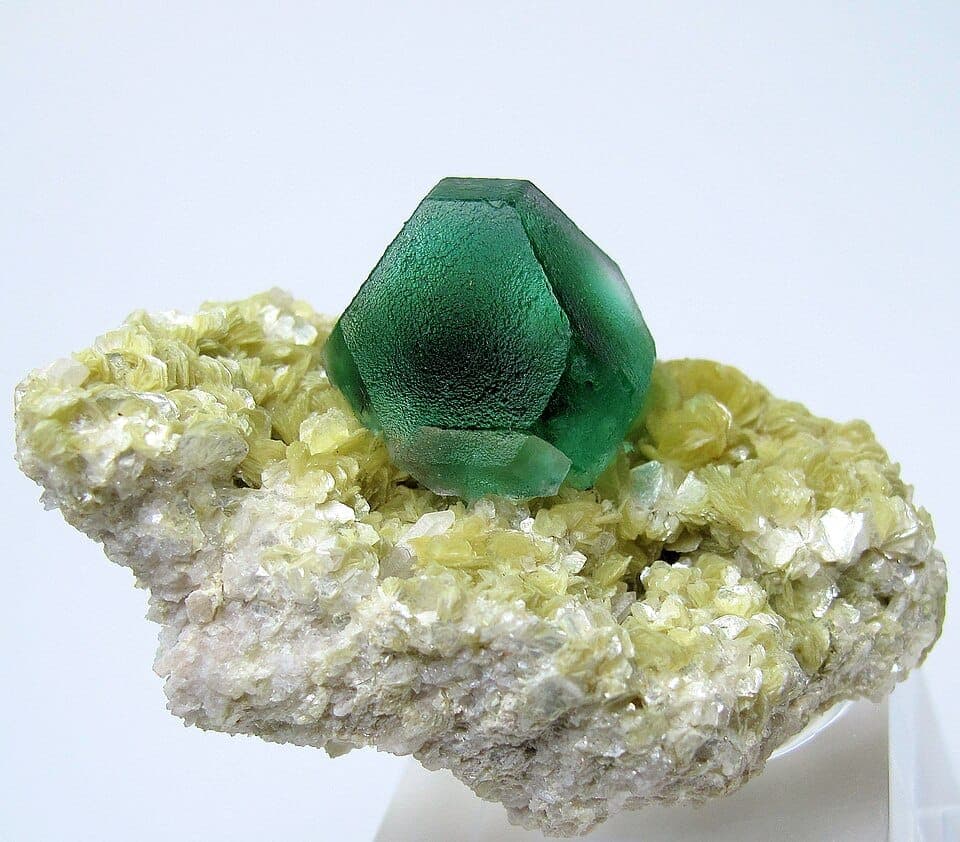
Fluorite is one of the easiest colorful minerals to recognize once you know its three signatures: glassy, cube-shaped crystals, an enormous range of colors — purple, green, blue, yellow, and clear, often banded together in one piece — and a softness that lets a steel knife scratch it easily. It is calcium fluoride, a common mineral that rockhounds and collectors prize for its clean geometric crystals and its habit of glowing under ultraviolet light (the word "fluorescence" is named after it). The catch is that fluorite’s beautiful colors are also easy to imitate with dyed glass and other minerals, so identifying it means checking crystal shape, hardness, and cleavage rather than trusting color alone. Here is how to do it.
How to Identify Fluorite
No single feature proves a mineral is fluorite, but the combination below is distinctive. Work through color, crystal shape, hardness, and cleavage, and genuine fluorite stands out quickly.
Color
Fluorite is famous for color. It occurs in nearly every hue — deep purple and violet are the most iconic, but green, blue, yellow, golden, pink, colorless, and even near-black all occur, and a single specimen often shows several colors in bands, zones, or cubes within cubes. Many pieces are also strikingly transparent to translucent. This rainbow range is a clue, but because so many minerals and dyed-glass fakes share these colors, color alone can never confirm fluorite — it only puts it on the list.
Crystal shape — cubes and octahedrons
When fluorite forms good crystals, they are unmistakable: sharp-edged cubes, often intergrown into blocky clusters, and sometimes eight-sided octahedrons (two pyramids set base to base). Perfect glassy cubes with crisp straight edges, especially purple or green ones, are a strong sign of fluorite — few other common minerals grow neat cubes, and the one that does, pyrite, is hard, brassy, and metallic rather than soft and glassy. If your piece shows no crystal faces at all, you will lean more heavily on the hardness and cleavage tests below.
Hardness — a soft 4 on the Mohs scale
Fluorite sits right at 4 on the 1-to-10 Mohs hardness scale, which is its most useful diagnostic property — it even defines that point on the scale. That means a steel knife or nail (hardness about 5 to 6.5) scratches fluorite easily, but fluorite will not scratch glass (about 5.5). This is the opposite of quartz and most quartz look-alikes, which are harder than glass and cannot be scratched by a knife. If a purple "amethyst" crystal scratches with a knife and refuses to scratch a glass bottle, you are probably holding fluorite, not quartz.
Cleavage and luster
Fluorite has perfect octahedral cleavage, meaning it breaks cleanly along four directions to produce flat, triangular faces and perfect octahedron-shaped fragments. You can often see these smooth cleavage planes glinting inside or at the corners of a broken piece, and cut fluorite octahedrons are sold specifically because the mineral splits so neatly. Its luster is glassy (vitreous), not metallic and not greasy. Quartz, by contrast, has no such cleavage and breaks in curved, shell-like (conchoidal) fractures.
Fluorescence under UV light
Many fluorites glow vividly — often blue, violet, or green — under ultraviolet light, and the phenomenon of fluorescence is literally named after the mineral. That makes a UV flashlight a fun confirmation. Be careful, though: not all natural fluorite fluoresces, and plenty of other minerals and even some fakes glow too, so a lack of glow does not rule fluorite out, and a glow by itself does not prove it. Treat fluorescence as a bonus clue, not a stand-alone test.
Try Spotter Free on iOS & Android
Plants, animals, fungi, and rocks — all from a photo. 5 free identifications every day, no credit card required.
Quick Tests, in Order
Think you have fluorite? Run down this list — most people can decide after the scratch test.
- 1Look for crystal shape. Glassy cubes or octahedrons with sharp, straight edges strongly suggest fluorite; metallic cubes suggest pyrite instead.
- 2Check color and banding. Purple, green, blue, or yellow — especially several colors banded in one piece — fits fluorite, but is not proof on its own.
- 3Try to scratch glass. Fluorite (hardness 4) will NOT scratch a glass bottle. If your sample scratches glass easily, it is harder than fluorite — likely quartz or a glass fake.
- 4Scratch it with a steel knife or nail. Fluorite scratches easily under steel. If steel cannot mark it, the sample is too hard to be fluorite.
- 5Look for cleavage. Flat triangular faces and clean octahedral breaks inside the stone point to fluorite; curved, shell-like fractures point to quartz or glass.
Fluorite vs. Common Look-Alikes
A few materials fool people most often:
- Quartz and amethyst — look similar in purple and clear forms, but quartz is much harder (7), scratches glass, has no cleavage, and breaks in curved fractures. The knife test separates them instantly: a knife scratches fluorite but not quartz.
- Dyed glass and resin "crystals" — sold as tumbled stones and carvings; glass often shows swirl lines, trapped air bubbles, and a curved fracture, feels warmer to the touch, and lacks true cubic crystal faces and cleavage.
- Calcite — also soft and sometimes colorful, but calcite is hardness 3, fizzes in a drop of weak acid such as vinegar, and cleaves into tilted rhombs rather than octahedrons; fluorite does not fizz.
- Apatite — can mimic fluorite’s colors and is close in hardness (5), but apatite is slightly harder, lacks fluorite’s perfect octahedral cleavage, and tends to form hexagonal (six-sided) crystals rather than cubes.
Is Fluorite Valuable — and Is It Safe to Handle?
Fluorite is a popular and affordable collector’s mineral; fine, richly colored, well-formed crystals and classic specimens (such as banded "Blue John" fluorite) can be genuinely sought after, but most pieces are modestly priced. Because it is soft and has perfect cleavage, fluorite is fragile — it chips, scratches, and cleaves easily, so it needs more careful handling and storage than quartz. The solid mineral is safe to hold and display; just wash your hands afterward, do not lick or taste specimens to test them, and skip any acid tests you are not trained to do. The old habit of "tongue-testing" minerals is never worth the risk.
Frequently Asked Questions
What is the easiest way to identify fluorite?
Combine the scratch test with crystal shape. Fluorite is soft enough that a steel knife scratches it, yet it will not scratch glass, and it often grows glassy cubes or octahedrons in purple, green, or blue. That softness plus cubic crystals separates it from the harder quartz it is most often confused with.
Does real fluorite glow under UV light?
Often, but not always. Many fluorites fluoresce blue or violet under ultraviolet light — fluorescence is named after the mineral — but some natural fluorite does not glow at all, and other materials can glow too. Use UV as a supporting clue, not the only test.
How can I tell fluorite from amethyst or quartz?
Hardness. Amethyst and other quartz are hardness 7 and will scratch glass while resisting a knife, whereas fluorite is hardness 4, so a knife scratches it and it cannot scratch glass. Fluorite also shows flat octahedral cleavage faces, while quartz breaks in curved, shell-like fractures.
Is fluorite dangerous to have around?
Solid fluorite specimens are safe to display and handle. The mineral is calcium fluoride, which is stable as a crystal; just avoid grinding it into dust, do not lick or ingest it, and wash your hands after handling, as with any mineral.
Not sure whether the colorful, glassy crystal in your hand is fluorite, quartz, or dyed glass? Snap a photo and let Spotter help you identify the rock or mineral as a starting point — then confirm it with a quick scratch and cleavage check.
Try Spotter Free on iOS & Android
Plants, animals, fungi, and rocks — all from a photo. 5 free identifications every day, no credit card required.