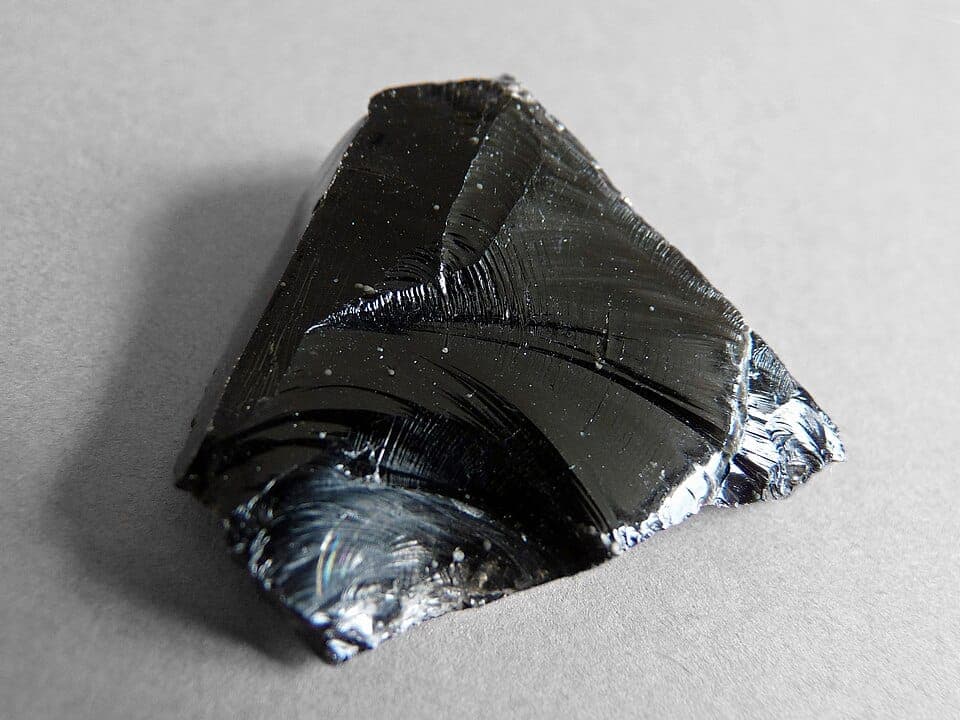
The fastest way to identify obsidian is by its look and its break: obsidian is natural volcanic glass, so it is usually a glossy, jet-black stone (sometimes brown, gray, or with a colored sheen) that shines like thick bottle glass and breaks into curved, shell-shaped chips with razor-sharp edges. It has no crystals, no grain, and no layers — just a uniform glassy body that may show a few frozen bubbles or swirls inside when you hold it to the light. Those traits, plus a hardness of about 5 to 5.5 on the Mohs scale, separate real obsidian from ordinary black rocks and from the manmade glass it is most often confused with. Here is how to identify obsidian for certain and tell the real thing from a fake.
How to Identify Obsidian
Obsidian is not a mineral with a crystal structure — it is a glass, formed when lava cools so fast that atoms never line up into crystals. That single fact drives every field mark: it breaks like glass, shines like glass, and has no grain, layers, or sparkle of individual crystals. Work through its color and luster, the way it fractures, its hardness, and what you can see frozen inside, and obsidian is one of the easiest natural materials to recognize.
Color and luster
Most obsidian is a deep, glossy black, but it also comes in dark brown, smoky gray, and green, and some pieces throw a colored sheen. The luster is the giveaway — a bright, wet-looking glassy shine, exactly like a chunk of thick bottle glass, not the dull or grainy surface of ordinary dark rocks like basalt. Turn a thin edge to the light and true obsidian is often faintly translucent, glowing at the margins even when the body looks jet black.
Conchoidal fracture and razor edges
When obsidian breaks, it does not split along flat faces or crumble into grains. It fractures in smooth, curved, scoop-shaped surfaces — called conchoidal fracture, like the inside of a clamshell or the dish left when a BB hits a window — and those breaks leave edges sharper than surgical steel. Ancient people knapped obsidian into blades and arrowheads for exactly this reason. If a black stone breaks into curved, glassy flakes with wickedly sharp edges, it is almost certainly obsidian (or manmade glass).
Hardness and the scratch test
Obsidian sits at about 5 to 5.5 on the Mohs hardness scale. A steel knife blade or a hardened nail (roughly 5.5) will barely scratch it, and it resists a copper coin or fingernail easily. But it is more brittle than the quartz-family stones like agate and jasper, which are harder (about 7) and will scratch obsidian, not the other way around. A stone that a knife gouges easily is too soft to be obsidian.
Bubbles, swirls, and sheen inside
Because it froze from flowing lava, real obsidian often traps evidence of that motion: irregular gas bubbles, wispy swirls or flow bands, and clusters of tiny crystallites. "Snowflake obsidian" is peppered with pale, snowflake-like spots; "rainbow" and "sheen" obsidian throw a gold, silver, or multicolored glow from microscopic mineral layers when tilted in the light. These natural, slightly irregular inclusions are one of the best ways to separate real obsidian from flawless manmade glass.
Where obsidian forms and is found
Obsidian forms only where thick, silica-rich lava cooled quickly, so it is tied to volcanic regions — in the U.S. that means the West: Oregon, California, Idaho, Nevada, Wyoming, Arizona, and New Mexico. You will not find it weathering out of the sedimentary rock of the Midwest or East. Loose pieces turn up in volcanic gravels, on desert flats, and along streams draining old lava flows. If someone reports "obsidian" far from any volcanic source, it is worth a second, skeptical look.
Try Spotter Free on iOS & Android
Plants, animals, fungi, and rocks — all from a photo. 5 free identifications every day, no credit card required.
Obsidian vs. Look-Alikes and Fakes
Several natural rocks and a lot of manmade glass get mistaken for obsidian. Here is how to rule them out:
- Manmade glass (bottle glass, slag glass, glass beads) — the most common fake; it also breaks conchoidally but tends to look too perfect, with uniform color, a mold seam, rows of identical round bubbles, or unnaturally bright colors, while natural obsidian shows irregular bubbles, swirls, and subtle color variation.
- Basalt — the dark volcanic rock obsidian often forms near, but basalt is dull, grainy, and opaque with a rough surface, not glassy, and may show tiny visible crystals or gas holes rather than a smooth shine.
- Jet, hematite, and black tourmaline — jet is much lighter and warmer and scratches easily; hematite is heavier with a reddish-brown streak; tourmaline forms elongated crystals with lengthwise striations rather than a glassy blob.
- Onyx and black agate — these are chalcedony, harder (about 7) with a waxy rather than glassy luster and often faint banding; they will scratch obsidian, not the other way around.
- Apache tears — these are actually obsidian: small, rounded, translucent-brown nodules weathered out of gray perlite, so they pass every obsidian test.
A quick combined check settles most cases: a glassy shine, curved conchoidal breaks with sharp edges, hardness around 5.5 (a knife barely marks it), faint translucence at the edges, and irregular natural bubbles or swirls inside. Hit all of those away from any factory glass, and you have obsidian.
Is Obsidian Dangerous to Handle? Safety First
Obsidian itself is not toxic, but freshly broken or knapped obsidian is genuinely dangerous to handle: its edges can be sharper than a razor and will slice skin under almost no pressure. Pick up broken pieces by a blunt face, keep them away from children and pets that might mouth them, and never run a finger along a fresh break to "test" it. Weathered, tumbled pieces like Apache tears are far safer to hold. If you collect on public or protected land, check the rules first — many volcanic areas and national parks prohibit removing rocks.
Frequently Asked Questions
Is obsidian a rock or a mineral?
Neither in the strict sense — it is a mineraloid. Minerals have an ordered crystal structure, but obsidian is a natural glass with no crystals, formed when lava cools too fast to crystallize. It is usually grouped with the igneous (volcanic) rocks for convenience.
How can I tell obsidian from black glass?
Look for natural irregularity. Manmade glass is often flawless or shows a mold seam and rows of identical bubbles, while real obsidian has irregular bubbles, swirls, faint flow bands, and subtle color variation. Where you found it matters too: natural obsidian turns up in volcanic regions, not embedded in factory-made objects.
Is obsidian valuable?
As a raw stone obsidian is common and inexpensive, especially plain black pieces. Distinctive varieties like snowflake, rainbow, sheen, and mahogany obsidian are more sought after by collectors and lapidaries, but obsidian is prized far more for its beauty and knapping quality than as a high-value gemstone.
Can obsidian scratch glass?
Only barely. Obsidian (about 5 to 5.5 on the Mohs scale) and window glass (about 5.5) are nearly the same hardness, so obsidian may leave a faint mark but will not cut cleanly through glass the way harder quartz stones (about 7) do. That similar hardness is exactly why the two are so easy to confuse.
Found a glossy black stone and not sure if it’s obsidian, basalt, or bottle glass? Snap a photo and let Spotter help you identify it.
Try Spotter Free on iOS & Android
Plants, animals, fungi, and rocks — all from a photo. 5 free identifications every day, no credit card required.