
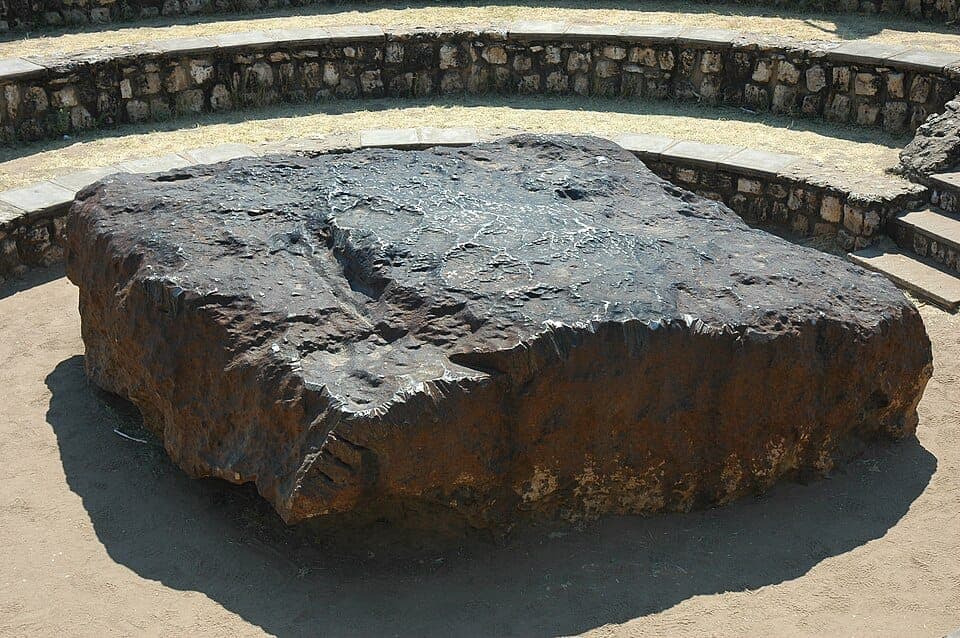
The honest answer is that the great majority of rocks people suspect are meteorites turn out to be ordinary Earth rocks — experts call them “meteorwrongs.” But you can screen a suspect quickly at home: a real meteorite is usually attracted to a strong magnet, feels noticeably heavier than a same-size Earth rock, wears a thin dark “fusion crust” from its fiery fall, and lacks the features that give away common impostors — no bubbly holes, no sparkly quartz crystals, and no layering. If your rock fails these, it is almost certainly terrestrial; if it passes them all, it is worth having a specialist look. Here is how to run each check and read the result.
How to Tell If a Rock Is a Meteorite
No single test proves a meteorite, and no single test rules one out on its own. Run them together — the pattern of results is what matters.
The magnet test
Start here. Almost all meteorites contain metallic iron and nickel, so most are attracted to a strong magnet (a rare-earth magnet works best). If a rock shows no magnetic pull at all, it is very unlikely to be a common meteorite. The catch: plenty of Earth rocks are magnetic too — especially those containing magnetite — so a magnetic rock is a candidate, not a confirmation. And a few genuine meteorites, such as some from the Moon and Mars, are only weakly magnetic or not at all, but those are extraordinarily rare.
Fusion crust
As a meteorite screams through the atmosphere, its surface melts and forms a thin rind called fusion crust — usually dull black to dark brown and only about a millimeter thick, sometimes with a slightly glossy or matte, eggshell-like texture. On a fresh fall it is dark and smooth; older finds weather to rusty brown. The key is contrast: if you can see a broken edge, the interior is typically a different, lighter color than the thin dark skin. A rock that is the same color all the way through, or that has a thick, crumbly, or rusty outer layer, is probably not showing true fusion crust.
Weight and density
Meteorites are dense because of their metal content, so they feel surprisingly heavy for their size. Heft your suspect and compare it against an ordinary rock of similar size: if the candidate is clearly heavier, that is a point in its favor. This is one of the reasons experienced hunters can often “feel” a meteorite — it just weighs more than it looks like it should.
Regmaglypts (“thumbprints”)
Many meteorites carry shallow, rounded depressions across their surface, as if a sculptor pressed thumbs into soft clay. These are called regmaglypts, and they form as superheated air ablates the surface during the fall. Gentle, smooth thumbprint-like dimples are a good sign. Sharp-edged holes, deep pits, or a spongy, bubbly surface point the other way — toward slag or volcanic rock.
The streak test
This one is great at unmasking the two most common impostors. Drag your rock across the unglazed back of a ceramic tile. Magnetite leaves a gray-black streak and hematite leaves a reddish-brown streak — both are magnetic Earth minerals, and a colored streak means you are almost certainly holding one of them, not a meteorite. A genuine meteorite typically leaves little to no streak at all. A rust-red or dark streak is a strong “not a meteorite” signal.
What the inside should look like
If a small edge is already broken or filed, examine the fresh interior with a hand lens. A stony meteorite (the most common kind) often shows tiny specks of shiny metal scattered through the rock and small round grains called chondrules. An iron meteorite is solid metal inside. What you should not see are the sparkly, glassy crystals of quartz, bands or layers, or the frothy holes of lava — those are all hallmarks of Earth rocks. Do not grind or cut a rock you care about; leave any window-cutting to a specialist so a potential specimen is not damaged.
Try Spotter Free on iOS & Android
Plants, animals, fungi, and rocks — all from a photo. 5 free identifications every day, no credit card required.
Meteorwrongs: What It Usually Turns Out to Be
Most suspected meteorites are one of a handful of familiar look-alikes. If your rock matches one of these, it is almost certainly terrestrial:
- Magnetite and hematite — dense, magnetic iron minerals that fool people constantly; the streak test (black or red-brown) gives them away.
- Slag — industrial waste from smelting; heavy and often magnetic, but riddled with gas bubbles and holes that a real meteorite does not have.
- Basalt and other lava rock — dark and sometimes magnetic, but full of small vesicles (bubbles) and lacking metal flakes or fusion crust.
- Ironstone and iron concretions — rounded, rusty, heavy lumps that look otherworldly but are ordinary sedimentary Earth features.
- Pyrite and other sulfides — shiny and metallic-looking, but brittle and often cubic, with a greenish-black streak.
- Man-made metal — shot, ball bearings, and foundry scrap are heavy and magnetic; a perfectly smooth sphere or a machined shape is a person’s work, not the sky’s.
What to Do If You Think You Found One
If your rock passes the magnet, weight, crust, and streak checks, do not stop there — the only way to confirm a meteorite is expert analysis. Photograph it next to a scale bar, note exactly where you found it, and avoid over-cleaning, sanding, or soaking it, which can destroy fusion crust and contaminate the specimen. Then contact a university geology or earth-science department, a natural history museum, or a recognized meteorite lab; many will examine a suspect at no cost or point you to someone who will. Skip acid tests and home chemistry, and be wary of “instant” online appraisals — a proper classification looks at the interior structure and mineral chemistry under a microscope.
Frequently Asked Questions
Are all meteorites magnetic?
Most are, because they contain iron and nickel, so a total lack of magnetic pull is a strong sign a rock is not a meteorite. The rare exceptions are some lunar and Martian meteorites, which are only weakly magnetic — but those are vanishingly uncommon finds.
What does a meteorite look like on the outside?
Freshly fallen meteorites usually have a thin, dull-to-glossy black fusion crust and may show smooth, thumbprint-like dimples called regmaglypts. They rarely have holes or bubbles, and they are not round, shiny, or crystal-covered. Older finds weather to a rusty brown.
Why is my magnetic, heavy rock probably not a meteorite?
Because the most common Earth minerals that mimic meteorites — magnetite and hematite — are also dense and magnetic. The tiebreaker is the streak test: if your rock leaves a black or red-brown streak on unglazed tile, it is one of those minerals, not a meteorite.
Can I confirm a meteorite at home?
No. Home tests can only screen candidates in or out; a genuine confirmation requires a specialist to examine the interior structure and chemistry. If your rock passes every home check, take it to a university or museum rather than trusting a quick online verdict.
Not sure whether that heavy, dark rock is a space traveler or just a handsome Earth stone? Snap a photo and let Spotter help you identify rocks and minerals — and narrow down what you are really holding before you take it to an expert.
Try Spotter Free on iOS & Android
Plants, animals, fungi, and rocks — all from a photo. 5 free identifications every day, no credit card required.