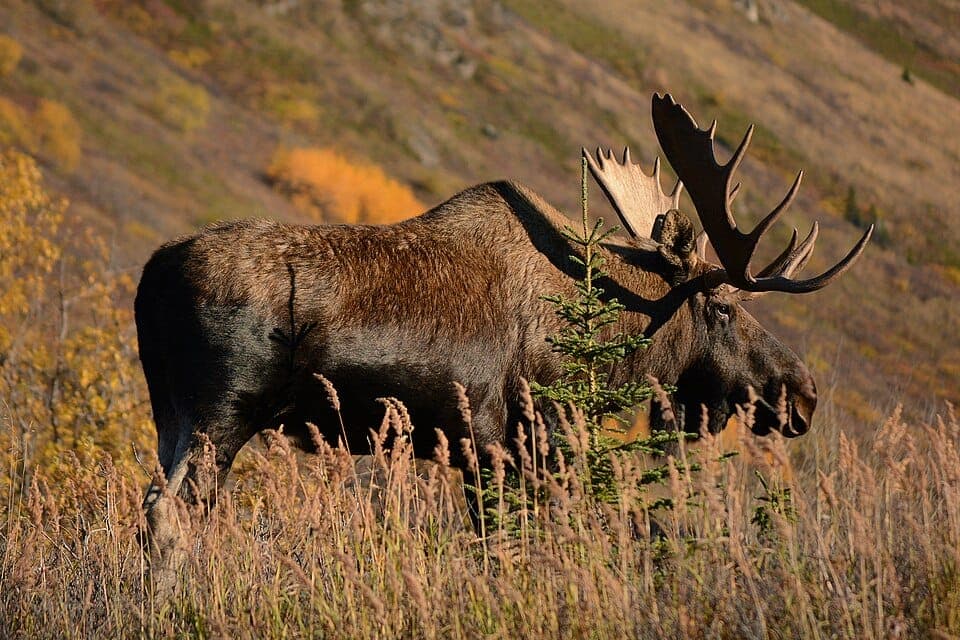
Moose and elk are easiest to tell apart by size, antler shape, and the head. A moose is the giant of the deer family — nearly black, long-legged, and horse-tall, with a humped shoulder, a dangling flap of skin under the throat called a "bell," a long drooping nose, and broad, flat, paddle-shaped antlers. An elk is smaller and tan to golden brown with a dark shaggy neck mane, a big pale rump patch, and tall, sweeping antlers built from long, pointed tines. If the animal is dark and towering with paddle antlers and a droopy muzzle, it is a moose; if it is tan with a cream rump and a crown of spike-like points, it is an elk. Here is how to identify each one for certain, even at a distance.
How to Tell a Moose From an Elk
Both are members of the deer family and both are far bigger than a white-tailed or mule deer, which is where the confusion usually starts. But side by side they look nothing alike, and even alone each one carries a short list of features that settle it: overall size and shape, the antlers, the color and neck, and the head. Any one of these is usually enough; together they are conclusive.
Size and build
A moose is enormous — the largest deer on Earth. A big bull stands five to six and a half feet tall at the shoulder and can weigh 1,200 to 1,600 pounds, with long, gangly legs, a pronounced hump over the shoulders, and a heavy, down-turned muzzle that gives it a slightly awkward, prehistoric silhouette. An elk is large but far more deer-like in its proportions: four to five feet at the shoulder, 500 to 1,100 pounds, with a sleeker body, a level back, and an elegant, upright carriage. If the animal looks as tall as a horse and oddly top-heavy, it is a moose; if it looks like an oversized, graceful deer, it is an elk.
Antlers (on bulls)
Antlers are the single most reliable clue when the animal is a mature male. A bull moose grows palmate antlers — broad, flat, paddle- or hand-shaped plates with short points, or tines, running along the outer edge, spreading wide out to either side of the head. A bull elk grows a tall, branching rack: a long main beam on each side that sweeps up and back, with six or more long, slender, pointed tines coming off it in a crown. Flat paddles mean moose; tall, many-pointed spikes mean elk. Cows of both species lack antlers, so fall back on size, color, and the head.
Color and the neck
Color separates them even at long range and even on antlerless animals. A moose is uniformly dark — chocolate brown to nearly black — with grayish lower legs and no contrasting rump patch. An elk is two-toned: a tan to light-brown body, a noticeably darker chocolate neck and head carrying a shaggy mane, and a large pale cream or buff patch on the rump. That bright rump patch is a quick elk giveaway; a moose shows no such patch and reads as one dark color all over.
Head, nose, and throat
The head is almost a caricature once you know what to look for. A moose has a very long, bulbous, overhanging nose and muzzle, and most moose — bulls and cows — have a "bell," a dangling pendant of fur-covered skin that hangs beneath the throat. An elk has a narrower, more typical deer face with a tidy muzzle and no bell. If the animal has a huge, drooping nose and a flap swinging under its chin, it is a moose.
Sound
In the fall rut the two even sound different. A bull elk "bugles" — a famous, far-carrying call that rises into a high, eerie whistle or scream and drops into grunts, echoing across mountain valleys at dawn and dusk. A bull moose is far quieter and lower, giving deep grunts and moans, while a cow moose makes a long, wailing bawl. A ringing, whistling scream from the hillsides is almost always elk.
Quick checks
- 1Size and shape: horse-tall, humped, and gangly with a down-turned nose means moose; a large but sleek, deer-like body means elk.
- 2Antlers: broad, flat paddles means moose; a tall crown of long pointed tines means elk.
- 3Color: one dark, near-black color all over means moose; a tan body with a dark neck mane and a pale rump patch means elk.
- 4Head: a huge drooping nose and a throat "bell" means moose; a neat deer face means elk.
Try Spotter Free on iOS & Android
Plants, animals, fungi, and rocks — all from a photo. 5 free identifications every day, no credit card required.
Quick Comparison
- Moose — the largest deer, near-black, humped, and long-legged, with a bulbous nose, a throat bell, and broad palmate antlers; a solitary animal of northern forests, wetlands, and willow bogs across Canada, Alaska, the northern Rockies, the upper Midwest, and New England.
- Elk — large but sleek and tan with a dark neck mane and a pale rump patch, bulls carrying tall, many-tined crown antlers; a herd animal of mountain meadows, foothills, and open forest across the western United States, with reintroduced herds in parts of the East and Midwest.
- Overlap — in the northern Rockies and parts of the West the two share ground, so lean on size, antler shape, and the head rather than location.
Other Big Animals People Confuse Them With
A handful of other large animals get pulled into the mix:
- Caribou (reindeer) — the only deer where both sexes grow antlers; antlers are tall and sweeping with a distinctive forward-pointing brow "shovel," and the coat is grayer with a pale neck. Found in the far north.
- White-tailed and mule deer — far smaller than either, with a tan coat and a white tail or rump; if the animal is dog-to-pony sized rather than horse sized, it is a deer, not an elk or moose.
- Horses and cattle at a distance — a dark moose in a field or a tan elk herd is sometimes mistaken for livestock until the antlers or long legs give it away.
Safety: Give Both Animals Plenty of Room
Moose and elk are huge wild animals and can be dangerous, especially in the fall rut when bulls are aggressive and in spring when cows are protecting calves. Moose in particular injure more people in some regions than bears do; they may not run from you, and a provoked moose can charge and stomp. Never approach, feed, or crowd either animal, keep dogs leashed and back, and give them a wide berth — well over a hundred feet, and more if the animal stops feeding, lays its ears back, or raises its hackles. Use a zoom lens or your phone from a safe distance rather than stepping closer for a photo.
Frequently Asked Questions
What is the easiest way to tell a moose from an elk?
Color and antler shape. A moose is one dark, near-black color with broad, flat, paddle-shaped antlers; an elk is tan with a dark neck mane, a pale rump patch, and tall antlers made of long pointed tines. Size helps too — a moose is noticeably taller and lankier.
Which is bigger, a moose or an elk?
A moose is considerably bigger. Bull moose stand five to six and a half feet at the shoulder and weigh 1,200 to 1,600 pounds, while bull elk stand four to five feet and weigh 500 to 1,100 pounds. The moose is the largest living member of the deer family.
Do moose and elk live in the same places?
Their ranges overlap in the northern Rocky Mountains and parts of the West, but broadly moose favor cold northern forests, wetlands, and willow thickets while elk favor mountain meadows, foothills, and open forest. Elk also live in large herds, while moose are usually solitary, which is itself a clue.
Do both moose and elk bugle?
No. The ringing, whistling "bugle" of the autumn mountains is the bull elk. A bull moose instead gives deep grunts and moans, and a cow moose gives a long, wailing bawl. If you hear a high, eerie scream carrying across a valley, you are hearing elk.
Spotted a big animal and not sure whether it is a moose, an elk, or a large deer? Snap a photo from a safe distance and let Spotter help you identify it as a starting point, then confirm it with the size, the antlers, and the head.
Try Spotter Free on iOS & Android
Plants, animals, fungi, and rocks — all from a photo. 5 free identifications every day, no credit card required.