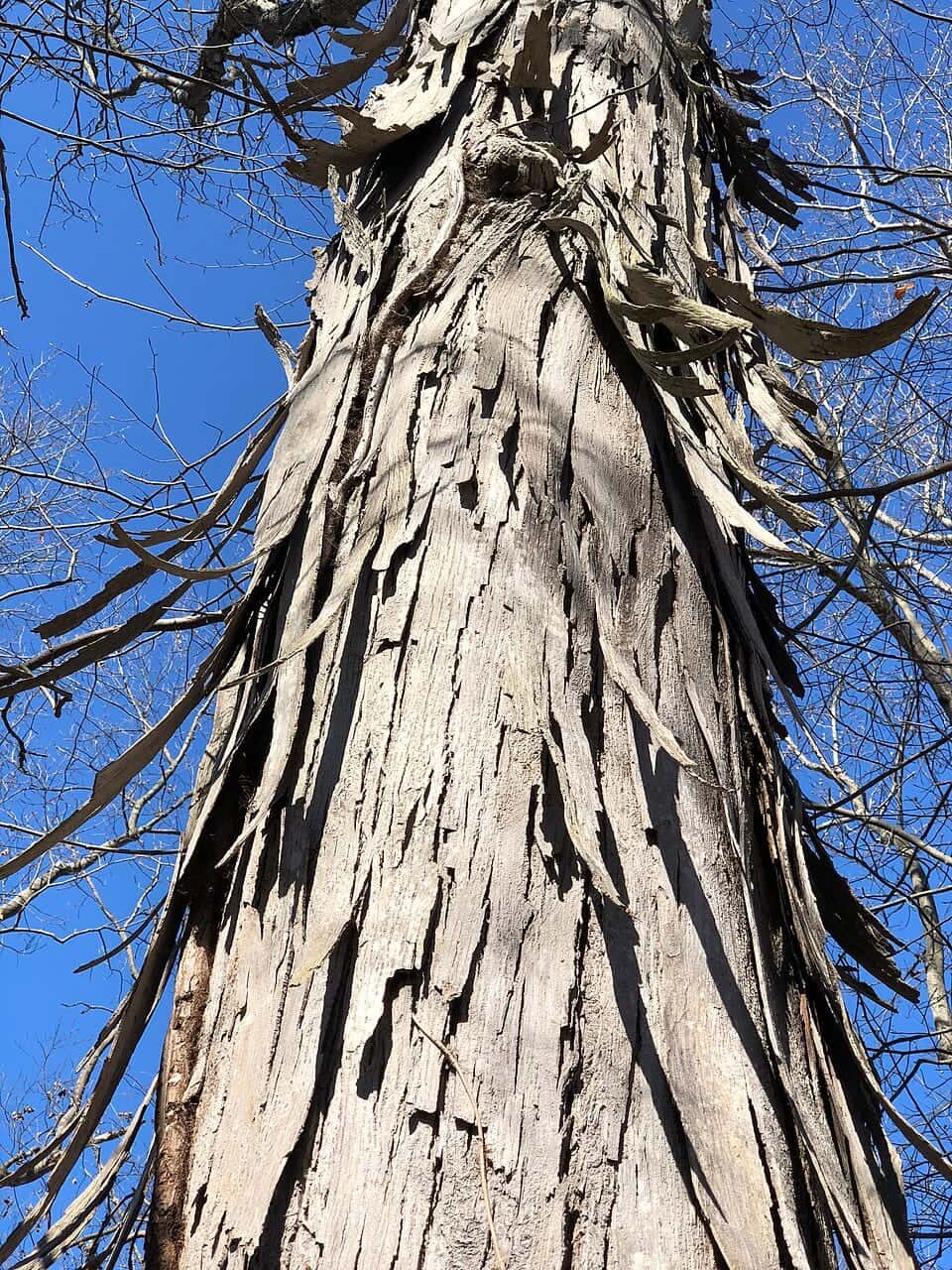
It is early fall and something keeps hitting the driveway with a hard thud: round nuts wrapped in a thick husk, green at first and browning as they dry, that split cleanly into four sections and release a pale, four-ribbed nut inside. When you finally look up to find the source, the tree announces itself — a tall hardwood whose grayish bark has come loose in long, flat plates that curl away from the trunk at the top and bottom, giving the whole trunk a shaggy, unkempt, almost peeling look. That combination of a shedding trunk and husked nuts underfoot points to one tree: the shagbark hickory, one of the most recognizable native hardwoods in eastern North America and a heavy producer of nuts that drop from late summer into fall. Here is how to identify it with confidence and tell it apart from the walnuts and other nut trees it gets confused with.
How to Identify a Shagbark Hickory
The shagbark hickory earns its name, and its bark alone will usually clinch the identification — but a few other features confirm it:
- The bark: this is the giveaway — on mature trees the gray bark separates into long, thick vertical plates a foot or more long that curl outward at the ends, so the trunk looks like it is peeling or shedding in loose strips
- The nuts: round nuts inside a thick, four-part husk that splits open into quarters when ripe, dropping a light-tan, faintly four-ridged nut with a hard shell — falling from roughly late summer into fall
- The leaves: large compound leaves, each with usually five (sometimes seven) leaflets arranged in a feather-like row, the end three leaflets noticeably larger than the pair near the base
- The build: a tall, straight-trunked tree of woodlands and old fields, often reaching 60 to 80 feet, with a relatively narrow crown
- The buds: in fall and winter, large, plump tan terminal buds tip the twigs — bigger than the buds of most trees its size
A tall hardwood with shaggy, peeling bark, feather-like compound leaves, and round husked nuts on the ground is a shagbark hickory. The bark is so distinctive that experienced tree-watchers name it from across a field, but the combination of bark plus the four-parted husk and five-leaflet leaves removes any doubt.
Try Spotter free on iPhone or Android
Plants, animals, fungi and rocks from one photo. 5 free identifications every day, no card required.


Hickory, Walnut, or Buckeye? Sorting the Nut Trees
Several trees drop large nuts in fall, and they are easy to mix up until you look closely. Black walnut produces round nuts too, but inside a thick, solid green husk that does not split into neat sections and that stains everything it touches dark brown; walnut leaves also have many more leaflets — often 15 to 23 — in a long feathery row, versus the hickory’s five. Buckeyes and horse chestnuts drop shiny, dark-brown nuts from a leathery capsule, and their leaves are palmate, with leaflets radiating from a single point like fingers rather than lined up along a stalk. Other hickories — such as the pignut and mockernut — share the compound leaves and husked nuts but lack the dramatic peeling plates of the shagbark, wearing tighter, more furrowed bark instead. When the nut, the husk, and the bark all agree, identification is straightforward; the shagbark’s shredding trunk is what sets it apart from the rest of the hickory clan.
Why the Nuts Matter to Wildlife
A shagbark hickory in a good year is a wildlife supermarket. The energy-rich nuts are a prized fall and winter food for squirrels and chipmunks, which cache them by the hundreds, as well as for deer, foxes, raccoons, wild turkeys, wood ducks, and woodpeckers. Like oaks, hickories tend to have boom-and-bust seasons, dropping a heavy crop some years and little in others, so a driveway suddenly buried in nuts can mark a bumper year. The loose, shaggy bark plates are valuable too: they are a favored summer roosting spot for certain bats, which tuck up underneath the peeling strips during the day. All of which is to say a shagbark hickory is worth having around, litter and all — it feeds a remarkable amount of the local wildlife.
A Note on the Nuts
Hickory nuts are a well-known native food source, but this article is about identifying the tree, not harvesting from it — and the usual cautions on anything wild apply. Nuts on the ground can be hollow, moldy, or riddled by weevils, and shagbark has a bitter-nutted relative, the bitternut hickory, whose nuts are unpalatable. If you are ever considering eating anything gathered from the wild, confirm the tree’s identity with an expert or a good regional guide first, inspect the nuts carefully, and never rely on a photo or a quick resemblance alone. For most people the real reward here is simpler: learning to name a striking native tree by its unmistakable peeling bark.
Not sure whether the tree raining nuts on your driveway is a shagbark hickory, a walnut, or something else? Snap a photo of the bark, a leaf, and one of the husked nuts and let Spotter help you identify it as a starting point for getting to know the trees around your home.
Try Spotter free on iPhone or Android
Plants, animals, fungi and rocks from one photo. 5 free identifications every day, no card required.