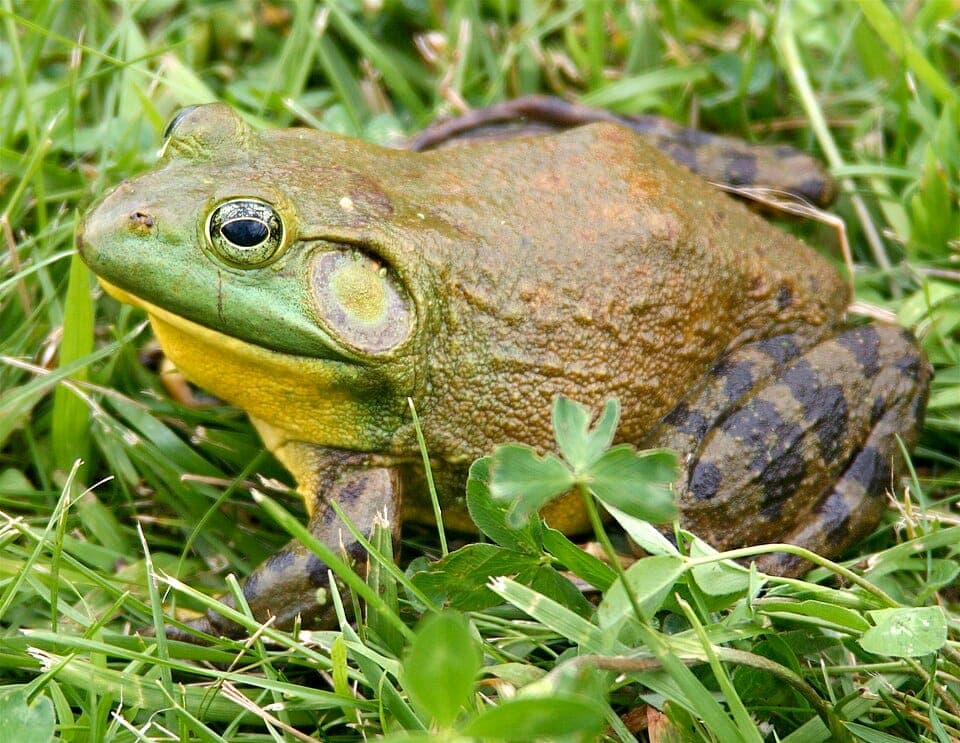
The most reliable way to tell a bullfrog from a green frog is to look at the ridges of skin on its back: a green frog has two raised folds (called dorsolateral folds) that run from behind each eye all the way down its back, while a bullfrog has no such back ridges — its only fold curves down and around the eardrum instead. Both are big, green-to-brown pond frogs that overlap in range and get mixed up constantly, especially since a young bullfrog can be the same size as an adult green frog. Here is how to tell them apart by those back ridges, by size and build, and by their unmistakably different calls.
How to Tell a Bullfrog From a Green Frog
Size is the clue most people reach for, but it is the least reliable, because a half-grown bullfrog and a full-grown green frog can look identical in a bucket. The skin ridges and the call settle it every time. Work through all of the features below and the two separate cleanly.
The back ridges (dorsolateral folds) — the real giveaway
This single feature identifies the frog no matter its size. On a green frog, a pair of raised skin ridges — the dorsolateral folds — run from just behind each eye straight down the length of the back. On a bullfrog those long back ridges are absent; instead, a single fold starts behind the eye, curves down and around the back edge of the round eardrum, and stops there. Ridges down the back mean green frog; a fold that wraps the eardrum and quits means bullfrog.
Size and build
When both are adults, size helps. The American bullfrog is the largest frog in North America, with a body 4 to 6 inches long (some reach 8 inches) and a heavy, powerful build. A green frog is a more modest 2 to 4 inches long and lighter overall. The catch is that a juvenile bullfrog passes right through the green frog’s size range on its way up, so use size only to confirm what the back ridges already told you.
The eardrum (tympanum) and throat
The round eardrum, or tympanum, just behind the eye is useful for sexing both species: in males it is distinctly larger than the eye, while in females it is about the same size as the eye. In breeding males, the throat turns bright yellow in both species, so a yellow throat tells you the frog’s sex, not its species — go back to the back ridges to name the frog itself.
Color and pattern
Color is variable and overlaps too much to rely on. Both frogs range from bright green to olive to brownish, and both often show a green upper lip. Bullfrogs tend toward a plainer body sometimes mottled with gray or brown, while green frogs frequently show darker spotting or banding on the legs — but treat color as a hint, never as proof, and confirm with the ridges.
The call — "jug-o-rum" vs. a plucked banjo
If you can hear the frog, the call is a dead giveaway. A bullfrog gives a deep, resonant, low-pitched "jug-o-rum" or "rrrum" that carries a long way across the water. A green frog makes a single, higher, abrupt note that sounds exactly like someone plucking a loose banjo string — often a single "gunk," sometimes repeated a few times. A deep foghorn is a bullfrog; a banjo pluck is a green frog.
Try Spotter Free on iOS & Android
Plants, animals, fungi, and rocks — all from a photo. 5 free identifications every day, no credit card required.
Frogs They’re Both Confused With
A few other frogs share the same ponds and add to the confusion. Here is how to keep them straight:
- Mink frog — a northern look-alike of the green frog that also has back ridges, but it smells faintly of rotten onions when handled and its call is a rapid, stuttering "cut-cut-cut" rather than a single banjo note.
- Pig frog — a southern bullfrog look-alike with no back ridges; it is slimmer, has more webbing on the hind feet, and grunts like a pig instead of saying "jug-o-rum."
- Northern leopard and pickerel frogs — both slimmer and boldly marked with rows of dark spots or squarish blotches, and both have long back ridges like a green frog’s, but their patterning is far more distinct than a plain green frog’s.
- Young bullfrog vs. adult green frog — the classic mix-up; ignore size entirely and check whether the back ridges run down the body (green frog) or stop at the eardrum (bullfrog).
Why It Matters
Both frogs are native across much of eastern North America, where they are a normal, healthy part of pond life. West of the Rockies, though, the American bullfrog is a serious invasive species: introduced bullfrogs eat native frogs, turtles, and just about anything else they can swallow, and they help spread amphibian diseases, so wildlife agencies in western states actively discourage moving or releasing them. Knowing which frog is in your pond — and where you are — tells you whether you are looking at a welcome native or an animal your state may ask you to report. Never move frogs, tadpoles, or pond water from one body of water to another, which is a main way both invasive frogs and their diseases spread.
Frequently Asked Questions
What’s the easiest way to tell a bullfrog from a green frog?
Look at the back. Two raised ridges running from the eyes down the length of the body mean a green frog; if the only fold curves around the eardrum and the back is smooth, it is a bullfrog. This works at any size.
Is a bullfrog just a big green frog?
No — they are two different species. A big frog is not automatically a bullfrog, and a small one is not automatically a green frog, because young bullfrogs and adult green frogs overlap in size. The back ridges, not the size, tell you which is which.
Are bullfrogs bad for a pond?
In their native eastern range, no — they belong there and balance out with everything else. Where they have been introduced in the West, yes: they prey heavily on native amphibians and reptiles and are treated as a harmful invasive species.
How can I tell a young bullfrog from a green frog?
Do not rely on size, since a juvenile bullfrog can be exactly the size of an adult green frog. Check the dorsolateral folds: present and running down the back means green frog, absent means bullfrog. If you can hear it call, the banjo "gunk" versus the deep "jug-o-rum" confirms it.
Heard a frog you can’t place, or caught a good look at one at the water’s edge? Snap a photo and let Spotter help you tell a bullfrog from a green frog — and from their many look-alikes.
Try Spotter Free on iOS & Android
Plants, animals, fungi, and rocks — all from a photo. 5 free identifications every day, no credit card required.