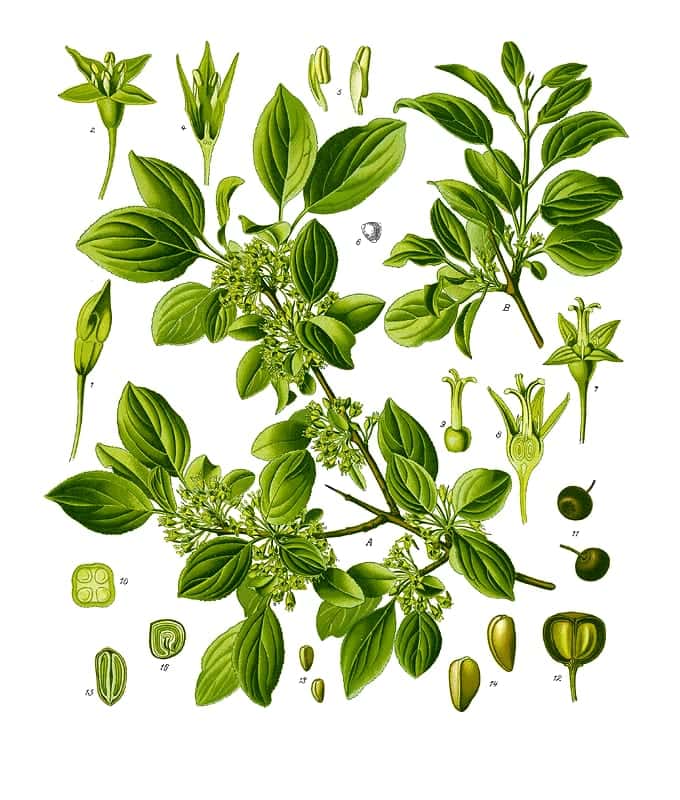
Common buckthorn (Rhamnus cathartica) is an invasive shrub or small tree you can identify by its sub-opposite oval leaves with fine teeth and curved veins, twigs tipped with a short sharp spine, and bright orange inner bark under a dark gray outer bark. The fastest giveaway in late fall is simple: it holds glossy green leaves for weeks after the native trees around it have gone bare.
Common buckthorn is not native to North America. It was brought from Europe as a hedge plant and now forms dense thickets across the upper Midwest and Northeast, shading out native seedlings and wildflowers. Wisconsin lists it as a Restricted invasive species. In early November 2026, a Spotter user photographed a shrub that was still in full green leaf while the woods around it had dropped; the app identified it as common buckthorn, and the features it reported match the textbook marks below: oval green leaves with curved veins, dense clusters of small black berries, a shrubby many-branched habit, and leaves still green in late autumn. That late-season green is exactly why now is the easiest time of year to spot it.
How to Identify Common Buckthorn
Common buckthorn grows 10 to 25 feet tall, usually with several stems and a crooked, spreading crown. Work through the leaves, the twig tips, and the bark, and it separates cleanly from the native shrubs it grows among.
Leaves that stay green late into fall
This is the single most useful field mark, and it only works this time of year. Long after oaks, maples, and native shrubs have dropped or turned, buckthorn keeps its dark, glossy green leaves well into November and sometimes December. Scan a bare November woodland and the patches that are still solid green are very often buckthorn. The Wisconsin DNR notes that the leaves stay green late into fall, which is why land managers schedule cutting and control for this window when the plant is easy to pick out.
Sub-opposite leaves with curved veins and fine teeth
The leaves are oval to football-shaped, 1 to 2.5 inches long, dark and shiny on top and duller underneath. They sit in a sub-opposite arrangement, meaning the pairs are slightly offset rather than perfectly across from each other. Look closely at the veins: three to five pairs curve away from the midrib and arc forward toward the leaf tip, like the ribs of a wishbone. The leaf edge carries fine, rounded teeth. That combination, curved arcing veins plus a toothed margin, is the detail that separates it from the smooth-edged native dogwoods it otherwise resembles.
A sharp spine at the twig tip
Most branches end in a short, stiff spine, which is where the name buckthorn comes from. On many twigs the growing tip is replaced by this spine, flanked by a pair of dark brown buds. Run a branch gently through your fingers and you will feel the points. Native cherries and dogwoods do not tip their twigs this way, so a thorn-ended branch on a shrub with glossy, still-green leaves is a strong buckthorn sign.
Orange inner bark
The outer bark is dark gray to brown with pale, raised pores called lenticels, and can look a lot like a native cherry. The tell is underneath. Scratch or cut a stem and the inner bark and sapwood show a vivid orange to yellow-orange. Few native shrubs do this, so a quick scrape settles most hard cases.
Black berry clusters on female plants
Female buckthorns carry dense clusters of round, pea-sized berries that ripen from green to glossy black in late summer and hang on into winter. Each berry holds three or four seeds. Birds eat them and scatter the seeds widely, which is a big part of why buckthorn spreads so fast. The berries are not a food source for people, as the safety note below explains.
Common Buckthorn Look-Alikes
Buckthorn is confused most with glossy buckthorn (another invasive), native gray dogwood, native cherries, and the invasive Amur honeysuckle, which also holds its leaves late. Penn State Extension separates common from glossy buckthorn by the toothed versus smooth leaf margin. This table lines up the field marks that set them apart.
| Plant | Leaf arrangement | Leaf margin | Veins | Spine at twig tip? | Berries |
|---|---|---|---|---|---|
| Common buckthorn | Sub-opposite | Fine teeth | Curved, arcing forward | Yes, short spine | Black, in clusters |
| Glossy buckthorn | Alternate | Smooth, no teeth | Curved, parallel | No | Red, ripening to black |
| Gray dogwood (native) | Opposite | Smooth, no teeth | Curved, arcing | No | White on red stalks |
| Native cherry / chokecherry | Alternate | Fine teeth | Straight, feather-like | No | Red to black, one pit |
| Amur honeysuckle (invasive) | Opposite | Smooth, slightly hairy | Straight-ish | No | Red, in pairs |
Amur honeysuckle is the trickiest of these in late fall because it also keeps green leaves after natives drop. A Spotter user photographed one in early November 2026 with green leaves remaining late into the fall; its opposite leaves, lack of a twig spine, and paired red berries separate it from buckthorn. For either shrub, the plant identifier can confirm the species from a photo.
Is Common Buckthorn Dangerous?
Common buckthorn is not aggressive toward people, but its berries are mildly toxic. North Carolina State Extension rates the fruit as low-severity poisonous, with glycosides that can cause nausea, vomiting, and stomach cramps if the berries are swallowed; the species name cathartica points to that purging effect on the gut. Keep the berries away from small children and pets, and do not treat them as food. If someone swallows them and feels ill, call Poison Control at 1-800-222-1222 or contact emergency services. The twig spines are sharp enough to scratch, so wear gloves if you are pulling or cutting the plants. Like poison ivy and its look-alikes, buckthorn is a plant worth learning to recognize on sight.
Frequently Asked Questions
Why is this shrub still green in November?
Common buckthorn leafs out early in spring and holds its leaves far later than native trees and shrubs, staying green well into November and sometimes past the first frosts. That extended green season is one reason it outcompetes natives, and it is the easiest way to spot buckthorn once the surrounding woods have gone bare.
How do I tell common buckthorn from glossy buckthorn?
Check the leaf edge and arrangement. Common buckthorn has sub-opposite leaves with fine teeth along the margin; glossy buckthorn has alternate leaves with a smooth, toothless edge and a glossier upper surface. Both show orange inner bark when cut, but only common buckthorn tips its twigs with a spine.
Are common buckthorn berries poisonous?
The berries are considered mildly toxic to people. Swallowing them can cause stomach cramps, nausea, vomiting, and diarrhea, so they are not a food source. They are, however, readily eaten by birds, which is how the plant spreads so widely. If a child or pet eats the berries, call Poison Control at 1-800-222-1222.
Is common buckthorn illegal in Wisconsin?
Wisconsin classifies common buckthorn as a Restricted invasive species under its invasive species rule, which means it cannot be sold, transported, or planted in the state. Removing it from your own property is encouraged. Check your state’s invasive species list for local rules, since the designation varies.
Found a shrub still holding glossy green leaves when everything else is bare? Check the twig tips for a spine and scratch the bark for orange, and Spotter can confirm whether it is common buckthorn from a photo.
Try Spotter free on iPhone or Android
Plants, animals, fungi and rocks from one photo. 5 free identifications every day, no card required.