Quartz is one of the most common minerals on Earth, and you can identify it with four tests working together: it is hard enough to scratch glass and a steel knife, it has no flat cleavage so it breaks in curved, shell-like surfaces, it does not fizz in vinegar, and when it grows in open space it forms six-sided crystals with a glassy shine. Clear and white quartz trips up beginners because it has few flashy marks, but those tests settle it almost every time.
Quartz is the second most abundant mineral in Earth’s crust, after feldspar, which is exactly why it fills so many "what is this rock" questions. In Spotter’s recent rock identifications it showed up in three guises at once: plain milky quartz pebbles, a milky-white quartz vein running through dark schist, and banded chert, which is microcrystalline quartz. The plain milky pieces came back at the lowest confidence of the group, about 0.55, while the quartz vein in schist scored around 0.90. That gap is the whole point: clear and white quartz is identified by its physical tests, not by how it looks.
How to Identify Quartz
No single test is perfect, but run these together and quartz is hard to miss. The first two, hardness and how it breaks, do most of the work.
It scratches glass and steel (hardness 7)
On the Mohs hardness scale quartz is a 7, and it is the reference mineral for that step. That makes it harder than a steel knife blade (about 5.5) and ordinary window glass (also about 5.5), so a quartz point will scratch both and neither will scratch it. Try to scratch an out-of-the-way spot on the sample with a knife: if the blade just skates off and leaves no mark, you are likely holding quartz. If the knife bites in, you have a softer mineral such as calcite or gypsum. The USGS gemstone hardness chart lists quartz at 7 alongside the other reference minerals.
No cleavage, and a curved break
This is the mark that separates quartz from feldspar, its most common look-alike. Quartz has no cleavage, meaning no built-in flat planes where it splits. Instead it breaks in smooth, curved, shell-like surfaces called conchoidal fracture, the same way thick glass chips. Feldspar cleaves along two flat planes that meet at nearly 90 degrees, so broken feldspar shows flat, mirror-like faces and small stair-steps. Turn the stone in the light: flat reflective facets point to feldspar, curved glassy breaks point to quartz.
Six-sided crystals and a glassy luster
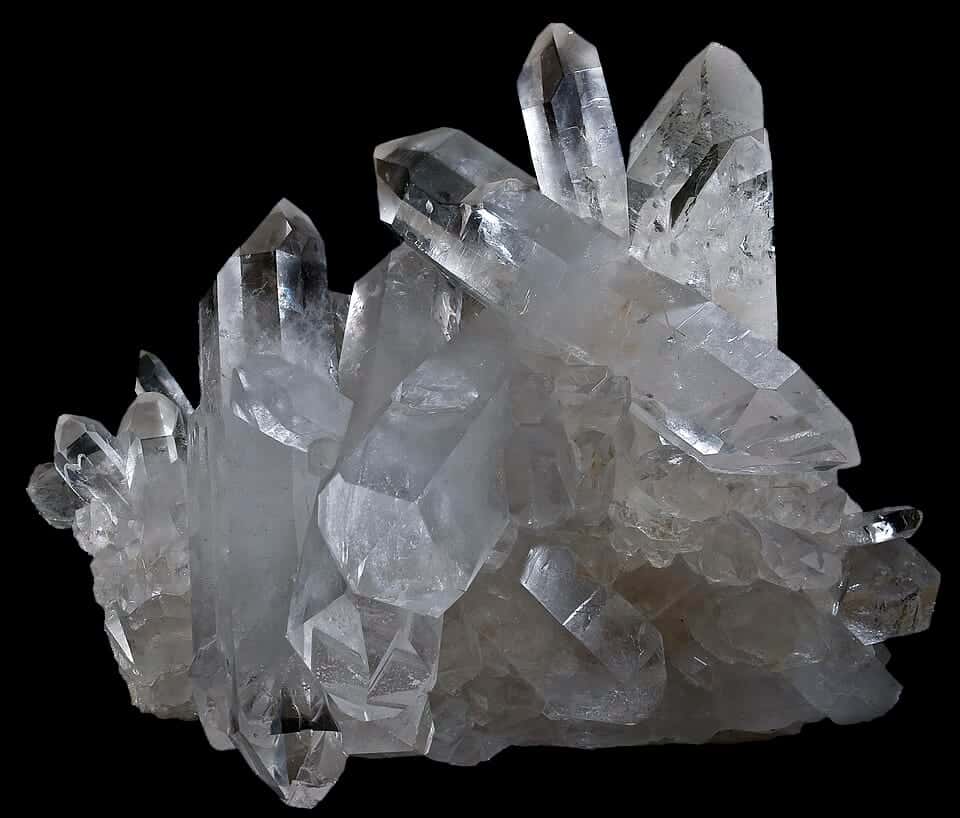
When quartz has room to grow into an open pocket, it forms six-sided (hexagonal) prisms capped by a six-sided pyramid point, usually with fine horizontal striations across the prism faces. The luster is glassy to slightly greasy, and the clear, colorless form is called rock crystal. Most quartz you find is not this tidy. It turns up as massive lumps, vein fillings, and waterworn pebbles. But any six-sided pointed crystal with that glassy shine is a strong quartz signal.
It does not fizz in vinegar
Quartz is silicon dioxide and is chemically inert to weak acid. A drop of white vinegar on quartz does nothing, while calcite, the other common clear mineral, fizzes and bubbles. If you are stuck between quartz and calcite, this test plus the scratch test settles it. Our quartz vs. calcite guide walks through both in detail.
Color and the common varieties
Pure quartz is colorless. Trace elements, natural radiation, and microscopic inclusions produce a whole family of colored varieties, so color tells you which variety you have, not whether it is quartz:
- Clear (rock crystal) and milky white are the same mineral; the milky look comes from large numbers of microscopic fluid and gas bubbles trapped as the crystal grew.
- Smoky quartz ranges from pale gray to near-black, colored by natural radiation acting on tiny aluminum impurities over long spans of time.
- Rose quartz gets its pink from microscopic fibers of an aligned silicate mineral woven through the crystal, according to the Gemological Institute of America.
- Purple quartz is amethyst and yellow-to-orange quartz is citrine; both are covered separately.
- Agate, jasper, and chert are microcrystalline quartz, built from crystals too small to see; our agate guide covers the banded kind.
Quartz Look-Alikes
The materials people most often confuse with clear or white quartz are calcite, feldspar, selenite (a form of gypsum), and manufactured glass. This table sorts them by the tests above.
| Material | Hardness (Mohs) | Cleavage and break | Vinegar (acid) | Crystal shape |
|---|---|---|---|---|
| Quartz | 7 (scratches glass) | None; curved (conchoidal) break | No reaction | Six-sided prism with pyramid tip |
| Calcite | 3 (a knife scratches it) | Three directions; breaks into leaning cubes | Fizzes | Rhombs, dogtooth, or nailhead points |
| Feldspar | 6 (close to quartz) | Two directions near 90 degrees; flat faces | No reaction | Blocky crystals, often pink or chalky white |
| Selenite (gypsum) | 2 (a fingernail scratches it) | One direction; peels into sheets | No reaction | Flat blades or clear plates |
| Glass (man-made) | About 5.5 (quartz scratches it) | None; curved break | No reaction | No natural faces; may show bubbles or a mold seam |
The quick version: if it scratches glass and does not fizz, you have narrowed it to quartz or feldspar, and the break settles it, curved for quartz, flat facets for feldspar. To check your answer against a photo, try the rock and mineral identifier or browse the common rocks and minerals guide.
Is Your Quartz Worth Anything?
Plain quartz is one of the most common minerals on the planet, so a milky vein pebble is not rare. What collectors look for is clarity, strong even color, well-formed undamaged crystals, and named varieties such as amethyst, citrine, and fine rose quartz. A clean crystal cluster or a vividly colored piece draws more interest than a cloudy lump, but condition and the specifics matter far more than the word "quartz" on its own.
Frequently Asked Questions
How can I tell quartz from glass?
Quartz is harder than glass and will scratch a glass surface, while glass cannot scratch quartz. Natural quartz also grows six-sided crystal faces and holds no internal bubbles, whereas manufactured glass is often full of tiny bubbles and may show a faint mold seam. If your "crystal" has rounded edges and trapped bubbles, it is probably glass.
Is quartz the same as rock crystal or "crystal"?
Rock crystal is simply the clear, colorless variety of quartz, so yes, it is quartz. The loose word "crystal" is used for many things, including cut glass sold as lead crystal, so it is not a reliable name on its own. Test for hardness and fracture to be sure.
How do I tell quartz from feldspar?
They are nearly the same hardness, so the scratch test will not separate them. Look at how the mineral breaks: feldspar cleaves along two flat planes that meet at about 90 degrees and shows flat, reflective faces, while quartz has no cleavage and breaks in curved, glassy surfaces. Feldspar is also often pink or chalky white, where quartz is more often glassy or clear.
Why is my quartz milky or cloudy?
Milky quartz is clouded by huge numbers of microscopic fluid and gas inclusions trapped while the crystal formed; they scatter light and turn the crystal white. It is still ordinary quartz, which is why Spotter and other tools lean on the hardness and fracture tests rather than color for these pieces.
Found a glassy or milky stone and not sure what it is? Photograph it in good light from a couple of angles and let Spotter help you identify it.
Try Spotter free on iPhone or Android
Plants, animals, fungi and rocks from one photo. 5 free identifications every day, no card required.