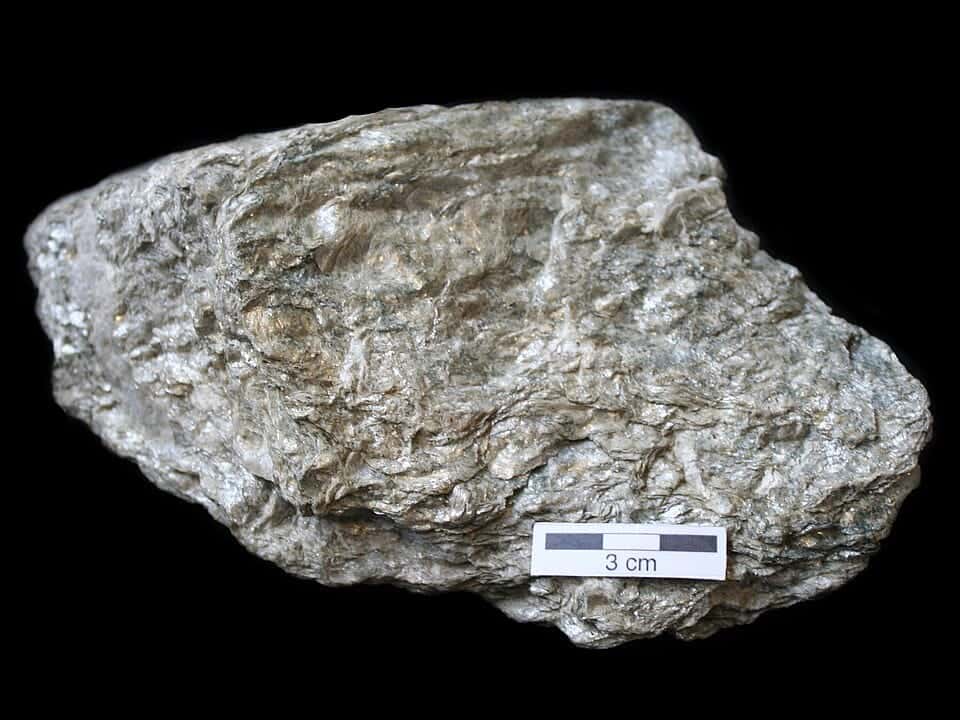
Schist is a medium-grade foliated metamorphic rock, and the fastest way to identify it is the glitter: countless flat mica flakes line up in parallel, so a schist surface sparkles in the light and splits into thin, flaky slabs. That shine, the visible grains, and the way the rock peels along its layers separate schist from the gneiss, phyllite, and slate it is most often confused with. Schist forms when a mudstone is squeezed and heated through a sequence of steps, from slate to phyllite to schist, with the clay in the original rock recrystallizing into mica. If your rock is layered, loaded with eye-catching mica flakes, and splits apart along those planes, schist is the leading answer.
How to Identify Schist
Run through four things together: the schistosity (the parallel sheen of aligned mica), the way it splits, the grain size, and any larger crystals studded through the surface. No single mark is proof on its own, but together they point to schist and separate it from its metamorphic cousins. Spotter identified a quartz vein in schist once this fall, at 90 percent confidence, and the features the app reported line up with the marks below: a layered or foliated texture in the host rock, a milky-white to orange crystalline quartz band running through it, a dark gray grainy surrounding rock, and a rough weathered surface.
The glittering, aligned mica (schistosity)
The defining feature of schist is schistosity: so many platy mineral grains, mostly mica, are aligned in the same direction that the whole rock glitters and breaks into thin slabs along that alignment. According to geology.com, this breakage along the plane of the platy grains is exactly what the name schist describes. Tilt the stone in sunlight and look for a sheet of tiny mirrors flashing at once. That brilliant, grainy sparkle, with flakes big enough to see without a lens, is the first thing that marks a rock as schist rather than a dull, fine-grained slate.
It splits into flaky, uneven slabs
Schist is weak along its foliation. Because the mica sheets stack like pages in a book, the rock peels and flakes apart into slabs, and the broken surfaces come out rough and uneven rather than flat. This is a test you can do by eye: a rock that is heavily layered, splits along those layers, and sheds crumbly, glittering flakes is behaving like schist. Gneiss, by contrast, holds together and tends to break across its bands.
Grains you can see
Schist is medium to coarse grained, and the mineral grains are easily seen with the naked eye or a cheap hand lens. That visible grain is what separates schist from the two lower-grade rocks it grows from. Slate is so fine it looks and feels smooth, and phyllite has a silky sheen but still shows no grains you can pick out one by one. Once the mica flakes are large enough to count individually, the rock has crossed over into schist.
Garnets and other crystals in the surface
Schist often carries porphyroblasts, oversized crystals that grew during metamorphism and stand out from the finer background. Per the Wikipedia entry on schist, these are commonly garnet, staurolite, kyanite, sillimanite, or cordierite. Deep-red garnets the size of peas, set into a silvery mica surface, are a classic sign of garnet mica schist. If your layered, sparkly rock has distinct lumps or gem-like crystals embedded in it, that is a strong vote for schist.
Where you will find it
Schist is a bedrock rock of mountain belts and old, deeply eroded terrains, from New England through the Appalachians to the northern Rockies. In the glaciated Upper Midwest, including Wisconsin, you are more likely to meet it as a tumbled cobble: Ice Age glaciers plucked schist and gneiss from the Canadian Shield to the north and scattered them across the region, so a sparkly, layered stone in a gravel bar or field is often a glacial traveler from far away. For the wider set of stones those glaciers carried, see our guide to common rocks and minerals, and for the banded cousin schist is most often confused with, read how to identify gneiss.
Schist vs. Gneiss, Phyllite, and Slate
All four rocks come from the same starting material, a mud or clay, metamorphosed to different degrees. The grade, meaning how much heat and pressure the rock has seen, climbs from slate at the low end to gneiss at the high end, and schist sits in the medium range. The table sorts them by marks you can judge with your eyes and a tilt toward the light.
| Rock | Grain size | Surface look | How it breaks | Metamorphic grade |
|---|---|---|---|---|
| Slate | Very fine, no visible grains | Dull, flat | Splits into flat, smooth sheets | Low |
| Phyllite | Fine, barely visible | Silky, wavy sheen | Splits along crinkled surfaces | Low to medium |
| Schist | Medium to coarse, grains visible | Glittering with aligned mica | Flakes and peels into rough slabs | Medium |
| Gneiss | Coarse, grains visible | Alternating light and dark bands | Breaks across the bands, hard to split | High |
The clean split between schist and gneiss is the sparkle versus the stripes. Schist is defined by aligned mica that makes the whole surface glitter and flake, while gneiss segregates its minerals into separate light and dark bands and, carrying less mica, is noticeably harder to split. Going the other way, if your rock is layered but shows no grains you can pick out and feels smooth or merely silky, you likely have slate or phyllite, the lower-grade steps below schist.
Frequently Asked Questions
What is schist made of?
Mostly mica, with quartz and feldspar filling in between. The platy mica minerals, muscovite and biotite, give schist both its sparkle and its habit of splitting into flakes. Many schists also carry larger crystals of garnet, staurolite, or kyanite that grew during metamorphism and stand out from the background.
Is schist the same as gneiss?
No. Both are foliated metamorphic rocks from the same family, but schist is rich in aligned mica, glitters, and flakes apart into thin slabs, while gneiss has coarser light-and-dark banding, less mica, and breaks across its bands instead of peeling. Gneiss also forms at higher temperature and pressure than schist.
How hard is schist?
It depends which mineral you test. The mica that dominates the surface is soft, roughly 2 to 3 on the Mohs scale, so a coin or fingernail can often scratch a flake loose, but the quartz grains mixed through the rock are hard enough to scratch glass. That uneven hardness, soft and flaky in places and hard in others, is itself a clue that you are holding a mica-rich schist.
Why does my schist sparkle?
Because of the mica. Thousands of flat mica flakes are lined up in the same plane, and each one acts like a tiny mirror, so the whole surface flashes when you turn it in the light. That aligned, glittering sheet of platy grains is called schistosity, and it is the single most reliable way to recognize schist in the field.
Found a layered, sparkly cobble and not sure whether it is schist, gneiss, or slate? Look for the glitter of aligned mica, try to flake it along its layers, and check whether you can see individual grains. Spotter can give you a first read from a photo on the rock identifier page, and these field marks confirm it.
Try Spotter free on iPhone or Android
Plants, animals, fungi and rocks from one photo. 5 free identifications every day, no card required.