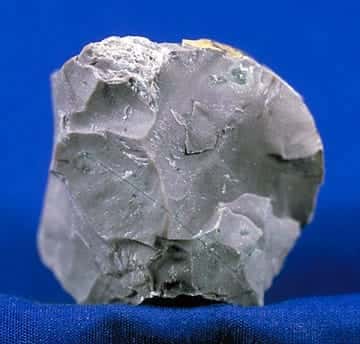
Chert is a hard, fine-grained sedimentary rock made of microcrystalline quartz, and the fastest way to identify it is a combination of four things: it sits at about 7 on the Mohs scale, so it scratches glass and resists a steel knife; it breaks with a smooth, scooped conchoidal fracture that leaves sharp edges; it has a dull to waxy luster; and a drop of vinegar does nothing because it holds no carbonate. Chert comes in almost any color, most often gray, brown, tan, white, or black, usually with no visible crystals because the quartz grains are far too small to see. Flint and jasper are not separate rocks but colored varieties of chert: flint is the dark, near-black form, and jasper is the opaque red-to-brown form. If your stone is hard, smooth-grained, waxy, and breaks like thick glass, chert is the leading answer.
How to Identify Chert
Run through five checks: the grain, the hardness, the fracture, the acid test, and where you found it. Together they separate chert from the softer pale rocks and the coarse crystalline ones it gets confused with. This month Spotter logged two chert identifications from reader photos. A plain gray-brown pebble came back at just 40 percent confidence, while a banded piece with concentric light and tan layers scored 85 percent. That gap is the real lesson of this rock: a plain, featureless chert pebble is one of the hardest stones to name with confidence, by app or by eye, because it offers so few marks to work with. The more pattern a piece carries, the easier the call.
Fine, even grain with no visible crystals
Chert is cryptocrystalline, meaning its quartz crystals are far too small to see, even with a hand lens. The result is a smooth, uniform surface with no sparkle and no individual grains that catch the light, unlike granite or gneiss, where you can pick out separate crystals of quartz, feldspar, and mica. Run a fingertip over a fresh break and it feels glassy-smooth rather than gritty or sugary. That even, grainless texture is the first thing that sets chert apart from sandstone and from most coarse igneous and metamorphic rocks.
Hardness: it scratches glass and shrugs off steel
Because chert is nearly pure quartz, it sits at about 7 on the Mohs hardness scale, harder than a steel knife or nail (around 5.5) and hard enough to scratch glass. Drag a corner of the rock across an old glass bottle: chert leaves a scratch, and the steel blade will not mark the chert in return. This single test rules out most pale look-alikes at once. Limestone and chalk are soft (Mohs 3), and a knife bites them easily, so a hard, unscratchable pale rock points toward chert, not limestone. You can see the opposite case in how to identify limestone.
Conchoidal fracture and sharp edges
The most diagnostic feature is how chert breaks. Like glass, it has a conchoidal fracture: instead of splitting along flat planes, it breaks in smooth, curved, scoop-shaped surfaces, as if someone pressed a thumb into clay. Those curved breaks meet at edges sharp enough to cut, which is exactly why ancient toolmakers prized it. If a broken face shows shell-like curved ridges and no flat cleavage, you are very likely looking at chert, flint, or another member of the quartz family. Obsidian fractures the same way, but it is natural volcanic glass, shiny and usually black, not a dull sedimentary rock.
No fizz with acid
Chert is silica, not carbonate, so a drop of vinegar or dilute acid produces no bubbles at all. This matters because chert often forms inside limestone and dolomite and can carry a pale, chalky rind that resembles those carbonate rocks. Put the acid on a fresh, unweathered surface: limestone and dolomite fizz (dolomite more weakly), while the chert itself stays silent. A pale rock that fizzes is not chert.
Where you found it
Most chert forms on the sea floor from the silica skeletons of tiny organisms such as diatoms and radiolarians, or from silica-rich fluids replacing limestone. It shows up two ways: as bedded layers, and as rounded nodules embedded in limestone and dolomite, often with a whitish exterior rind and a darker, harder interior. Across the Midwest and Great Lakes, glaciers broke chert nodules out of the region’s dolomite bedrock and scattered them through gravel and along shorelines, which is why plain chert pebbles are such a common find in Wisconsin and neighboring states. The rounded, water-worn stones that turn up in creeks and on lake beaches are usually these glacial survivors.
Chert vs. Flint, Jasper, and Agate
Chert, flint, jasper, and agate are all forms of the same material, microcrystalline quartz (chalcedony), and all sit near 7 on the Mohs scale. They differ mainly in color, pattern, and whether light passes through them. The table sorts them by features you can judge by eye. For the banded, translucent member of the group, see how to identify agate.
| Stone | Typical color | Translucency | Pattern | Quick tell |
|---|---|---|---|---|
| Chert | Gray, brown, tan, white | Opaque | Usually plain, sometimes faint bands | Dull to waxy, no visible crystals, breaks like glass |
| Flint | Dark gray to black, often a white rind | Opaque | Uniform | The dark, near-black variety of chert, classically in chalk or limestone nodules |
| Jasper | Red, brown, yellow, green | Opaque | Often mottled, spotted, or veined | Opaque and iron-rich, usually red to brown |
| Agate | Any color, commonly gray, white, red | Translucent at a thin edge | Concentric or wavy bands | Light passes through a thin edge; curved banding |
The line between chert and flint is loose. Geologists often treat flint as the dark, fine, nodular form of chert, while jasper is the opaque, iron-stained red-to-brown form. The clean split is with agate: hold a thin edge up to a bright light and agate glows, while chert, flint, and jasper stay solidly opaque. According to geology.com, chert and flint are names for the same microcrystalline quartz, with "flint" applied to the darker colors and "jasper" to the reddish ones.
Why Chert Shaped the Stone Age
Chert’s hardness plus its predictable conchoidal fracture made it one of the most important rocks in human history. Because a skilled knapper could strike it into thin flakes with razor edges, people used chert and flint for spear points, arrowheads, knives, and scrapers for hundreds of thousands of years. The National Park Service notes that prehistoric peoples fashioned spear and arrow points, knives, and other stone tools from fine-grained flint because it chips and shapes so readily. If you find chert with long, flat, deliberate-looking flake scars and a worked edge, you may be holding an artifact rather than a natural rock. On public land, worked stone tools are protected by law, so photograph the spot and leave them in place. For the wider family of silica stones chert travels with, see our guide to common rocks and minerals, or start on the rock identifier page.
Frequently Asked Questions
What is the difference between chert and flint?
They are the same rock, microcrystalline quartz. "Flint" is the traditional name for the dark gray to black variety that forms as nodules in chalk and limestone, while "chert" is the broader term covering all colors and both nodular and bedded forms. In practice, a dark, glossy, nodular piece gets called flint, and a pale or bedded piece gets called chert.
How can I tell chert from quartz or quartzite?
All three are quartz and all scratch glass, so hardness will not separate them. Look at grain and break: chert is cryptocrystalline with no visible crystals and a smooth conchoidal fracture, clear quartz grows as glassy six-sided crystals, and quartzite is a grainy, sugary-looking rock that breaks through the grains with a rougher surface. Chert’s dull-to-waxy, grainless look is the giveaway. See quartz vs. calcite for more on telling quartz apart.
Why does chert have such sharp edges?
Chert breaks with a conchoidal fracture, the same curved, shell-like break you see in glass. Because the rock has no internal planes to split along, the fracture surfaces curve and meet at very thin, sharp edges. Handle freshly broken chert carefully, because the edges can cut like a glass shard.
Where do I find chert?
Chert turns up wherever limestone and dolomite are exposed or were ground up by glaciers: creek beds, gravel bars, road cuts, plowed fields, and lake and river shores. In the Midwest and Great Lakes region it is one of the most common pebbles on the beach, left behind when Ice Age glaciers eroded the local carbonate bedrock.
Found a smooth, dull pebble and not sure whether it is chert? Check it against glass, look for a curved conchoidal break, and try a drop of vinegar. Spotter can give you a first read from a photo, and these three tests confirm it.
Try Spotter free on iPhone or Android
Plants, animals, fungi and rocks from one photo. 5 free identifications every day, no card required.