
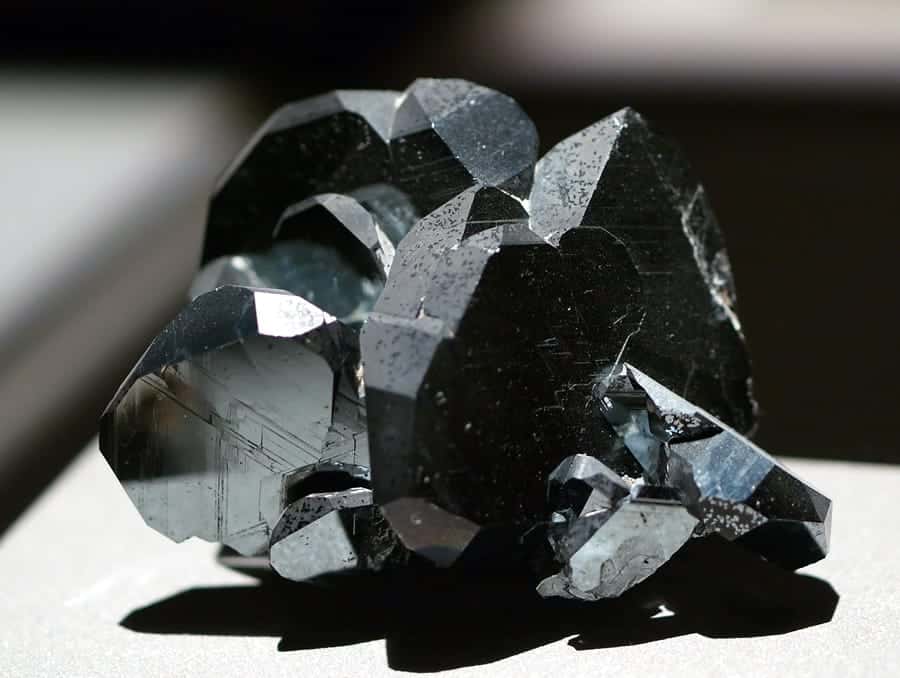
Hematite is a heavy iron-oxide mineral, and the fastest way to identify it is the streak test: whether the specimen looks silver-gray, black, or rusty red on the outside, it leaves a red to reddish-brown mark when you scrape it across unglazed porcelain. That rust-red streak, plus a noticeable heft for its size and a hardness that lets it scratch glass, separates hematite from the dark, metallic minerals it is most often confused with. The name comes from the Greek word for blood, a nod to the red streak and the red powder the mineral produces. Hematite is the most abundant iron ore on Earth, and it is a common find in the glaciated Midwest and around Lake Superior, where whole ranges of it were mined.
How to Identify Hematite
Run through five things together: the streak, the weight in your hand, the color and luster, the hardness, and where you found it. No single one is decisive, because hematite is a shape-shifter that can look like shiny silver metal, a dull black lump, or red earth. Taken together, they point to one answer.
The red-brown streak test
This is the single most reliable test, and it works even when the rock fools your eyes. Drag the specimen across the unglazed back of a ceramic tile or a piece of unglazed porcelain. Hematite leaves a streak that ranges from cherry red to reddish brown, according to geology.com, and that color holds whether the stone itself is silver, black, or red. The streak is the powdered mineral, and hematite powder is always some shade of red. A black metallic rock that leaves a red streak is hematite, not magnetite or galena, both of which streak gray to black.
Heavy for its size
Pick it up. Hematite has a specific gravity of about 5.0 to 5.3, close to twice that of common quartz or granite, so a hematite cobble feels startlingly heavy for how big it is. That dense, metallic heft is a quick first filter in the field: an ordinary-looking gray or black stone that weighs far more than it should is worth testing further. Only a few common minerals feel this heavy, and the streak test then tells them apart.
Color and luster: silver to rust-red
Hematite changes its appearance from one specimen to the next. The geology.com reference lists a luster ranging from earthy to submetallic to metallic, and colors from red to brown to black to steel-gray and silver. Specular hematite, also called specularite, is a dazzling silver-gray that sparkles with tiny plates. Botryoidal or kidney-ore hematite forms smooth, bubbly gray lobes. Earthy red-ocher hematite looks like dried brick dust. All of these share the red streak, which is why you never trust the surface color alone.
Hardness around 5 to 6.5
Crystalline hematite sits at roughly 5 to 6.5 on the Mohs scale, hard enough to scratch glass and resist a steel knife, though earthy and powdery forms feel much softer because the grains crumble apart. Test a solid, metallic piece against a glass plate: if it scratches the glass and leaves a red streak, you have strong evidence for hematite. Use this alongside the streak rather than on its own.
Where you will find it
Hematite is the most abundant iron ore on the planet, and the Upper Midwest is one of the classic places to meet it. The Gogebic Range, which runs from northern Wisconsin into Michigan just south of Lake Superior and is called the Penokee Range on the Wisconsin side, is a belt of nearly two-billion-year-old banded iron formation, alternating iron-rich and iron-poor layers, that yielded hundreds of millions of tons of hematite and magnetite ore. Ice Age glaciers scattered iron-rich cobbles south from these formations, so rockhounds across Wisconsin and the Great Lakes turn up heavy, red-streaking stones in gravel bars, fields, and along lakeshores far from any mine. For the wider set of stones these glaciers carried, see our guide to common rocks and minerals and the rocks and minerals of Michigan.
Hematite vs. Magnetite, Limonite, and Galena
Hematite gets confused with the other heavy, dark, metallic minerals, above all its fellow iron oxide magnetite. A streak plate and a magnet sort out almost every case. The table compares the four by marks you can judge with a tile, a magnet, and a glass plate.
| Mineral | Color and luster | Streak | Magnetic? | Hardness (Mohs) | Quick tell |
|---|---|---|---|---|---|
| Hematite | Silver-gray, black, or rust-red; earthy to metallic | Red to red-brown | Weak at most | 5 to 6.5 | Red streak whatever the outside color |
| Magnetite | Black, metallic | Black | Strongly magnetic | 5.5 to 6.5 | Sticks hard to a magnet; black streak |
| Limonite / goethite | Yellow-brown to dark brown, earthy | Yellow-brown | No | About 4 to 5.5 | Rusty brown through and through |
| Galena | Bright silver, metallic | Lead-gray | No | 2.5 (soft) | Very heavy, soft, breaks into cubes |
The magnet is the clean split between the two iron oxides. Magnetite is strongly magnetic and sticks hard to an ordinary magnet, while hematite is only weakly magnetic at most, and often shows no pull at all. The catch, noted by geology.com, is that some hematite specimens contain enough magnetite to show a faint attraction, so treat a weak response as a maybe and let the streak decide: red says hematite, black says magnetite. Galena gives itself away by being soft enough to scratch with a coin and by breaking into little cubes, and limonite is rusty brown all the way through, streak included. For another metallic look-alike that trips people up, see fool’s gold versus real gold, and for the magnet test in a different setting, how to tell if a rock is a meteorite.
Real Hematite vs. "Magnetic Hematite"
If you own magnetic hematite beads or a bracelet whose pieces snap together or grab firmly onto a magnet, they are usually not natural hematite. As Wikipedia’s entry on hematine explains, the strongly magnetic gray beads sold as magnetic hematite are a manufactured material called hematine or hemalyke, shown by analysis to be a synthetic barium-strontium ferrite rather than ground stone. Natural hematite is heavy and metallic but only feebly magnetic, so the giveaway runs backwards from what most people expect: a strong, obvious magnetic grab points to the man-made imitation, not the real mineral. To check a gray metallic bead, the red streak test still works, if you are willing to scuff it against a tile.
Frequently Asked Questions
Is hematite magnetic?
Only weakly, if at all. Pure hematite is very feebly magnetic and is not noticeably pulled by an ordinary magnet the way magnetite is. Some natural specimens contain enough magnetite to show a faint attraction. If a gray hematite object is strongly magnetic, it is most likely the synthetic material sold as magnetic hematite, not the natural mineral.
What is hematite’s streak color?
Red to reddish brown. Scraped across unglazed porcelain, hematite leaves a rust-red powder no matter whether the specimen looks silver, black, or red on the outside. This is the most dependable single test, and it is what separates hematite from magnetite and galena, which leave gray to black streaks.
How do I tell hematite from magnetite?
Use a magnet and the streak together. Magnetite is strongly magnetic and leaves a black streak. Hematite is at most weakly magnetic and leaves a red to red-brown streak. Both are dense, dark, metallic iron oxides, so neither color nor weight alone will separate them, but the streak and the magnet do.
Why does my hematite look silver but leave a red streak?
Because the streak shows the color of the powdered mineral, not the polished surface. Specular and polished hematite can look like bright silver-gray metal, yet when you grind off a little against a tile, the fine powder is red. That mismatch, a metallic silver stone that streaks blood-red, is a hallmark of hematite.
Found a heavy gray or black stone and not sure what it is? Scrape it on something unglazed and watch the streak: a rust-red mark is the telltale sign of hematite. For more identifications from a photo, start on the rock identifier page, and Spotter can give you a first read.
Try Spotter free on iPhone or Android
Plants, animals, fungi and rocks from one photo. 5 free identifications every day, no card required.