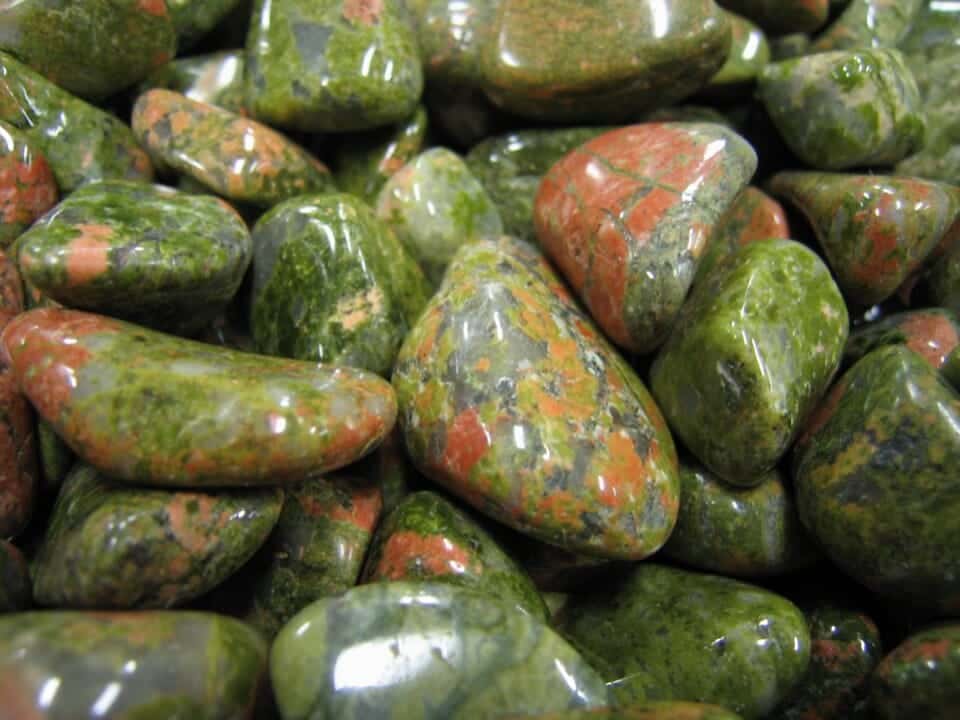
Unakite is an altered granite you can recognize by two colors locked together in one stone: salmon to rose-pink feldspar and pistachio to olive-green epidote, scattered through patches of gray or colorless quartz. That pink-and-green mottle is almost the whole identification, because little else common looks like it. To confirm a piece, add two quick tests: unakite is hard, so a clean edge scratches glass, and it is built from silicate minerals, so a drop of vinegar does nothing. The rock starts as ordinary granite and is changed by hot, mineral-rich fluids that turn its plagioclase feldspar into green epidote while the pink potassium feldspar and quartz stay put, which is why geologists call it an altered or epidotized granite. You meet it most often as a smooth, tumbled pebble, because unakite is tough and takes a high polish, so it survives in rivers and on glaciated beaches long after softer rock has worn away.
How to Identify Unakite
Unakite turns up in Spotter’s rock identifications more often than its obscure name suggests. Over the past 45 days the app identified unakite twice, at an average confidence of 88 percent, and on one of those a specimen was flagged as found on a Great Lakes shoreline, with the app keying on mottled green and pinkish-orange color, a smooth water-worn texture, and what it described as a blend of epidote and feldspar. That is a fair summary of the whole rock. Work through four features and a loose pink-and-green stone usually sorts itself out.
Pink and green, mottled together
This is the field mark that carries the identification. Unakite is a jumble of salmon to brick-pink grains and pistachio to avocado-green grains, with the two colors blotched and swirled together rather than banded in neat layers. The pink is potassium feldspar, usually orthoclase, and the green is epidote, a calcium-iron silicate that ranges from yellow-green to a deep olive. Milky white or gray quartz fills the gaps. Geology.com describes unakite plainly as “a pink and green metamorphic rock composed of pink orthoclase, green epidote, and colorless to milky quartz.” If a rock shows that pink-and-green pairing in a coarse, speckled mix, unakite is the leading answer before you run any other test.
Hardness of 6 to 7: it scratches glass
Unakite is hard, because every mineral in it is hard. Orthoclase sits at 6 on the Mohs scale, quartz at 7, and epidote between 6 and 7, so the whole rock scratches a glass bottle or plate and a steel knife will not mark it back. That single test rules out the soft pink-and-green impostors, especially serpentine and dyed or reconstituted stones, which are soft enough for a knife to scratch. The Mohs hardness scale puts glass at about 5.5, below every mineral in unakite. If your pink-and-green rock cannot scratch glass, it is not unakite.
No fizz with acid
A drop of white vinegar tells unakite apart from any carbonate look-alike. Feldspar, epidote, and quartz are all silicate minerals, so none of them react to weak acid, and unakite just sits there and does nothing. Marble or a calcite-cemented rock with pink and greenish staining would fizz and bubble instead. Pair the acid test with hardness and unakite is hard to mistake: hard, inert, pink and green.
A coarse, granite-like texture
Look closely and unakite has the same coarse, crystalline, salt-and-pepper build as the granite it came from, with mineral grains large enough to see without a lens. The difference is the color scheme: where granite shows pink or white feldspar with black flecks of mica and hornblende, unakite has traded most of those dark minerals for bright green epidote. Many of the pieces you find have been tumbled smooth and rounded by water or by a rock tumbler, because unakite is a popular lapidary stone that takes a bright polish, so a glossy, rounded pink-and-green pebble is a very common form.
Where you find it
Unakite is named after the Unaka Range on the border of western North Carolina and eastern Tennessee, where it was first described in 1874, and the best material still comes from the Blue Ridge of North Carolina and Virginia, including well-rounded stones in Virginia river beds. It is more widespread than that, though. Wikipedia’s unakite article records occurrences from New Jersey and Massachusetts to Colorado and New Mexico, and, closer to home for Midwest readers, from the Waupaca adamellite in Waupaca County, Wisconsin. On Great Lakes beaches it shows up as a glacial traveler: the ice sheets that scraped south out of Canada carried granite and its altered cousins down and dumped them along the shore, so a pink-and-green cobble rolling in the surf of Lake Superior or Lake Michigan is very likely unakite that rode a glacier here. For the unaltered parent rock, see how to identify granite, and for the pink mineral inside both, how to identify feldspar.
Unakite vs. Its Look-Alikes
A handful of stones share one of unakite’s two colors, but almost none share both in the same mottled mix. The table lines up the rocks people confuse with unakite and the mark that separates each one. For the glassy mineral that fills the gaps in unakite, see how to identify quartz.
| Stone | Colors | Hardness (Mohs) | Fizz in acid? | Quick tell |
|---|---|---|---|---|
| Unakite | Pink and green mottled together | 6 to 7 | No | Pink feldspar plus green epidote in one coarse stone |
| Epidosite | Mostly green, little or no pink | 6 to 7 | No | Green epidote and quartz, missing the pink feldspar |
| Rhodonite | Pink with black veins | 5.5 to 6.5 | No | Pink with crisscrossing black manganese veins, no green |
| Pink granite | Pink and white with black flecks | 6 to 7 | No | Pink feldspar with black mica, not green epidote |
The closest call is epidosite, which is built from the same green epidote and quartz but carries little or no pink feldspar, so it reads as a green stone rather than a pink-and-green one. Rhodonite is the pink-and-black one: its dark lines are manganese oxide, not green epidote, and it is a touch softer at 5.5 to 6.5. Pink granite shares the pink feldspar and the coarse texture, but its second color is the black and gray of mica and quartz, not green. If you see pink and green blotched together in a hard, coarse rock, you have almost certainly found unakite.
Frequently Asked Questions
What is unakite made of?
Unakite is made of three main minerals: pink potassium feldspar (usually orthoclase), green epidote, and colorless to milky quartz, with white plagioclase sometimes present too. It begins as granite and becomes unakite when hot fluids alter the granite’s plagioclase into green epidote while the pink feldspar and quartz remain, which is why it keeps a granite’s coarse, speckled texture but swaps gray and black for green.
Where does unakite come from?
It was first found and named in the Unaka Range of western North Carolina and eastern Tennessee, and the finest material comes from the Blue Ridge of North Carolina and Virginia. It also occurs across the United States, including Wisconsin’s Waupaca County, and internationally in South Africa, Sierra Leone, Brazil, and China. On Great Lakes beaches it arrives as a glacial erratic, carried south from Canada by Ice Age ice sheets.
Is unakite valuable?
Unakite is an inexpensive, widely available stone rather than a precious one, but it is a favorite for tumbling and lapidary work because its pink-and-green pattern is striking and it takes a high polish. You will see it cut into cabochons, beads, spheres, and carved eggs. As a find, a clean, well-patterned unakite pebble is a satisfying identification rather than a payday.
How can I tell unakite from granite?
Look for the color green. Granite and unakite share a coarse, crystalline texture and pink feldspar, but granite’s other grains are the black and gray of mica, hornblende, and quartz, while unakite’s are bright green epidote. If a granite-looking rock has swapped most of its dark flecks for green, it is unakite. Both are hard enough to scratch glass and neither fizzes in acid, so color does the work here.
Holding a speckled pink-and-green pebble and not sure what it is? Check that it scratches glass and stays quiet under a drop of vinegar, then look for the signature pairing of pink feldspar and green epidote in one coarse stone. For the wider family of stones unakite travels with, see our guide to common rocks and minerals, or start on the rock identifier page, where Spotter can give you a first read from a photo.
Try Spotter free on iPhone or Android
Plants, animals, fungi and rocks from one photo. 5 free identifications every day, no card required.